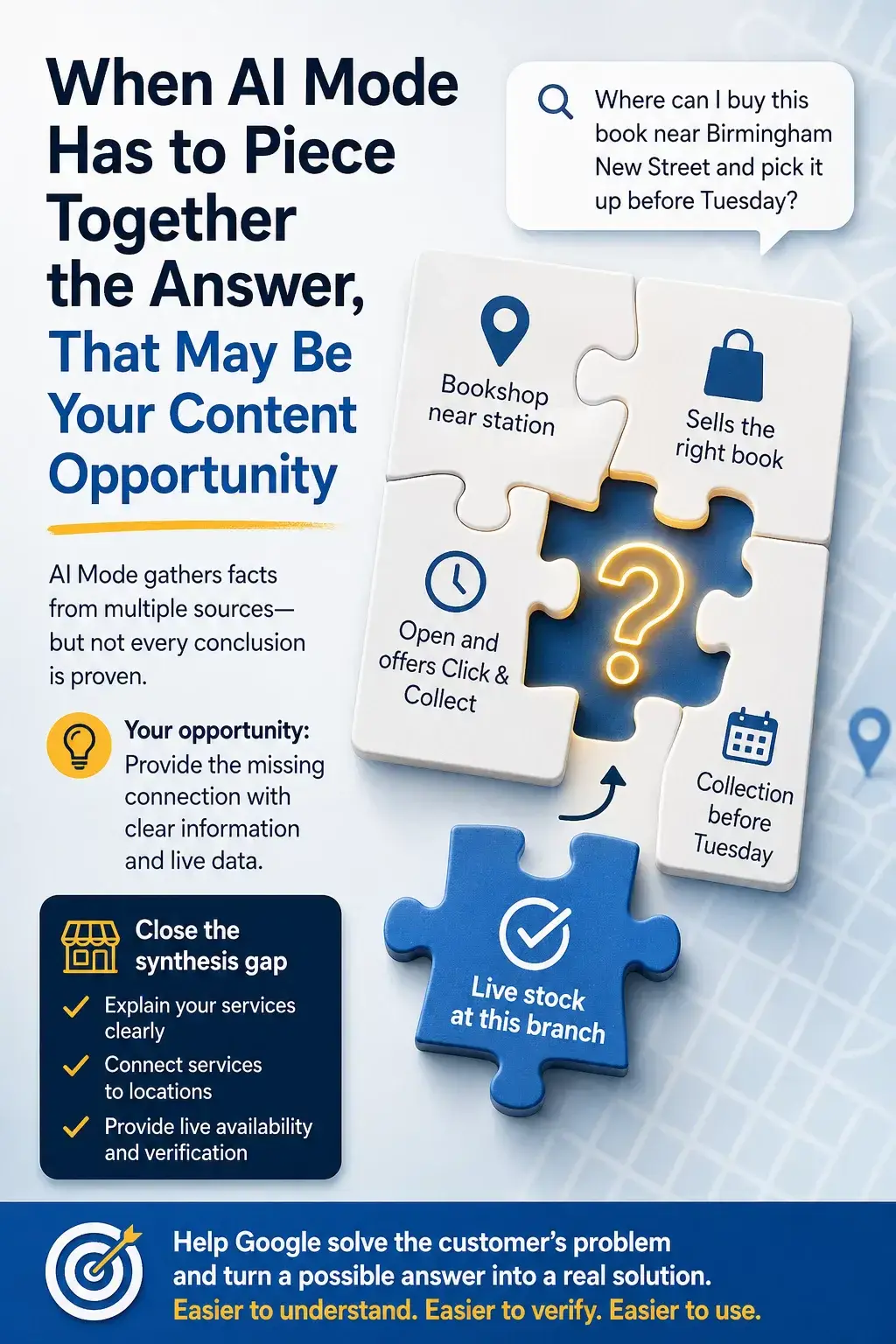
Google AI Mode can do something traditional search results could not do nearly as well.
It can take a complicated real-world problem, break it into smaller questions, gather information from several sources and assemble the pieces into what appears to be one complete solution.
That is the clever part.
But a series of experiments on this website exposed an important weakness. AI Mode can sometimes move from facts that are individually relevant to a conclusion that is only probable—and then present that conclusion as though it has been confirmed.
This creates a practical opportunity for businesses with websites.
When Google has to piece together an answer from several disconnected sources, ask whether your business could provide the missing connection more clearly, more reliably and, where necessary, through live operational data.
The objective is not merely to publish more content.
It is to make your business:
easier to understand, easier to verify and easier to use.
AI Mode Is Trying to Complete the Customer’s Task
Google explains that AI Mode may use a process called “query fan-out.” It can issue multiple related searches across different subtopics and data sources before combining the findings into a response.
A customer might ask:
Where can I buy a suitable true-crime book near Birmingham New Street Station and collect it before Tuesday?
That single request contains several smaller questions:
- What type of book would suit the recipient?
- Which titles are suitable?
- Which bookshops are near the station?
- When are those shops open?
- Do they offer collection?
- Is a recommended title currently available?
- Can the customer obtain it before the deadline?
AI Mode does not necessarily need to find one webpage that answers the entire question.
It can search for the different pieces separately and attempt to connect them.
That is potentially very useful for the searcher. It is also where uncertainty can enter the answer.
The First Experiment: AI Mode Did Not Need an Exact-Match Page
The first experiment involved someone near Glasgow Central Station with a chocolate-stained cotton shirt that needed to be cleaned before 3 p.m. the following day.
No laundrette was likely to have published a page matching that exact situation.
AI Mode therefore assembled the answer from separate information about:
- nearby businesses;
- opening hours;
- laundry services;
- stain treatment;
- express turnaround times;
- weekend availability.
The initial answer recommended a business that had already closed and would remain closed the following day.
When the prompt was refined, AI Mode found other businesses that were open. However, it then made assumptions about whether the particular branch could clean the stained shirt within the required deadline.
The cited information supported general facts such as:
The business exists.
The branch is open.
It offers some form of garment service.
It did not necessarily establish:
This branch can assess this particular stain, accept the shirt today and return it before 3 p.m. tomorrow.
The full experiment is explained in AI Mode Does Not Need an Exact-Match Page. It Needs Facts It Can Use Without Guessing.
The lesson was not that every business needs hundreds of pages targeting highly specific searches.
It was that businesses need to publish decision-linked facts.
“Open on Sunday” describes a business.
“Sunday express orders must be dropped off before 11 a.m. for collection after 2 p.m.” helps a customer decide whether the business can solve their problem.
The Book-Present Test Exposed the Same Weakness
The second experiment asked AI Mode to recommend a birthday present for someone interested in true-life crime who had previously read a lot of Jeffrey Deaver.
The customer was close to Birmingham New Street Station and needed the present by Tuesday.
AI Mode handled several parts of the task impressively.
It interpreted what the Jeffrey Deaver clue suggested about the recipient’s tastes. It recommended relevant true-crime books and identified nearby bookshops.
The answer effectively built this chain:
Reading preference → suitable book → nearby bookshop → collection service → possession before Tuesday
The early stages were well supported.
The problem was the final connection.
AI Mode found that nearby bookshops sold books and offered Click & Collect. It did not confirm that a particular recommended book was currently available from a specific branch before the deadline.
Nevertheless, the wording gave the impression that the problem had been solved.
This created what I described as a completeness illusion:
The answer contained enough accurate and relevant detail to feel complete, even though the decisive fact remained unknown.
You can read the complete experiment in The Book Present Test: Can Google AI Mode Turn a Recommendation Into a Real-World Solution?.
The important distinction was between three levels of evidence.
Relevant
The information relates to the problem.
A bookshop is located near Birmingham New Street Station.
Plausible
The proposed solution is likely to work.
A large bookshop may stock a popular true-crime title.
Verified
The decisive condition has been confirmed.
The paperback edition of Mindhunter is currently available from that branch for collection before Tuesday.
AI Mode found relevant information and constructed a plausible answer.
Its wording made that answer sound verified.
The Follow-Up Test Forced AI Mode to Admit What It Did Not Know
The next experiment separated the original task into different types of question.
Some questions asked for stable information, such as which Birmingham bookshops normally sold true-crime books.
Others asked about published information, such as which branches were open on Monday.
The final question asked for live operational proof:
Which bookshop near Birmingham New Street Station currently has the paperback edition of Mindhunter in stock for collection before Tuesday?
This time, the instructions explicitly stated that no shop should be recommended unless current branch stock could be confirmed.
When the task was framed that way, AI Mode did not provide a definite recommendation. It acknowledged that it could not verify live branch stock.
That result matters.
The earlier answers had enough surrounding information to construct a likely solution. Once the difference between possibility and proof was made explicit, the evidence was no longer sufficient.
The complete follow-up is available in The Follow-Up Test: What Happened When I Forced AI Mode to Separate Possibility From Proof.
Taken together, the tests suggest a recurring pattern:
AI Mode can be very good at identifying who might be able to solve a problem, but it may not always verify the final operational condition that determines whether they actually can.
The Opportunity Is at the Weakest Join
A complicated answer can contain many separate connections:
Product → branch
Branch → service
Service → deadline
Product → compatibility
Appointment → availability
Location → customer journey
The weakest join is the point where the evidence stops and assumption begins.
For the book-present query, the weakest join was:
The shop sells books and offers Click & Collect
therefore
this edition can be collected from this branch before Tuesday.
For the laundrette query, it was:
The branch is open and offers garment services
therefore
it can remove this stain within the customer’s deadline.
Those conclusions might be correct.
But “might be correct” is not enough when a customer needs to travel, spend money, make a booking or meet a deadline.
This is where a business website can create value.
Most Business Websites Reflect the Business, Not the Customer’s Task
Business websites are often organised around internal categories:
- Products
- Services
- Locations
- Opening hours
- Delivery
- Click & Collect
- Frequently asked questions
- Contact details
The customer’s problem cuts across those categories.
A customer is rarely asking only:
Do you offer dry cleaning?
The real question may be:
Can I bring one stained cotton shirt to your Glasgow branch on Sunday morning and collect it before my train leaves at 3 p.m.?
The relevant information might exist somewhere on the website, but be divided between a service page, branch page, FAQ, opening-hours listing and terms and conditions.
AI Mode then has to connect those facts itself.
The business can reduce that uncertainty by publishing information around the customer’s complete situation.
Publish Facts That Help Customers Decide
A useful business webpage should connect four elements:
Fact + condition + outcome + limitation
For example:
We provide same-day service washes on Sundays for standard washable garments dropped off before 11 a.m. Collection is normally available after 2 p.m., although heavily stained items may require additional treatment and cannot be guaranteed for same-day collection.
That statement is much more useful than four disconnected claims:
Open Sundays.
Express services available.
Stain removal offered.
Service washes undertaken.
The connected version tells the customer—and Google—how the facts work together.
The same principle applies across many industries.
A garage could publish:
Diagnostic appointments booked before midday are normally completed the same day. Repairs requiring replacement parts will depend on stock availability and cannot be guaranteed until the vehicle has been inspected.
A restaurant could explain:
Online reservations close two hours before service. A table shown as available in the booking system is held for ten minutes while the reservation is completed.
A training provider could state:
Places shown as available can be booked immediately online. Courses marked “register your interest” do not currently have confirmed availability.
A tradesperson could say:
Emergency call-outs are available within this postcode area until 8 p.m. Attendance elsewhere depends on travel time and must be confirmed by telephone.
These are not SEO phrases inserted for a crawler.
They are practical explanations of how the business actually operates.
Separate General Capability From Current Availability
One of the strongest lessons from the experiments is that businesses should clearly distinguish between what they generally offer and what is available now.
A bookshop offering Click & Collect is a general capability.
A particular edition being ready for collection at a particular branch is current availability.
A dentist offering emergency appointments is a general capability.
An appointment being available at 10 a.m. tomorrow is current availability.
A garage repairing a particular car manufacturer is a general capability.
Having the required part and a mechanic available this afternoon is current availability.
Stable information can usually be explained on an ordinary webpage.
Changing information may require something else.
Sometimes the Solution Is Not Another Article
Businesses should not assume that every information gap can be solved by writing a longer service page.
Some facts change too quickly:
- current stock;
- appointment slots;
- room availability;
- table reservations;
- service capacity;
- delivery times;
- product prices;
- course places;
- collection readiness.
These may require:
- a live stock checker;
- a booking calendar;
- a branch selector;
- an availability tool;
- an online quotation process;
- an ordering system;
- an inventory feed;
- an API.
The website content explains the service.
The live system proves whether the service can be used in the customer’s particular situation.
Google’s Local Inventory Tools Show the Direction of Travel
The book experiment raised the question of whether retailers can provide live branch stock information directly to Google.
Google’s Merchant Inventories API allows retailers to add store-specific product information, including a store code, price and availability. Retailers can connect Merchant Center with their Google Business Profile and make local products eligible to appear across Google through free local listings.
Google also supports “pickup today” information for eligible retailers. The website must clearly show when the item will be ready, allow the customer to purchase or reserve it online and provide confirmation when it is available for collection.
“Pick up later” can provide product-level and shop-level collection time information for items that are not immediately available in that store.
This is another way of closing the synthesis gap.
Instead of leaving Google to infer:
This retailer sells the product + this branch offers collection = the item is probably available
the retailer can provide the decisive product-and-branch information in a structured form.
There is no guarantee that AI Mode will use that information in every response. Google does not promise that any particular page, business or product will be shown.
But live, accurate inventory gives Google much stronger evidence than a general Click & Collect page.
From Descriptive Website to Action Endpoint
The most valuable business website is not merely a source that describes the company.
It is somewhere the customer can complete the next necessary action.
AI Mode might explain:
This bookshop appears suitable because it is near the station, sells the requested title and offers branch collection.
The website should then allow the customer to:
- check the exact edition;
- select the branch;
- see current availability;
- confirm the collection time;
- reserve or purchase the book.
That makes the website an action endpoint.
The business is not trying to conceal all useful information so the customer is forced to click.
It is supplying enough reliable information for Google and the customer to understand why the business is suitable, while making the website the natural place to verify, book, reserve or buy.
A Practical Audit for Business Websites
A business can use the following process to identify its own synthesis gaps.
1. Begin with real customer situations
Do not start only with broad keywords such as:
Birmingham bookshop
Glasgow laundrette
Emergency plumber
Start with the complete problems customers encounter:
Can I reserve this exact edition from your Birmingham branch and collect it tomorrow?
Can you clean a stained shirt on Sunday before my afternoon train?
Can an engineer attend this postcode before tonight’s forecast frost?
2. Map the required solution
Write down every condition that must be true for the customer’s plan to work.
For example:
Suitable product → correct branch → current stock → collection available → ready before deadline
3. Check what your website proves
Look at each stage and classify it:
- clearly confirmed;
- generally suggested;
- not explained;
- dependent on live information.
4. Find the weakest connection
Ask:
At what point would Google or the customer have to make an assumption?
That is the synthesis gap.
5. Choose the right way to close it
The solution could be:
- clearer wording;
- a branch-specific page;
- a turnaround guide;
- an FAQ;
- a decision tool;
- a booking system;
- live stock data;
- a direct confirmation process.
6. Create a clear next action
Once the customer has understood the offer, make it easy to:
- check;
- book;
- reserve;
- buy;
- request;
- call;
- visit.
This Is Not a Guaranteed AI Mode Strategy
Google says there are no special technical requirements or secret optimisation techniques needed to appear in AI Mode. The normal principles of helpful, reliable, people-first content still apply.
Google also recommends keeping Merchant Center and Business Profile information current. However, meeting its requirements does not guarantee that a page will be crawled, indexed or included in an AI response.
A business should therefore not treat this as a formula:
Add decision-linked facts and Google will recommend us.
The more defensible conclusion is:
Accurate, connected and actionable information gives Google stronger evidence with which to understand the business and gives customers a clearer route to completing their task.
That improves the website whether or not a particular AI Mode citation appears.
Stop Thinking Only About Keywords
The traditional question was:
Which keywords should this business rank for?
The more useful question may now be:
Which real customer problems could this business help Google resolve?
That does not mean keywords no longer matter.
It means that visibility increasingly depends on being useful within the complete decision.
A business that merely says:
We sell books.
is relevant to a broad category.
A business that can establish:
This edition is available from this branch and can be collected tomorrow.
is part of an actionable solution.
That is a much stronger position.
The Final Lesson From the Three Experiments
The three experiments began with a question about whether highly specific searches required highly specific webpages.
They produced a more useful conclusion.
AI Mode does not always need one page that matches the whole query. It can gather separate facts and assemble them into a response.
However, the assembled answer may sound more definite than the underlying evidence allows.
That creates an opportunity for businesses.
Do not leave Google to guess how your products, services, branches, deadlines and availability fit together.
Publish the stable information clearly.
Connect it to the decisions customers are trying to make.
Provide live verification where the answer depends on changing conditions.
Then give the customer somewhere to act.
The aim is not simply to feed AI Mode more content. It is to make your business easier to understand, easier to verify and easier to use.
When AI Mode has to piece together the answer, the missing connection may be your content opportunity.
And when that connection depends on live information, the opportunity may be bigger than a piece of content.
It may be the system that turns a possible recommendation into a real customer.