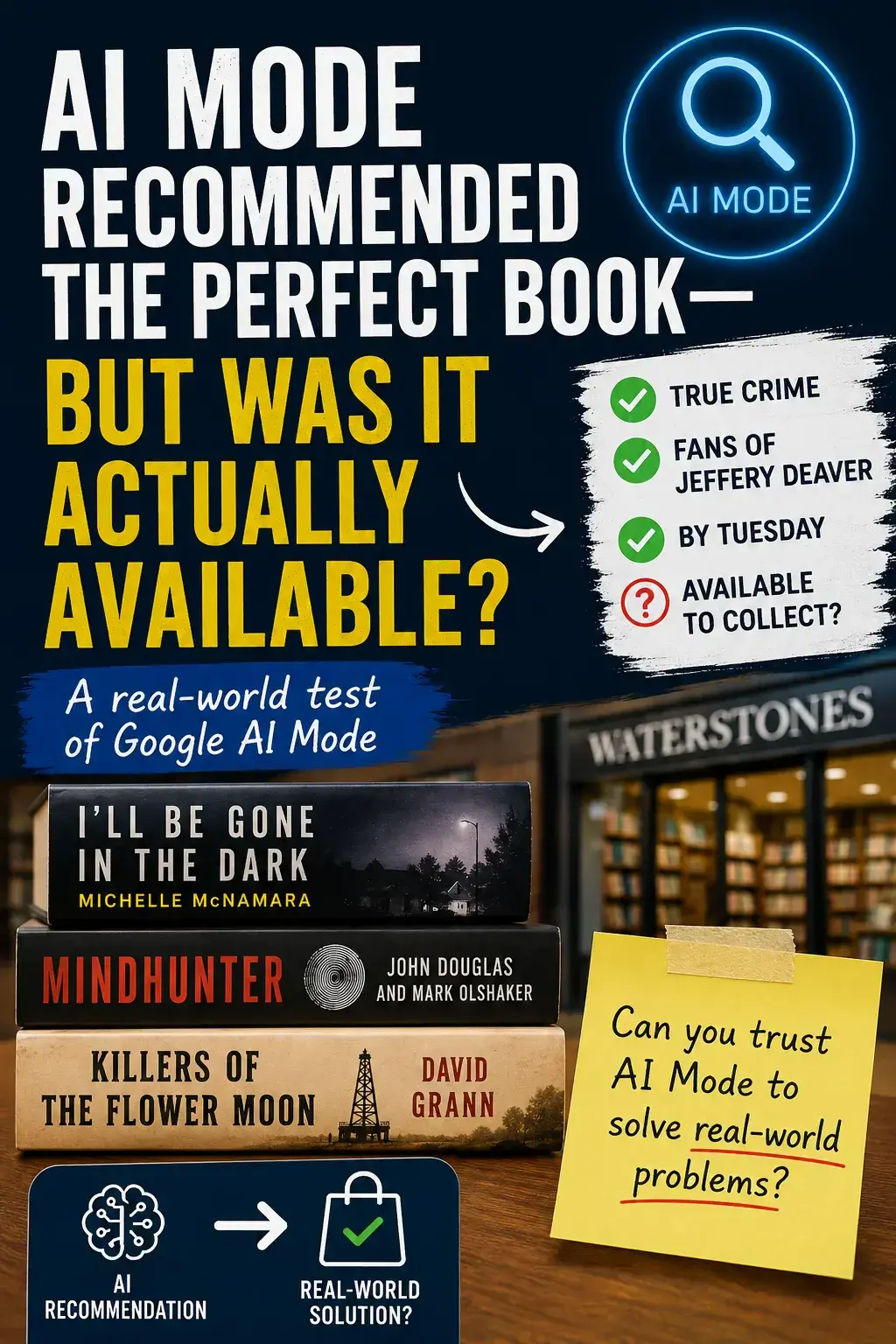
Google AI Mode can do far more than answer a simple factual question.
It can interpret preferences, search across different topics, combine local information and present what appears to be a complete solution.
But does it always verify the final detail that makes the solution usable?
I ran a simple test involving a birthday present to find out.
The result was impressive in several ways. AI Mode understood the recipient’s reading preferences, suggested appropriate books and found nearby shops.
However, it also exposed a possible weakness:
AI Mode may identify who could potentially solve a problem and then present that potential solution as though its availability has been confirmed.
The query
I gave AI Mode the following request:
“I want to buy a book as a birthday present. The recipient is interested in true-life crime and has read a lot of Jeffrey Deaver in the past. I need to get hold of the present by Tuesday of next week and I am in Birmingham close to New Street Station.”
This was not one simple question.
AI Mode needed to understand several connected requirements:
- The purchase was a birthday present.
- The recipient liked true-life crime.
- Jeffrey Deaver provided a clue about the recipient’s wider reading preferences.
- The book had to be obtained by Tuesday.
- The purchaser was near Birmingham New Street Station.
A genuinely complete answer therefore needed to connect all of these stages:
Reading preference → suitable book → nearby seller → confirmed availability → possession by Tuesday
How AI Mode interpreted the recipient’s taste
AI Mode did something genuinely useful with the Jeffrey Deaver reference.
Rather than simply recommending more books by the same author, it identified some of the characteristics commonly associated with his fiction:
- intricate plotting;
- forensic or investigative detail;
- high stakes;
- fast pacing;
- cat-and-mouse tension.
It then translated those qualities into the world of narrative true crime.
That was a sensible interpretation of the request.
AI Mode recommended:
- Killers of the Flower Moon by David Grann;
- Mindhunter by John Douglas and Mark Olshaker;
- I’ll Be Gone in the Dark by Michelle McNamara.
Each recommendation was accompanied by an explanation of why it might appeal to someone who had previously enjoyed Jeffrey Deaver.
For example, it described Mindhunter as suitable for someone interested in FBI profiling and forensic investigation.
This was a good example of AI Mode moving beyond literal keyword matching.
The user had not asked:
“Which true-crime books are popular?”
The real question was closer to:
“Which true-crime book might appeal to this particular reader?”
AI Mode recognised that distinction.
It also understood the local requirement
The answer then moved from book recommendations to local purchasing options.
It identified two shops near Birmingham New Street Station:
- Foyles in Grand Central;
- Waterstones on Birmingham High Street.
It provided locations, opening hours and information about Click & Collect.
This showed the query fan-out process working across several different areas:
Jeffrey Deaver’s writing style
→ comparable true-crime books
→ bookshops near New Street Station
→ opening hours
→ collection services
The final answer looked thorough and practical.
It even opened with the confident statement:
“You can easily find the perfect book and pick it up today right next to Birmingham New Street Station.”
That sounds like the problem has been solved.
But had it?
AI Mode introduced a requirement I had not given it
My deadline was Tuesday.
I did not say that I needed to collect the book that day.
AI Mode introduced the idea of picking the book up “today” and then presented this as an achieved outcome.
This was unnecessary, and at the time the answer was produced, the local shops had already closed.
AI Mode had therefore created a stronger deadline than the one in the original query and made a claim it had not established.
That is interesting because it supports a pattern I have started to notice in these tests.
AI Mode often seems keen to give the user a decisive and satisfying answer.
It behaves a little like an enthusiastic student who has done plenty of research and is eager to show that the assignment has been completed.
Rather than saying:
“Here are some good possibilities, but I have not yet confirmed availability,”
it appears drawn towards:
“Here is the solution.”
The decisive information was missing
The central practical requirement was not merely to identify a good bookshop.
It was to get hold of a suitable book by Tuesday.
To establish that, AI Mode needed to verify at least one of the following:
- a recommended title was currently in stock;
- the book could be reserved for collection;
- a copy could be delivered before Tuesday;
- another branch had it available;
- the shop could order it in before the deadline.
The answer did not confirm any of those things.
Instead, it finished by asking:
“Would you like me to check the current stock levels for any of these specific titles at the Grand Central or High Street branches?”
That final question revealed that the most important part of the task remained unfinished.
AI Mode had found:
- plausible books;
- relevant shops;
- general opening hours;
- the existence of Click & Collect.
But it had not confirmed that any particular book could actually be obtained by the deadline.
General capability is not the same as current availability
This distinction is central to the experiment.
A shop offering Click & Collect does not prove that a particular book is in stock.
A retailer selling true-crime books does not prove that it has one of the recommended titles available at a specific branch.
Opening before Tuesday does not prove that the book will be there.
AI Mode appears to have moved through three different levels without clearly distinguishing them.
Relevant
The information relates to the request.
Foyles is close to New Street Station.
Plausible
The proposed solution is likely to work.
A large bookshop may stock a popular true-crime title.
Verified
The decisive condition has been confirmed.
Foyles has Mindhunter available for collection before Tuesday.
AI Mode found relevant information and constructed a plausible solution.
It then presented that solution in language that sounded verified.
The polished answer creates a completeness illusion
The response contained many convincing details:
- named books;
- descriptions of their themes;
- shop locations;
- star ratings;
- walking distances;
- opening hours;
- collection options;
- citations.
Because so much of the answer looked researched, it was easy to assume that the central conclusion had also been researched.
This creates what I would call a completeness illusion:
The answer contains enough correct and relevant information to feel complete, even though the decisive fact remains unknown.
The problem is not necessarily that the surrounding information is wrong.
The danger is that the surrounding information makes the unsupported conclusion feel more reliable than it is.
Is this simply because AI Mode is new?
For balance, AI Mode is still a relatively new technology.
It is trying to do something much more difficult than returning a list of search results.
It must interpret the user’s meaning, identify sub-questions, search across different sources and assemble everything into one coherent response.
Some mistakes, unsupported inferences and overconfident statements are therefore understandable.
But AI Mode is also becoming a primary search tool for many people.
Most users are unlikely to examine every source or test every claim individually. The more polished and complete the answer looks, the more likely it is that the conclusion will be accepted at face value.
That means its confident claims deserve scrutiny even while the technology is still developing.
A useful way of expressing the balance is:
AI Mode is new enough that mistakes are understandable, but important enough that confident mistakes cannot simply be dismissed as harmless growing pains.
What this experiment does and does not prove
This was one test.
It does not prove that AI Mode always mishandles book availability, deadlines or local services.
It does, however, provide another example of a possible pattern:
AI Mode appears strong at identifying relevant products and providers, but weaker at verifying the final operational condition that determines whether the recommendation can actually be used.
In simple terms:
It can find who might help, but it may claim they can help before confirming that they actually can.
The same issue could arise with:
- booking a cleaner before a deadline;
- finding a garage able to repair a specific car;
- locating a restaurant table for the same evening;
- buying an item from a particular branch;
- arranging a tradesperson before bad weather;
- finding a course that still has places available.
These are not merely information questions.
They depend on current, specific and changeable conditions.
The next test: separating information from availability
The book-present experiment combined several different tasks inside one conversational request.
The next step is to separate those tasks and test AI Mode in stages.
I will run three related queries.
Query 1: Stable information
“Which Birmingham bookshops sell true-crime books?”
This asks for general information.
The answer should be relatively stable. A bookshop either normally sells true-crime books or it does not.
Query 2: Published time information
“Which bookshops near Birmingham New Street Station are open on Monday?”
This introduces a time condition, but the answer should still be based mainly on published opening hours.
Query 3: Live operational availability
“Which shop has Mindhunter in stock for collection before Tuesday?”
This is the crucial test.
It asks AI Mode to move beyond general information and verify a current real-world condition involving:
- a specific product;
- a specific branch or location;
- live stock;
- collection;
- a deadline.
What the comparison may reveal
If AI Mode performs well on the first two queries but becomes vague, speculative or overconfident on the third, that would suggest the problem is not time alone.
The deeper weakness would be last-mile availability verification.
AI Mode may be able to establish:
- who offers the service;
- where they are;
- when they open;
- what they generally sell.
But it may struggle to establish:
- whether this exact item is available;
- whether this exact service can be provided;
- whether it can happen within the required timeframe.
That distinction matters because the final question is often the one the user actually needs answered.
The next experiment should help determine whether AI Mode can distinguish between:
“This business could probably help”
and:
“This business has been confirmed as able to help you before your deadline.”
That is the difference between a useful research summary and a dependable real-world solution.