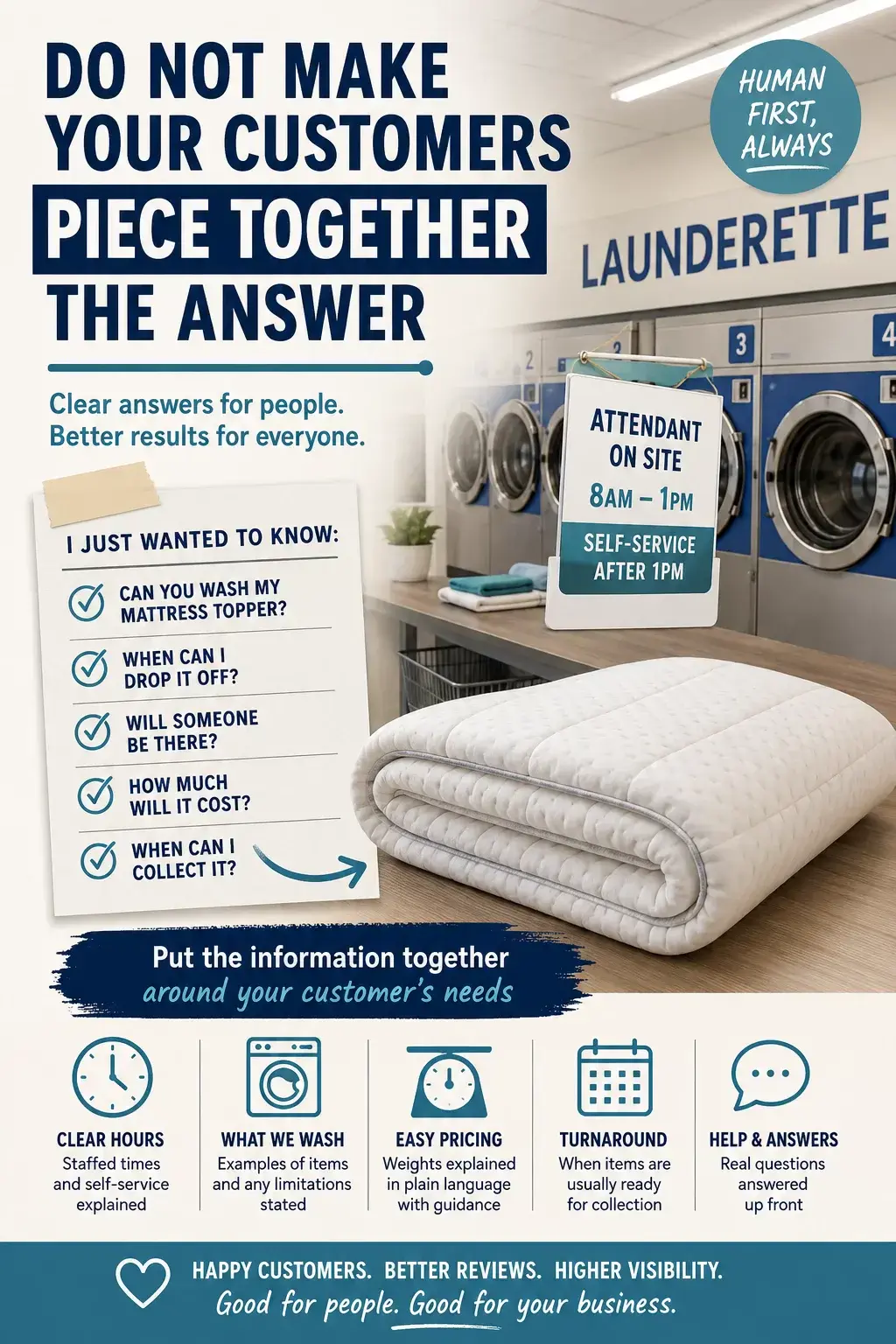
I recently needed to have a double-bed mattress topper washed.
It was too large for my domestic washing machine, so I searched online for a nearby launderette. I found one reasonably close to me and visited its website.
At first, everything looked promising.
The website said the launderette was open from 8am until 8pm, seven days a week. That gave me plenty of convenient opportunities to drop the topper off.
But then I found another page about service washes.
Hidden within that page was a line explaining that an attendant was only available until 1pm. After that, the launderette operated on a self-service basis.
That changed the situation completely.
I was not simply looking for access to a washing machine. I wanted to leave the mattress topper with someone, have it washed and then collect it as soon as possible.
The general opening hours did not answer the question I actually had:
What time can I drop off an item for a service wash?
The Information Was There, but It Was Not Joined Together
Technically, the website contained both pieces of information:
- The launderette was open from 8am until 8pm.
- An attendant was only present until 1pm.
But those facts were shown in different places and were not clearly connected.
A customer could easily read the opening-hours page, assume that service washes could be dropped off at any time before 8pm and arrive when no attendant was available.
The website had published the facts.
It had not explained what those facts meant for the customer.
That distinction matters.
Could the Mattress Topper Fit in the Machines?
I then faced another problem.
I wanted to confirm that the launderette could actually wash a double-bed mattress topper.
The website listed several types of items that could be cleaned, but much of its pricing and machine guidance was based on kilograms of washing.
There were different prices for different load weights.
That may make perfect sense to the business because it deals with laundry weights every day.
But I have no idea how much my mattress topper weighs.
Should I weigh it on bathroom scales?
Does the published weight refer to the item when it is dry or wet?
Are all double mattress toppers roughly the same weight?
Does the material or thickness matter?
Would it physically fit inside the machine even if it was below the maximum weight?
Once again, the website contained information, but it had not translated that information into something I could confidently use.
Businesses Often Describe Their Services From the Inside
This is a common website problem.
Businesses naturally organise information according to how they operate.
A launderette thinks in terms of:
- Machine sizes
- Load weights
- Wash programmes
- Attendant hours
- Service-wash prices
- Turnaround times
Customers think differently.
I was thinking:
- Can you wash my mattress topper?
- When can I bring it in?
- Will somebody be there to take it from me?
- How much will it cost?
- When can I collect it?
- Do I need to book?
- Could I make a wasted journey?
The business had largely published information from its own operational perspective.
What I needed was for that information to be rearranged around my situation as a customer.
AI Mode May Try to Fill the Gaps
An AI search system could potentially attempt to piece the answer together.
It might use query fan-out to investigate questions such as:
- How much does a double mattress topper normally weigh?
- What capacity washing machine is needed for a mattress topper?
- Can mattress toppers be cleaned in commercial washing machines?
- Does the material affect how they should be washed?
- What are the launderette’s staffed hours?
- Which service and price band would apply?
It could then try to compare general information about mattress toppers with the machine capacities and prices published by the launderette.
But this would still involve guesswork.
Mattress toppers vary considerably in thickness, material, construction and care requirements. The AI system would also have to decide whether the business’s maximum load weight meant that the item would physically fit and whether an attendant would accept it.
The system might produce a plausible answer.
That does not mean it would produce the correct answer.
The launderette itself is in a much better position to remove the uncertainty.
Do Not Make the Customer or the AI Perform the Calculation
The website could have answered my questions with a simple section such as:
Bringing Large Items for a Service Wash
Our attended service-wash counter is open from 8am until 1pm daily. The launderette remains open for self-service washing until 8pm.
We can normally wash:
- Single and double duvets
- Mattress protectors
- Most single and double mattress toppers
- Sleeping bags
- Large blankets
- Curtains
Very thick foam, memory-foam or specialist mattress toppers may not be machine washable. Check the care label or contact us before travelling.
Not sure about the weight? You do not need to weigh the item at home. Tell us what the item is, its size and material, and we will confirm the appropriate machine and price.
For the quickest turnaround, bring service-wash items before 11am. Most standard items are ready for collection within 24 hours.
That short section would have answered almost everything I needed to know.
It would also have given Google and AI systems a much clearer source from which to answer similar customer queries.
Information Should Be Organised Around Decisions
A useful business website does more than list facts.
It helps the visitor make a decision.
In my case, the decision was whether it was worth taking my mattress topper to that particular launderette.
To make that decision, I needed several pieces of information to work together:
Item accepted + staffed drop-off time + likely price + turnaround time = a confident decision
Publishing those details on separate pages forces the visitor to find them, connect them and interpret them.
Some visitors will persevere.
Others will call the business.
Some will ask an AI system.
Many will simply choose another company whose website gives them a clearer answer.
The Real Meaning of Human-First Content
Writing for humans first is sometimes discussed as though it simply means using friendly language or avoiding excessive keywords.
It goes much deeper than that.
Human-first content starts by understanding what the visitor is trying to accomplish.
The visitor does not arrive wanting to study the internal structure of the business.
They arrive with a problem.
The website should guide them from that problem to a confident next action.
For the launderette, that might mean creating pages or sections around real customer needs:
- Can you wash my duvet?
- Can you wash a mattress topper?
- When can I drop off a service wash?
- How quickly can I collect it?
- Which machine do I need for a king-size duvet?
- How do I estimate the price if I do not know the weight?
- Is someone available to help me use the machines?
These are not merely additional keywords to add to a page.
They are the questions standing between the customer and a purchase.
Clearer for Humans Usually Means Clearer for Search Systems
A web crawler does not experience confusion in exactly the same way a human visitor does.
But search systems still have to identify facts, understand relationships and decide which information answers a particular query.
When service hours conflict with general opening hours, important information is spread across several pages, or customers must convert unfamiliar measurements themselves, the system has more interpretation to perform.
Clear pages reduce that burden.
Useful signals include:
- Consistent opening and staffed hours
- Descriptive headings
- Plain-language item examples
- Prices connected to recognisable customer situations
- Clear exceptions and limitations
- Turnaround times
- Direct next steps
- Frequently asked questions based on real enquiries
The objective is not to write for a crawler instead of a person.
It is to remove the same uncertainty for both.
The Best Optimisation May Be Better Customer Understanding
The lesson from my mattress-topper search is simple.
A business can publish accurate information and still leave the customer unable to act.
The secret is not a complicated SEO technique.
It is aligning the website with the needs of the person using it.
Start with the customer’s situation.
Identify the questions they must answer before they can buy, visit, book or make contact.
Then connect those answers clearly, in one place, using language they already understand.
When a human can quickly see how everything fits together, search engines and AI systems are also given a much better opportunity to understand the business and recommend it as part of the solution.