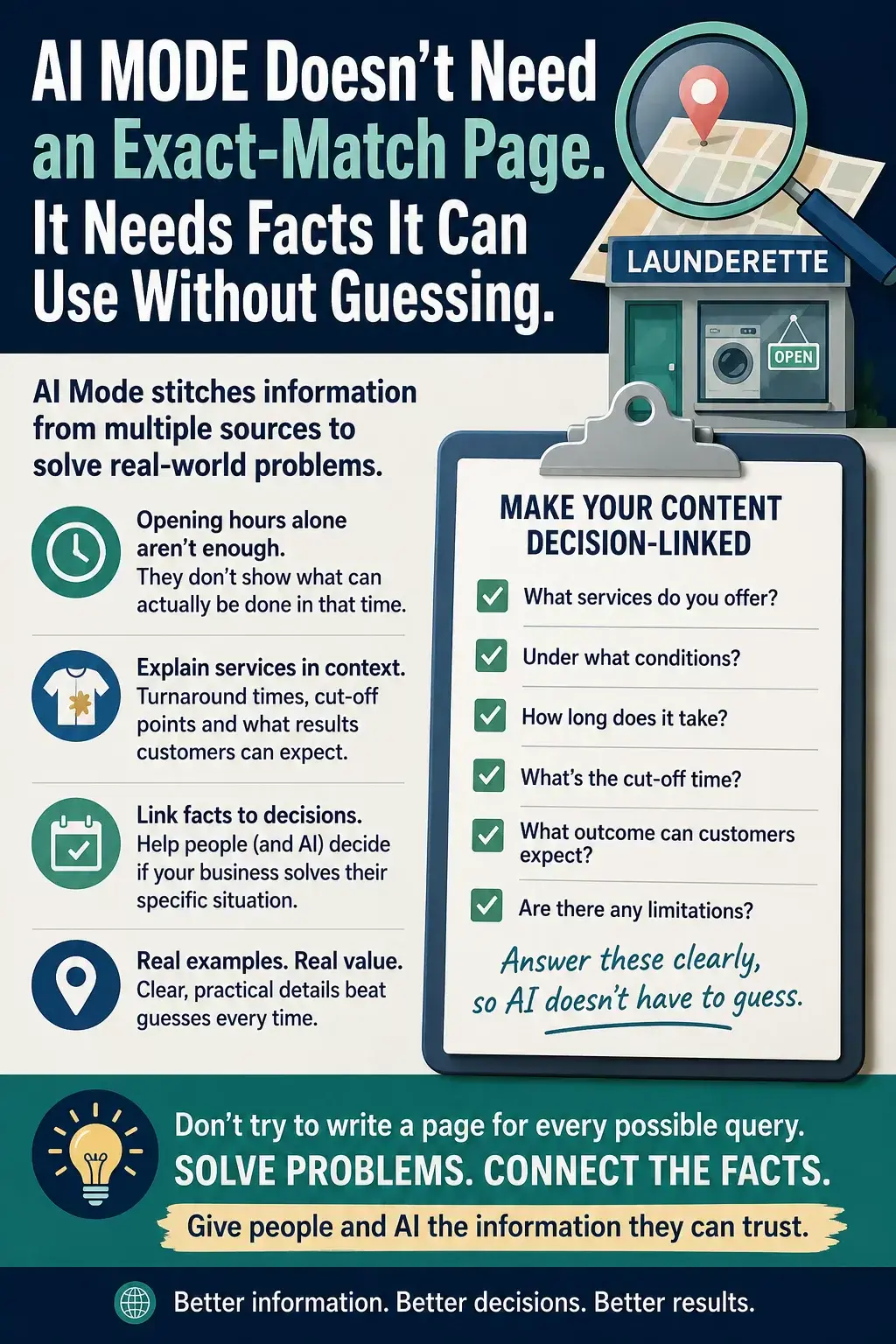
I began with a simple question about very specific searches.
If someone gives Google AI Mode an unusually detailed problem, will it find and cite a webpage that closely matches the whole situation?
For example, imagine someone standing at Glasgow Central Station on a Saturday afternoon. They have a fresh chocolate stain on a cotton shirt, cannot clean it themselves and need the shirt ready by 3 p.m. on Sunday.
That is an extremely specific problem.
My original theory was that an equally specific webpage might have an advantage. Perhaps AI Mode would surface a page written for almost exactly that situation.
What actually happened was more interesting.
AI Mode did not appear to find one webpage containing the complete answer. It broke the problem into parts, gathered information from several sources and attempted to assemble a practical solution.
In doing so, it also exposed what happens when the cited sources contain facts but do not explain how those facts work together in the real world.
The Search Was More Specific Than Any Likely Webpage
The problem contained several separate requirements:
- The business had to be close to Glasgow Central Station.
- It had to be open at the current time.
- It needed to handle a chocolate stain on cotton.
- It needed to accept an individual shirt.
- It had to complete the work before 3 p.m. on Sunday.
- The customer needed to know when to drop it off and collect it.
It would be unreasonable to expect a laundrette to publish a page titled:
I Am at Glasgow Central Station on Saturday Afternoon With a Chocolate-Stained Cotton Shirt That I Need Before 3 p.m. on Sunday
Almost nobody would write that page, and very few people would search using those exact words.
AI Mode therefore had to solve the problem another way.
Google explains that AI Mode can use query fan-out, issuing multiple related searches across different subtopics and data sources before bringing the findings together into a response.
The original question may therefore have produced searches relating to:
- laundrettes near Glasgow Central;
- Saturday and Sunday opening hours;
- urgent laundry services;
- dry cleaning and stain removal;
- chocolate stains on cotton;
- turnaround times;
- walking distances from the station.
AI Mode then tried to turn those separate pieces of information into one recommendation.
The First Answer Looked Helpful but Failed a Basic Test
The first recommendation was Glasgow City Laundrette & Dry Cleaners on Argyle Street.
AI Mode explained that it was only a few minutes from Glasgow Central Station and described it as the best place to get the stain handled professionally.
It then stated that the laundrette:
- closed at midday on Saturday;
- was closed on Sunday;
- needed to be visited immediately.
The problem was that it was already around 2 p.m. on Saturday.
The recommended business had been closed for approximately two hours and would remain closed throughout the following day.
AI Mode had apparently found the correct opening hours. It even included them in its answer.
But it failed to apply those hours when deciding whether the business could solve the problem.
This was not simply an inaccurate citation. It was a failure to connect the cited fact to the user’s real-world situation.
The answer knew when the shop was open.
It did not correctly determine whether the customer could use it.
Refining the Prompt Produced New Recommendations
The prompt was then refined to emphasise that the customer needed somewhere that was open now and capable of returning the shirt before Sunday afternoon.
AI Mode changed its answer.
This time, it recommended an open Timpson branch on Argyle Street. It instructed the customer to request a same-day or express wash-and-press service and collect the shirt before 3 p.m. on Sunday.
It also suggested another laundrette as a backup and claimed that an express service wash could normally be completed in about two hours.
This corrected the most obvious opening-hours problem.
However, it introduced a different one.
The cited sources appeared to establish facts such as:
- the shops existed;
- where they were located;
- when they opened;
- that they offered some form of laundry or garment service.
They did not necessarily establish that:
- the particular branch offered same-day specialist cleaning;
- chocolate-stain treatment could be completed within the available time;
- Sunday collection was available;
- an individual stained shirt qualified for an express service;
- the business could guarantee the required result.
AI Mode had moved beyond the facts and constructed a plausible service around them.
It effectively reasoned:
This shop is open, offers garment services and is nearby, so it may be able to clean this shirt by tomorrow.
That might be true.
But the cited information did not demonstrate that it was true.
The Missing Information Was Not Another Opening Time
At first, this might look like a lesson about keeping opening hours accurate.
That certainly matters. Google recommends keeping Business Profile information current, and LocalBusiness structured data can communicate information such as business hours in a standardised format.
But opening hours alone would not have solved this problem.
“Open Sunday from 10 a.m. until 4 p.m.” only tells us when the premises are accessible.
It does not tell us what can be completed during that window.
The customer needed to know:
- Can I drop off the shirt at 10 a.m.?
- Is specialist stain treatment available on Sundays?
- How long does it normally take?
- What is the latest drop-off time for collection before 3 p.m.?
- Does the item need to be inspected first?
- Is same-day treatment guaranteed?
- Should I telephone before travelling?
Those are not ordinary descriptive facts.
They are facts connected to a decision.
Websites Need Decision-Linked Facts
A useful way to describe this information is decision-linked facts.
A basic fact describes a business, product, place or activity.
A decision-linked fact explains what that fact means for someone trying to accomplish something.
| Basic fact | Decision-linked fact |
|---|---|
| Open Sunday from 10 a.m. to 4 p.m. | Sunday express items must be dropped off before 11 a.m. for collection after 2 p.m. |
| We provide stain removal | Fresh food stains on washable cotton can be assessed for same-day treatment |
| We offer dry cleaning | Dry-cleaning orders require at least 48 hours and cannot be collected on Sunday |
| We provide service washes | Standard service washes take approximately three hours when accepted before midday |
| Express service available | Express service depends on staff capacity and must be confirmed by telephone |
| Dogs are allowed | Dogs are permitted on the full route but must remain on leads through the livestock field |
| The walk is three miles | Allow 75 to 90 minutes, plus seven minutes to return to the railway station |
| The café closes at 5 p.m. | Hot food finishes at 4 p.m. and dogs are allowed only in the outside seating area |
The right-hand column gives AI Mode—and a human reader—something it can use to decide whether the option fits a particular situation.
The left-hand column leaves important gaps.
When Websites Leave Gaps, AI Mode May Fill Them
The laundrette experiment suggests that AI Mode does not always stop when a required fact is missing.
It may attempt to bridge the gap.
For example:
Open on Sunday + offers laundry services = can probably complete a Sunday service wash.
Or:
Offers dry cleaning + open tomorrow = the cleaned shirt can probably be collected tomorrow.
Or:
A different laundrette advertises a two-hour service = this nearby laundrette may offer something similar.
These conclusions can sound entirely reasonable.
That is what makes them dangerous.
They are not obviously absurd. They are plausible connections between partially established facts.
However, plausible is not the same as confirmed.
A well-designed webpage can reduce the amount of guesswork required by clearly explaining the relationship between:
- the service;
- the conditions under which it is available;
- the time required;
- the result the customer can expect;
- any important limitation.
A useful information pattern is:
Fact + condition + outcome + limitation
For example:
We offer same-day service washes on Sundays for items dropped off before 11 a.m. Collection is normally available after 2 p.m., although heavily stained garments may require additional treatment and cannot be guaranteed for same-day collection.
That single statement is more useful than separate boxes saying:
Open Sundays.
Service washes available.
Stain removal offered.
It explains how the facts interact.
This Applies Far Beyond Opening Hours
The principle is not limited to laundrettes or local businesses.
A dog-walking guide
Basic information:
This is a dog-friendly three-mile walk near York station.
Decision-linked information:
The route took 85 minutes at a relaxed pace, including two short stops. The finish is seven minutes from York station. Dogs must be kept on leads through one livestock section, and the riverside path can become muddy after heavy rain.
AI Mode can now use that page to help someone who:
- has only two hours before a train;
- is walking with an older dog;
- needs to avoid muddy terrain;
- wants a route ending near the station.
The author does not need four separate exact-match pages.
A telescope guide
Basic information:
This telescope accepts 1.25-inch eyepieces.
Decision-linked information:
Standard 1.25-inch eyepieces fit without an adaptor. However, the supplied mount becomes unstable with heavier eyepieces above approximately 300 grams.
That helps answer compatibility and usability questions, rather than merely repeating a specification.
A gardening article
Basic information:
Tomatoes need regular watering.
Decision-linked information:
During hot weather, the two plants in our 30-litre container required approximately four litres of water each morning. When we skipped a day, the compost dried below the top few centimetres and the plants began to wilt by late afternoon.
Now the reader can relate the general advice to a real setup and make a practical decision.
An attraction page
Basic information:
Last entry is at 4:30 p.m.
Decision-linked information:
Allow at least 90 minutes for the full visit. Visitors arriving after 3:30 p.m. are unlikely to complete every section before closing.
The second version helps someone decide whether the visit is worthwhile.
You Do Not Need a Page for Every Highly Specific Query
The experiment began with the possibility that a very specific search might require a very specific webpage.
It produced the opposite conclusion.
A laundrette does not need to create dozens of pages such as:
- emergency chocolate-stain cleaning on Saturday;
- urgent coffee-stain cleaning before Sunday;
- same-day cotton-shirt cleaning near Glasgow Central;
- cleaning a sauce stain before an afternoon train.
One strong service page could explain:
- which stains it assesses;
- which garments it accepts;
- normal and express turnaround times;
- daily drop-off cut-offs;
- Sunday service restrictions;
- when customers must call first;
- which outcomes cannot be guaranteed.
That page could support many different specific questions.
This also aligns with Google’s current guidance.
Google says its systems can understand a page’s relevance even when there is no exact wording match between the search and the page. It says publishers do not need to capture every long-tail variation or break content into tiny pieces for AI systems.
Google also warns against creating separate pages for every possible search variation or fan-out query when the primary purpose is to manipulate rankings or generative AI responses. Producing large quantities of unoriginal pages without adding value can fall under its scaled content abuse policy.
A highly specific page is not automatically bad. It may be excellent when it serves a genuine audience and contains substantial original value.
The problem is manufacturing pages around every imaginable prompt purely in the hope of triggering an AI citation.
A Better Content Strategy
Instead of trying to predict the exact sentence someone will type, consider the real situations in which people need your information.
Ask:
What decision is the visitor trying to make?
Then identify the facts required to make it safely and confidently.
For a business, that might include:
- availability;
- turnaround;
- cut-off times;
- booking requirements;
- capacity;
- restrictions;
- guarantees;
- exceptions.
For a hobby guide, it might include:
- realistic duration;
- compatibility;
- conditions;
- skill level;
- equipment used;
- measured results;
- points of failure;
- circumstances in which the advice does not apply.
Then connect those facts explicitly.
Do not make the reader—or AI Mode—deduce that because two things are separately true, the desired outcome must also be possible.
The Practical Test for Every Page
After writing a page, look at each important claim and ask:
Does this merely describe something, or does it help the reader decide what they can actually do?
“Open on Sunday” describes the business.
“Drop off before 11 a.m. for collection after 2 p.m.” helps the customer act.
“Three-mile circular walk” describes the route.
“Allow 90 minutes and turn back at this point if your train leaves within an hour” helps the reader use it.
“Compatible with 1.25-inch eyepieces” describes the product.
“Fits without an adaptor but becomes unstable with heavier eyepieces” helps the buyer decide.
This is not writing for an AI crawler at the expense of a human.
It is better human communication.
Google’s own guidance continues to emphasise unique, useful, people-first content and says that original, non-commodity information is more likely to influence long-term visibility than supposed AI optimisation tricks.
The Real Lesson From the Experiment
The original question was:
Will an extremely specific query surface an equally specific webpage?
The answer appeared to be:
Not necessarily.
AI Mode instead found separate pieces of information and attempted to build a solution.
The more important question then became:
Did the cited sources provide enough information for AI Mode to determine that the solution would actually work?
In this case, they did not.
AI Mode found locations, services and opening hours, but it lacked confirmed information connecting those facts to the customer’s deadline. It filled the gaps with assumptions and produced recommendations that sounded more certain than the sources justified.
That creates a legitimate opportunity for website owners.
Do not attempt to publish an exact-match page for every possible problem.
Instead:
Think about the real problems people encounter, identify the facts they need to solve them and explain clearly how those facts interact.
The objective is to give both readers and AI systems enough reliable information to reach the correct conclusion without guessing.
The winning page may not be the one that repeats the user’s entire question.
It may be the one that supplies the missing connection between a general fact and a real-world decision.