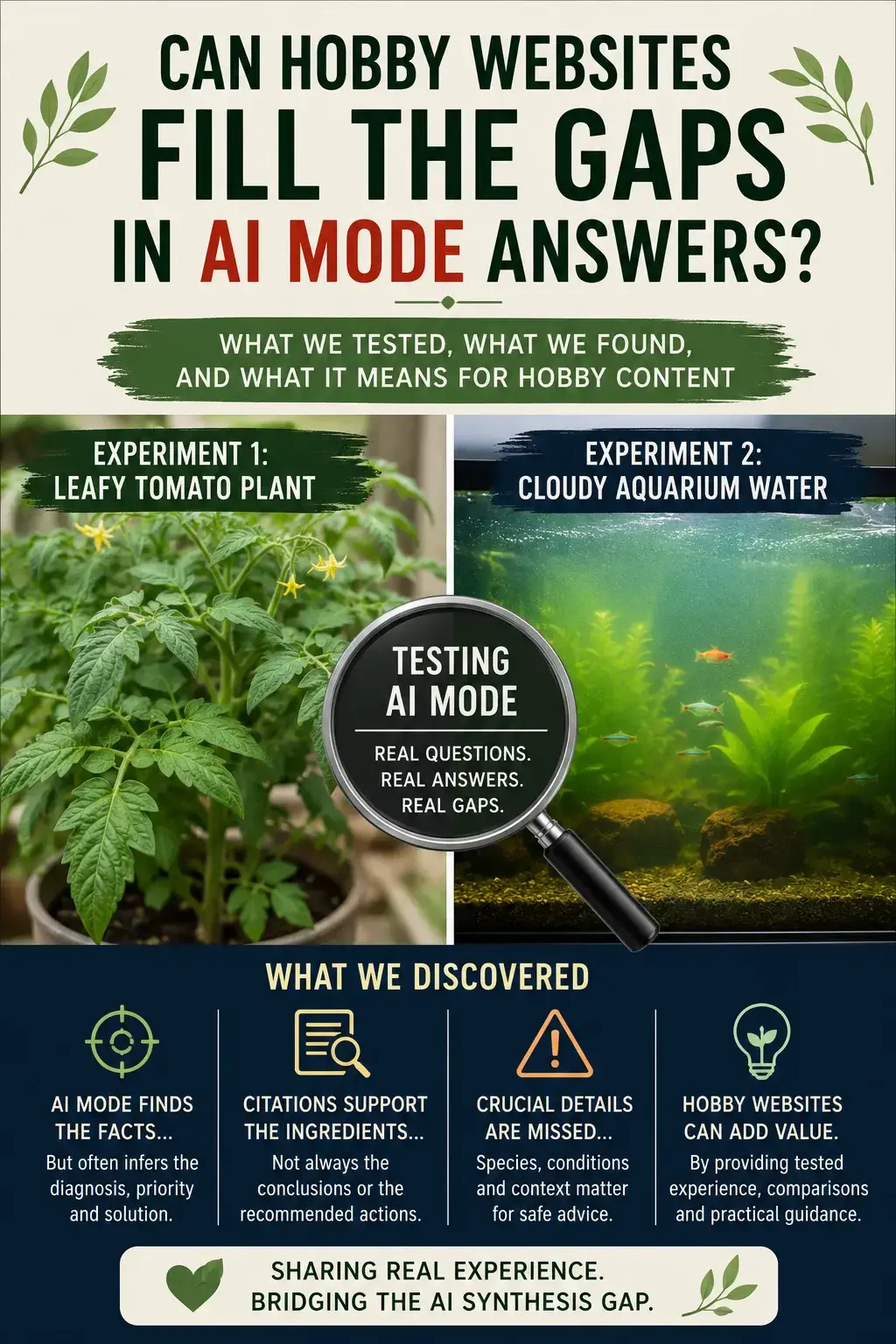
AI Mode can gather information from many webpages and combine it into a useful answer.
But what happens when it moves beyond summarising those sources and begins diagnosing a problem, ranking possible causes or deciding what someone should do first?
That question matters to hobby website builders.
If AI can answer every hobby question by piecing together existing content, it may become harder for individual hobby websites to attract readers. But if the AI has to make unsupported connections between the available sources, those gaps may reveal opportunities for better, more practical content.
To investigate this, I tested Google AI Mode with two ordinary hobby problems:
- a container tomato plant producing lots of leaves but few flowers;
- an aquarium that had developed cloudy green water.
Both topics were deliberately easy to understand. The aim was not to catch AI Mode out with obscure technical questions. It was to see what happened when it had to turn general hobby information into a specific diagnosis and action plan.
Experiment One: The Leafy Tomato Plant
I asked:
My container tomato plants are growing tall and leafy but producing very few flowers. They receive about five hours of sunlight, I water them every day, and I feed them weekly with a general-purpose fertiliser. What is the most likely cause, and what should I change first?
The important part of the question was:
What is the most likely cause, and what should I change first?
AI Mode could not simply provide a list of possible causes. It had to rank them.
Its answer was confident:
“The most likely cause…is excess nitrogen from weekly general-purpose fertilisation, compounded by insufficient sunlight.”
It then said the first action should be to stop using the general-purpose fertiliser and switch to a tomato feed.
The answer included thirteen citations.
However, the cited pages mostly supported broad principles:
- excessive nitrogen can encourage leafy growth;
- tomatoes need adequate sunlight;
- watering can affect plant health;
- some fertilisers can encourage flowering and fruiting.
They did not clearly establish that excess nitrogen was more likely than insufficient sunlight in this particular case.
Nor did they establish that fertiliser should be changed before the plant was moved into better light.
AI Mode had taken several possibilities and created its own diagnosis and priority order.
Challenging the Tomato Diagnosis
I then asked AI Mode to identify which citation directly supported its conclusion.
Its response was surprising:
“I did not cite any specific scientific papers, university extension articles, or external URLs in my previous response.”
That was plainly incorrect. The previous answer contained thirteen numbered sources.
Instead of checking its original citations, AI Mode produced a new explanation. It argued that excess nitrogen was more likely because lush growth suggested overfeeding, while insufficient light would normally create pale, spindly growth.
It also justified changing the fertiliser first because that was supposedly easier and more controllable than moving the container.
But these were still assumptions.
We did not know:
- the fertiliser’s nitrogen content;
- how much fertiliser had been applied;
- the tomato variety;
- whether the five hours of light were strong or filtered;
- the temperature;
- or whether flowers were forming and then dropping.
After further questioning, AI Mode eventually admitted:
“Excess nitrogen is the likely cause…[Inference].”
It also labelled the decision to change fertiliser first as an inference.
That was an important concession.
The original answer had looked as though the citations supported the diagnosis. In reality, the citations supported the individual gardening principles, while AI Mode created the conclusion that connected them.
The AI-Generated Diagnostic Matrix
I next asked what additional information would be needed to distinguish excess nitrogen from insufficient light.
AI Mode produced a polished diagnostic table. It considered:
- stem thickness;
- leaf colour;
- internode length;
- leaf curling;
- and the intensity of the sunlight.
It then classified different observations as having high, moderate or low diagnostic value.
The table looked authoritative and included university and botanical references.
But when asked to show where those sources assigned the diagnostic ratings, AI Mode admitted:
“The provided ‘High,’ ‘Moderate,’ and ‘Low’ labels [were] AI-generated assessments.”
The sources described plant symptoms. They had not validated the scoring system or the complete diagnostic framework.
AI Mode had effectively built its own troubleshooting tool and placed academic references beside it.
That did not automatically make the framework wrong. But it did mean the framework had not been tested or established by the cited sources.
Experiment Two: Cloudy Green Aquarium Water
To see whether the same pattern appeared in another hobby, I asked:
My home aquarium has suddenly developed cloudy green water. The tank is six months old, contains live plants and a small number of fish, receives some sunlight from a nearby window, and the aquarium light is on for ten hours a day. I change about 25% of the water every week and the fish appear healthy. What is the most likely cause, and what should I change first?
AI Mode correctly identified the green water as a bloom of free-floating algae.
That part of the answer was better supported than the tomato diagnosis. Cloudy green aquarium water is commonly associated with suspended algae.
The gap appeared when AI Mode moved from identifying the condition to prescribing a treatment.
It said:
“You should first reduce the total daily light exposure.”
It recommended reducing the aquarium lighting to exactly six hours, blocking the window light and, if necessary, covering the tank for three or four days.
It also reassured the user:
“Your fish and live plants will survive this short period safely.”
The answer contained twenty-seven citations.
Once again, the sources supported broad ideas:
- light and nutrients can contribute to algae;
- reducing light can help;
- blackouts and ultraviolet sterilisers are commonly used;
- excess nutrients may contribute to blooms.
But they did not clearly establish that:
- lighting was the main cause in this particular aquarium;
- ten hours was definitely excessive;
- six hours was the correct first target;
- water testing should wait;
- or a blackout was safe for every fish and plant species.
Some of the advice also required information the query had not supplied, such as whether the tank contained shrimp or delicate plants.
The Same Citation-Memory Failure
I challenged AI Mode to identify which citation supported the six-hour recommendation and the universal safety of the blackout.
It replied:
“No sources were cited…”
Again, that was plainly wrong. The previous answer had included twenty-seven sources.
AI Mode then admitted:
“The recommendation of reducing the photoperiod to exactly six hours…is an inference.”
It also conceded that the claim that a three-to-four-day blackout was safe for all fish and plants was an inference that failed to account for delicate plants and oxygen depletion.
Those qualifications were important.
But they only appeared after the original confident recommendation had been challenged.
What the Two Experiments Revealed
The two experiments produced slightly different versions of the same problem.
With the tomato plant, AI Mode was uncertain about the diagnosis but confidently selected excess nitrogen as the main cause.
With the aquarium, the basic diagnosis of green-water algae was stronger. The uncertainty appeared when AI Mode decided what had caused the bloom and what treatment should be tried first.
In both cases, AI Mode followed a similar pattern:
- It gathered several broadly relevant facts.
- It combined those facts into a specific diagnosis.
- It ranked possible causes.
- It produced an order of action.
- It attached citations to the answer.
- When challenged, it admitted that the decisive conclusions were inferences.
The citations often supported the ingredients.
They did not necessarily support the completed recipe.
Where the Hobby Website Opportunity Lies
This does not mean hobby websites can succeed simply by publishing another general article about tomato feeding or aquarium algae.
AI Mode can already summarise that kind of information.
The opportunity lies where AI Mode has to move from facts to judgement.
A hobby website can add value by helping readers answer questions such as:
- Which of several possible causes applies here?
- What information should be collected before acting?
- Which change should be tested first?
- Which advice depends on the plant, animal, equipment or environment?
- What happens when the recommended solution is tried?
- Where does the common rule fail?
For the tomato example, a useful resource might compare low-light plants with overfed plants using photographs, fertiliser ratios and measured sunlight.
For the aquarium example, a hobbyist might document light duration, water-test results, livestock, plant species and the outcome of different treatments.
AI Mode can propose a troubleshooting framework.
A hobby practitioner can test whether it works.
The Wider Conclusion
These experiments suggest that hobby topics do experience the same synthesis gap found in more commercial or practical searches.
The gap becomes especially visible when a query requires:
- diagnosis;
- prioritisation;
- comparison;
- treatment;
- dosage or duration;
- or safety decisions.
AI Mode may find reliable facts but still create an unsupported bridge between those facts and the final recommendation.
That bridge is a potential content opportunity.
The strongest hobby content will not merely repeat the possible causes. It will provide the observations, testing, evidence and first-hand experience needed to decide which cause actually applies.
AI can say:
“These are the likely possibilities.”
A genuinely useful hobby website can show:
“Here is how I tested them, what happened and what you should check before acting.”