
For years, the basic website strategy was simple.
Find a question people are searching for.
Write a useful article that answers it.
Get found in Google.
Earn the click.
That model is not dead, but it is becoming much weaker.
The reason is simple: AI Mode is very good at absorbing, summarising, combining, and repackaging text.
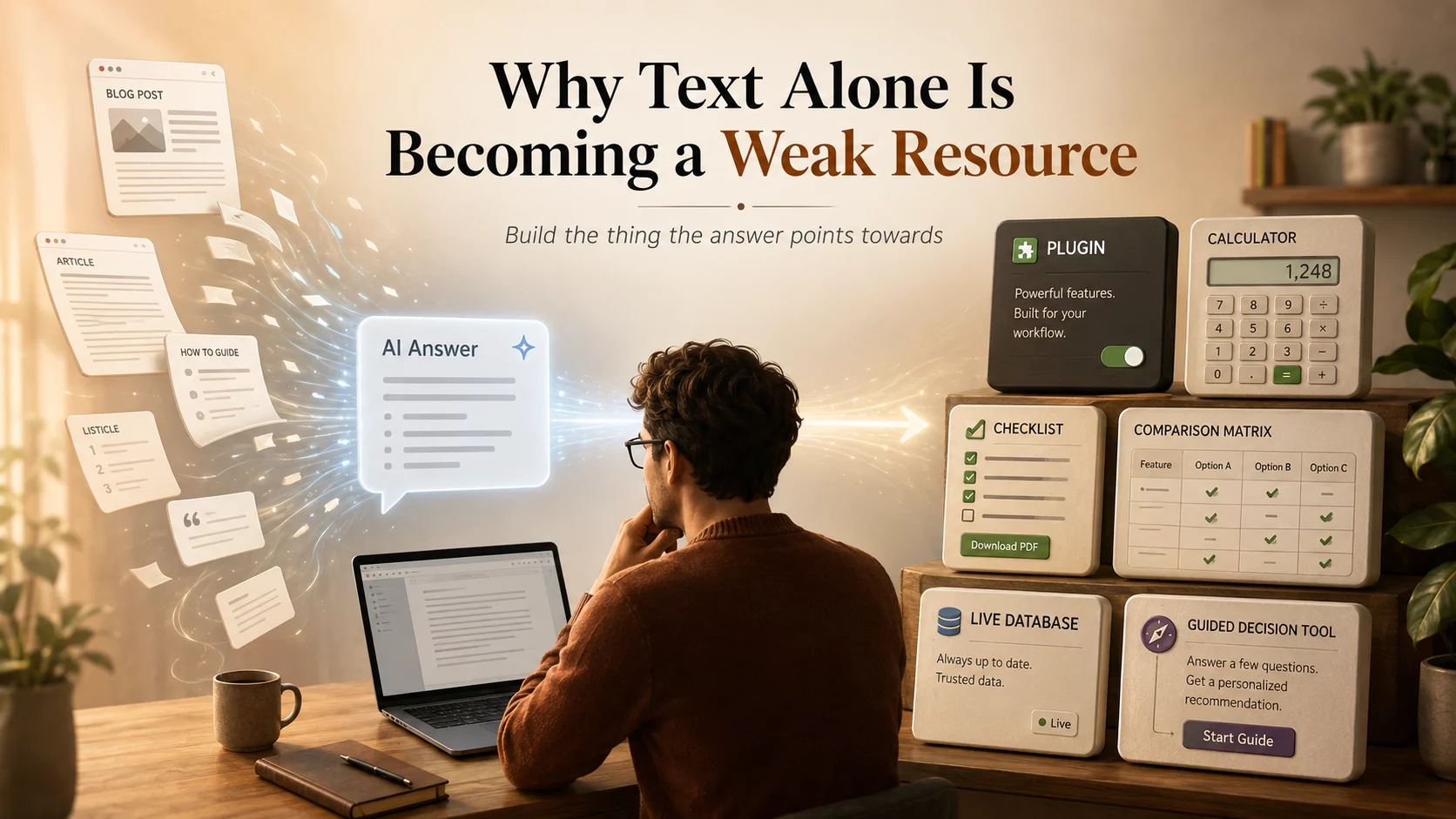
If a website page is only a written explanation, AI Mode may eventually be able to use that page as one small ingredient in a much larger generated answer. The user may get the summary, the steps, the comparison, the pros and cons, and the next suggested action without ever needing to visit the original website.
That is uncomfortable for website owners.
But it is also the reality we now have to work with.
The future opportunity is not simply to write the answer.
It is to build the missing thing the answer points towards.
Text Is the Easiest Thing for AI to Absorb
Text is the natural material of AI search.
A written article can be read, broken down, summarised, compared with other articles, and converted into a short answer.
That is exactly why ordinary explanatory content is vulnerable.
A page that says “how to clean a washing machine filter” can be summarised.
A page that says “best beginner telescope for planets” can be folded into a wider product recommendation.
A page that explains “how to convert PNG to WebP” can be turned into a set of instructions.
A page that lists “10 tips for saving money on energy bills” can become a neat AI-generated checklist.
This does not mean those articles have no value.
It means the value may no longer be enough to win a click.
If AI Mode can satisfy the user inside the search window, the user has little reason to continue to your site.
That is the strategic problem.
“Best X” and “How To Y” Content Is Especially Exposed
The most exposed content is the kind of content that exists mainly to answer a clear, common question.
For example:
“Best running shoes for beginners.”
“How to start a blog.”
“Best chess books for improvers.”
“How to remove mould from a bathroom ceiling.”
“What is the best telescope for beginners?”
These are exactly the kinds of queries where AI Mode can be helpful.
It can collect the main considerations, compare options, ask follow-up questions, and produce a reasonable answer.
The old website path looked like this:
Search query → Google results → website → answer.
The AI Mode path increasingly looks like this:
Search query → AI answer → follow-up question → refined answer → decision.
That middle website click is no longer guaranteed.
In many cases, the website is no longer the destination.
It is just one source in the answer.
That is a very different world for website owners.
Unique Experience Helps, But It May Not Be Enough
One obvious response is to say:
“Add personal experience.”
That is still good advice.
A real person’s experience matters.
If you have actually used the telescope, built the WordPress plugin, repaired the garden pond, run the bookkeeping process, tested the chess training method, or tried the affiliate marketing strategy, your content has something generic AI output does not.
But personal experience on its own may not always be enough.
A paragraph saying “I tried this and it worked well” can still be summarised.
A personal story can still be absorbed into a generated answer.
A review can still be reduced to “one user found this useful for X, but noted Y.”
Experience makes content stronger.
It does not automatically make it defensible.
The stronger question is this:
What can the website provide that cannot easily be recreated inside the AI answer window?
That is where the opportunity starts.
The Stronger Website Becomes the Endpoint
A weak website is a paragraph on the way to the answer.
A stronger website is the place the user needs to go next.
That difference is crucial.
If the user only needs an explanation, AI Mode may provide it.
But if the user needs to do something, calculate something, compare something, download something, configure something, track something, or interact with something, then the website has a stronger reason to exist.
The website is no longer just explaining the solution.
It is delivering part of the solution.
That is why tools, templates, workflows, calculators, datasets, comparison systems, downloads, plugins, communities, and interactive resources are more defensible than text alone.
They turn the website into an endpoint.
Examples of Stronger Resources
A stronger resource does not need to be hugely complicated.
It simply needs to offer something beyond a static explanation.
For example, a WordPress plugin is stronger than an article explaining a WordPress task.
An article can explain how to convert PNG images to WebP.
But a plugin that lets a user upload an image, rename it, add alt text, add a caption, convert it to WebP, and place it into the WordPress media library is much harder to replace with a paragraph.
AI Mode can describe the process.
The plugin performs the process.
That is the execution gap.
A calculator is stronger than a general advice article.
An article can explain how to estimate profit margin.
But a calculator that lets a small business owner enter costs, selling price, VAT, postage, platform fees, and desired profit gives them a result specific to their situation.
AI Mode can explain the formula.
The calculator does the calculation.
A comparison matrix is stronger than a “best X” list.
An article can say which beginner telescope is best.
But a comparison matrix that lets users filter by budget, storage space, observing goals, balcony use, garden use, portability, and ease of setup gives the user a more practical decision-making tool.
AI Mode can suggest options.
The comparison system helps the user choose.
A downloadable checklist is stronger than a “things to remember” article.
An article can explain what to check before publishing a blog post.
But a printable checklist, Notion template, Google Sheet, or WordPress workflow gives the user something they can actually use repeatedly.
AI Mode can list the steps.
The download becomes part of the user’s working process.
A live database is stronger than a static list.
An article can list useful chess resources.
But a searchable database of chess opening videos, tagged by opening, variation, player level, theme, and source, gives users a reason to return.
AI Mode can recommend a few videos.
The database lets users explore the whole map.
A guided decision tool is stronger than general advice.
An article can say “choose the right product for your needs.”
But a guided tool that asks the user about budget, constraints, goals, experience level, and preferences can lead them to a more specific recommendation.
AI Mode can guide the conversation.
The website can package that guidance into a reliable, repeatable journey.
The Key Shift: From Information to Function
This is the big strategic change.
Old website thinking was often about information.
What can I write about?
What keywords can I target?
What questions can I answer?
New website thinking needs to include function.
What can I help the user do?
What can I help them decide?
What can I help them compare?
What can I help them calculate?
What can I help them organise?
What can I help them complete?
That does not mean every website needs to become a software company.
A useful resource can be simple.
It could be a checklist.
A spreadsheet.
A downloadable template.
A visual planner.
A curated map.
A niche-specific workflow.
A plugin.
A form.
A small calculator.
A comparison table.
A private community.
A searchable resource library.
The point is not complexity.
The point is usefulness beyond text.
AI Mode May Send Better Visitors, Not Just Fewer Visitors
There is another side to this.
A lot of website owners are understandably worried about AI Mode reducing clicks.
That is a real concern.
But the clicks that do arrive may be more specific and more valuable.
If a user has already gone through an AI Mode journey, clarified their problem, explored the general answer, and then clicked through to your site, that visitor may arrive with a much clearer need.
They are not casually browsing.
They are looking for the thing AI Mode could not fully provide.
That is the opportunity.
The aim is not simply to win more random traffic.
The aim is to become the resource AI Mode points towards when the generated answer is not enough.
That changes how we think about website strategy.
Instead of asking, “What article can I write for this keyword?”
We should ask, “Where does the AI answer stop being enough?”
That stopping point is where the website opportunity begins.
The Noindex Problem
Some creators may look at this situation and think:
“If AI systems are going to absorb my content, should I block indexing?”
That is understandable.
But it creates a trade-off.
If your content is not indexed, it is much harder to gain search visibility.
For most small website owners, that is not a realistic growth strategy.
A public website is, by nature, part of the open internet.
If you want visibility, you are usually allowing search systems to crawl, understand, and display information from your pages in some form.
That means grumbling about AI summaries may be emotionally understandable, but it is not much of a strategy.
The practical question is not whether the old landscape was fairer.
The practical question is what works now.
And what works now is building resources that are harder to reduce to a short summary.
Complaining Will Not Change the Direction of Travel
Many website owners are angry about AI search.
Some see it as unfair.
Some see it as content theft.
Some believe small publishers should take legal action.
There may be serious legal, ethical, and commercial arguments to be had.
There is also a genuine risk that if creators cannot earn from publishing, fewer people will publish useful material in the long run.
That risk should not be dismissed.
But for an individual website owner trying to decide what to build next, anger does not solve the problem.
The search landscape has changed.
AI summaries are not a small temporary feature.
They are part of a much bigger movement from search engines as link directories to search engines as answer engines, assistants, and task-completion systems.
We can dislike that.
We can criticise it.
We can argue about whether it is fair.
But we still have to adapt to it.
The opportunity belongs to the people who observe the new landscape clearly.
How to Find the New Opportunities
The best way to find stronger website ideas is to follow real AI Mode journeys.
Search for something a real person might ask.
Then watch what happens.
Does AI Mode answer the question completely?
Does it leave the user needing a tool?
Does it suggest a process but not provide the workflow?
Does it give options but not help the user choose?
Does it summarise information but fail to organise it properly?
Does it explain what to do but leave the execution to the user?
Does it need fresh data, user-specific inputs, or niche judgement?
Those gaps are the opportunities.
For example:
If AI Mode explains how to choose a telescope but the user still needs a personalised comparison tool, that is an opportunity.
If AI Mode explains how to prepare for a VAT deadline but the user still needs a checklist or calculator, that is an opportunity.
If AI Mode explains how to organise chess opening videos but the user still needs a curated opening map, that is an opportunity.
If AI Mode explains how to convert images for WordPress but the user still needs a plugin that performs the process, that is an opportunity.
If AI Mode explains how to plan a garden project but the user still needs a visual planner, materials list, and printable step-by-step guide, that is an opportunity.
The gap is not the topic.
The gap is the unfinished journey.
Text Still Matters, But Its Role Changes
This does not mean we should stop writing.
Text still matters.
A tool needs explanation.
A plugin needs a landing page.
A calculator needs examples.
A comparison matrix needs guidance.
A downloadable checklist needs context.
A visual planner needs instructions.
A curated database needs descriptions.
But the text is no longer the whole resource.
The text supports the resource.
It explains why the resource exists, who it helps, how to use it, and what problem it solves.
That is a better position.
Instead of writing another article that AI Mode can summarise, you build something useful and use the article to introduce it.
The article becomes the doorway.
The resource becomes the destination.
The Strategic Question for Every New Page
Before creating a new page, ask:
Is this just an answer?
Or is this a useful endpoint?
If it is just an answer, it may still be worth writing, especially if you have strong experience or a clear point of view.
But if the answer can be easily summarised, do not assume it will keep winning clicks forever.
Try to add something more.
A simple table.
A downloadable checklist.
A worked example.
A calculator.
A template.
A decision tree.
A comparison system.
A workflow.
A small tool.
A resource list that is genuinely curated.
A visual guide.
A repeatable process.
A reason to bookmark the page.
A reason to return.
The more your page helps someone complete the journey, the more defensible it becomes.
Opportunity or Threat?
So is AI Mode a threat or an opportunity?
The answer is both.
It is a threat to text-only websites.
It is a threat to generic “best X” content.
It is a threat to ordinary how-to articles that simply repeat what many other articles already say.
It is a threat to websites that exist only as a thin bridge between search traffic and someone else’s product.
But it is also an opportunity.
It reveals where users still need more than an answer.
It exposes the gaps where AI Mode cannot fully complete the journey.
It may send more focused visitors to resources that genuinely solve the next problem.
It pushes website owners to build things that are more useful than yet another article.
That is the shift.
The old opportunity was to write the answer.
The new opportunity is to build the missing thing the answer points towards.
That is where small website owners should be looking now.