
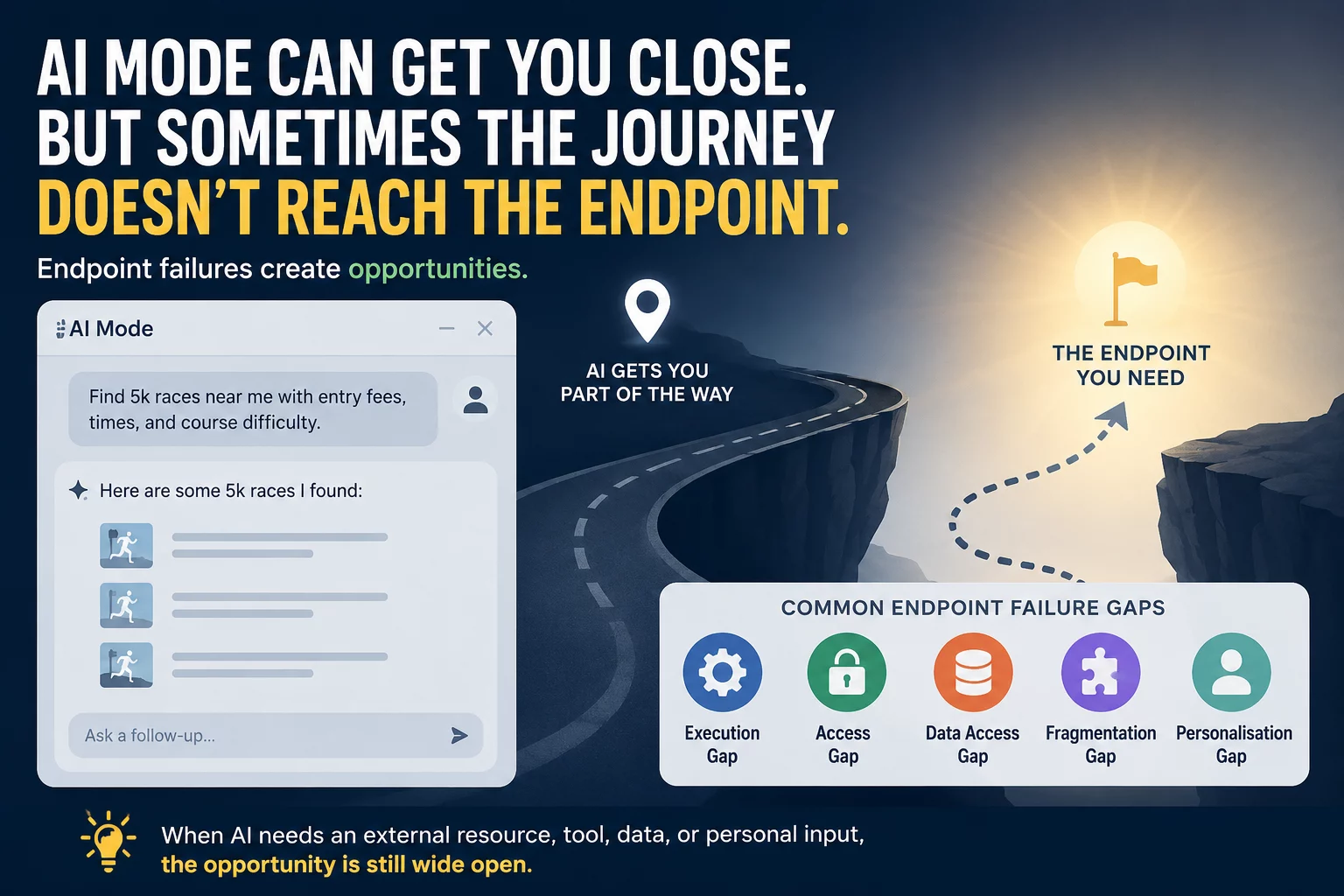
AI Mode changes the way we need to think about websites.
In traditional search, the pathway was fairly simple.
A user typed a query into Google. Google showed a list of websites. The user clicked one or more of those websites. The website then helped the user find the answer, make a decision, solve a problem, or complete a task.
That old pathway looked like this:
Query → search results → website → answer or solution
AI Mode changes that.
Now the search engine is trying to do much more of the journey inside the AI window itself. It does not only want to show the user links. It wants to understand the query, expand the query, ask or infer follow-up questions, summarise sources, compare options, and guide the user closer to the endpoint.
The new pathway looks more like this:
Query → AI answer → follow-up detail → refined answer → possible endpoint
That matters because many website owners are still thinking only in terms of ranking for queries. But the real question is changing.
The question is no longer just:
“Can I answer this query?”
The better question is:
“Can AI Mode already carry the user all the way to a satisfactory endpoint?”
If the answer is yes, a normal text article may be weak. AI Mode can often summarise ordinary explanations, combine basic facts, and answer simple informational queries without the user needing to click away.
But if AI Mode cannot complete the journey, that is where the opportunity appears.
The opportunity is not simply to write another article. The opportunity is to identify where the AI journey fails, and then build the resource, tool, guide, dataset, workflow, checklist, plugin, comparison system, or specialist page that helps complete the endpoint.
I think of these as endpoint failure gaps.
They are the places where AI Mode can help, but cannot fully finish the job.
What Is an Endpoint Failure Gap?
An endpoint failure gap appears when AI Mode can take the user part of the way, but cannot complete the actual thing the user needs.
That failure does not always mean the AI answer is bad.
In fact, the AI answer may be very good. It may explain the issue clearly. It may suggest sensible options. It may even give step-by-step instructions.
But the endpoint still fails if the user needs something outside the AI window.
That “something outside” might be:
- access to a private account
- a downloadable tool
- an external program
- a live database
- paid API access
- human judgement
- local knowledge
- current prices
- scattered information pulled into one place
- a personalised decision process
- a practical workflow
- a plugin or calculator
- a trusted specialist resource
This is important because AI Mode is trying to absorb more and more of the search journey. But every time it needs an external resource, external input, or external action, the journey has not been fully completed inside the AI window.
That is where websites can still matter.
Not all endpoint failures fit neatly into one category. A single query may fail for several reasons at once.
A problem may involve personal circumstances, fragmented data, private account access, and the need for a practical tool. These categories are not sealed boxes. They are useful ways of spotting where the journey breaks.
1. The Execution Gap
The execution gap appears when AI Mode can explain what needs to be done, but cannot actually do the task for the user.
This is one of the clearest endpoint failures.
The user does not only want instructions. The user wants a result.
I had a real example of this with my WordPress site. I needed to delete some duplicate plugin files from the server.
ChatGPT could explain the steps. It could tell me that I needed to access the WordPress file structure, find the plugin folder, identify the duplicated files, and remove them safely.
That was useful.
But it did not complete the task.
To actually delete the files, I had to use an external program. In my case, that meant downloading FileZilla, connecting to the server, locating the relevant WordPress plugin folder, and deleting the files myself.
The endpoint was not:
“Tell me how to delete duplicate plugin files.”
The endpoint was:
“Get the duplicate plugin files removed from my WordPress site.”
AI helped with the knowledge, but it could not complete the action inside the AI window.
That is the execution gap.
The same principle applies to many other tasks. AI can explain how to compress images, convert files, clean spreadsheets, create invoices, structure data, fix code, or upload media to WordPress. But if the user still has to leave the AI window and use a tool, plugin, app, script, or external service, the endpoint has not been fully completed by AI Mode.
This creates opportunities for practical resources.
A website that only explains the process may be vulnerable. But a website that provides the tool, template, plugin, checklist, calculator, or workflow that actually helps the user complete the task may be much stronger.
2. The Access Gap
The access gap appears when AI Mode understands the task, but cannot access the private system, account, file, server, dashboard, or data needed to complete it.
This is closely related to the execution gap, but it is not exactly the same.
The execution gap is about doing the action.
The access gap is about reaching the place where the problem lives.
The WordPress file example also fits here. The duplicate plugin files were not sitting inside the AI window. They were inside my private hosting environment. AI could tell me what to do, but it could not log into my hosting account, open the server folders, inspect the plugin files, and delete the duplicates itself.
That required access.
The access gap appears in many real-world situations:
A user may need help with a WordPress issue, but the answer depends on what is inside their actual plugin folder.
A business owner may need help fixing an accounting problem, but the answer depends on what is inside Sage, Xero, QuickBooks, or a spreadsheet.
A blogger may ask why traffic has dropped, but the useful answer depends on Search Console, Analytics, ranking data, and the actual site structure.
A user may ask which emails need attention, but AI cannot answer properly unless it can access the inbox.
In these cases, the missing piece is not general knowledge. The missing piece is access.
This matters because many AI answers stop at instructions for a reason. The model may understand the process, but it cannot always enter the private environment where the process needs to happen.
For website owners, this creates a different kind of opportunity. The useful resource may not be a general article. It may be a diagnostic checklist, a troubleshooting workflow, a plugin, a private upload tool, or a guide that helps the user safely gather and interpret the information AI cannot see by default.
3. The Fragmentation Gap
The fragmentation gap appears when the information needed to reach the endpoint exists, but it is scattered across many different places.
This is one of the most interesting opportunities for small websites, because the problem is often not that the information is unavailable. The problem is that it is messy, incomplete, spread out, and inconvenient to use.
I noticed this when I was trying to get fitter and wanted to work towards running a 5k race.
Finding 5k races was more awkward than it should have been.
There were individual sites promoting single races. Some websites tried to pull together lists of races, but they were not complete. Some races were mentioned in running blogs, local club pages, event platforms, or other scattered sources.
The endpoint was not simply:
“Find me a 5k race.”
The endpoint was more like:
“Give me a complete, useful list of 5k races, including location, entry fee, start time, course difficulty, surface type, beginner-friendliness, parking, facilities, and practical notes.”
That information may exist, but it is fragmented.
AI Mode may be able to list a few races or suggest some places to search. But unless it can reliably gather, verify, structure, and update all of that scattered information, the user still does not have the complete endpoint.
This is where a specialised website can still be valuable.
A simple article about “how to find a 5k race” is one thing. But a properly maintained local 5k race finder, with filters for difficulty, cost, location, date, facilities, and beginner suitability, is a much stronger resource.
It does something AI Mode may not fully complete by itself.
However, there is an important warning with the fragmentation gap.
If the fragmented information is valuable enough, a major player may eventually solve it.
UK petrol prices are a useful example. Fuel prices were naturally fragmented across thousands of forecourts. Drivers wanted to know where the cheapest nearby petrol was, but the information was not always easy to compare.
That kind of fragmentation creates an opportunity. But if the problem matters enough, governments, large platforms, comparison sites, or major apps may step in and centralise the data.
So the opportunity is not simply:
“Find fragmented information.”
The better question is:
“Can I organise fragmented information in a niche where the problem is real, but not so large that a major player is likely to dominate it quickly?”
That is where smaller websites may find space.
4. The Personalisation Gap
The personalisation gap appears when AI Mode can give a general answer, but the useful endpoint depends heavily on the user’s specific circumstances.
This is different from a simple informational query.
If someone asks, “What is a 5k run?”, AI can answer that easily.
But if someone asks, “What is the best way for me to train for and choose my first 5k?”, the answer depends on many personal factors.
Age matters. Current fitness matters. Injury history matters. Confidence matters. Location matters. Available training time matters. The type of race matters. A flat park run is different from a hilly trail event.
The same applies to travel.
I have a friend who likes to travel with his family. But he has some mobility issues and two young children, so planning trips is more complicated than reading a generic travel guide.
It is not enough to say that a hotel is “family friendly” or that a destination is “easy to reach.”
He may need to know whether there is step-free access, whether lifts are available, how far the hotel is from transport links, whether the pavements are manageable, whether there are toilets nearby, whether the route is practical with young children, whether there are places to rest, and whether the attraction is genuinely suitable for his family’s needs.
The endpoint is not:
“Find a nice place to go.”
The endpoint is:
“Find a realistic trip that works for this specific family, with mobility needs, young children, energy levels, transport options, facilities, and practical limitations all taken into account.”
That is the personalisation gap.
AI Mode tries to solve this through query fan-out. It can ask follow-up questions or infer that it needs more information. It may ask about budget, children’s ages, mobility level, destination type, transport preferences, travel dates, and accommodation needs.
That is useful.
Query fan-out reduces the personalisation gap.
But it does not remove it in every case.
The more specific the circumstances, the more likely the answer depends on detailed, real-world information. That information may be buried in hotel reviews, accessibility pages, transport websites, local maps, attraction guides, family forums, and recent visitor experiences.
In other words, the personalisation gap may overlap with the fragmentation gap and the access gap.
AI can ask better questions. But if the answer depends on scattered, incomplete, or hard-to-verify details, the endpoint may still fail inside the AI window.
This is where specialist resources can help: decision tools, guided questionnaires, accessibility checklists, comparison tables, local guides, family travel planners, and resources built around specific real-life constraints.
These Gaps Often Overlap
It is important not to treat these endpoint failure gaps as completely separate boxes.
Real queries often fall into more than one category.
The WordPress duplicate plugin file problem involved both an execution gap and an access gap. AI could explain the steps, but I still needed access to the server and an external tool to delete the files.
The 5k race example involved a fragmentation gap, but it could also involve personalisation. A complete race list is useful, but the best race for a beginner depends on location, fitness level, confidence, transport, course difficulty, and available dates.
The family travel example clearly involved personalisation, but it may also involve fragmented data. Accessibility details, child-friendly facilities, transport routes, hotel layouts, and recent visitor experiences may all be spread across different sources.
This overlap matters.
A strong website opportunity may appear where several gaps meet.
For example, imagine a tool for families planning accessible trips with young children.
That could involve:
- personalisation, because every family has different needs
- fragmentation, because the relevant information is scattered
- access, because some details may sit inside booking platforms or transport tools
- execution, because the user needs a practical plan, not just a general article
The more gaps a query contains, the harder it may be for AI Mode to complete the endpoint by itself.
That does not automatically mean the opportunity is easy. In fact, it may be difficult. But it may also be more defensible than writing another basic informational post.
What This Means for Website Owners
The big mistake is to assume that every query is still a good website opportunity.
Some queries are becoming weak targets because AI Mode can already complete the user journey well enough inside the answer window.
If a user asks a simple factual question, a basic definition, or a common how-to query, AI may answer it clearly without the user needing to click.
That does not mean websites are dead.
It means the opportunity is moving.
The stronger opportunity is to look for the point where AI Mode gets stuck.
Where does it need an external tool?
Where does it need access to private information?
Where does it need a paid database?
Where is the information scattered?
Where does the user’s situation become too specific for a generic answer?
Where does the user need a workflow, checklist, calculator, template, plugin, comparison table, or curated resource?
These are the places where a website can still become the endpoint.
The future opportunity is not simply to write the answer.
It is to build the thing that helps complete the journey.
A Practical Way to Find These Opportunities
One useful exercise is to follow AI Mode queries all the way through.
Do not just ask whether the answer sounds good.
Ask whether the user has actually reached the endpoint.
Try questions like:
- Did AI Mode complete the task, or only explain it?
- Did it need an external tool?
- Did it need data it could not access?
- Did it rely on scattered information?
- Did it give a generic answer when the user needed a personal one?
- Did it suggest a paid tool, API, plugin, or service?
- Did the answer leave the user with more work to do?
- Could a website, tool, database, checklist, plugin, or guide complete the journey better?
This changes how you look at search.
Instead of asking, “What keywords can I rank for?”, you start asking, “Where does the AI journey break?”
That is a very different mindset.
AI Mode is trying to move users from query to endpoint inside the AI window.
But every time that journey fails, there may be an opportunity.
Not always for another article.
Often for something more useful.
This post is part of my wider guide to AI Gap Resource Building.