
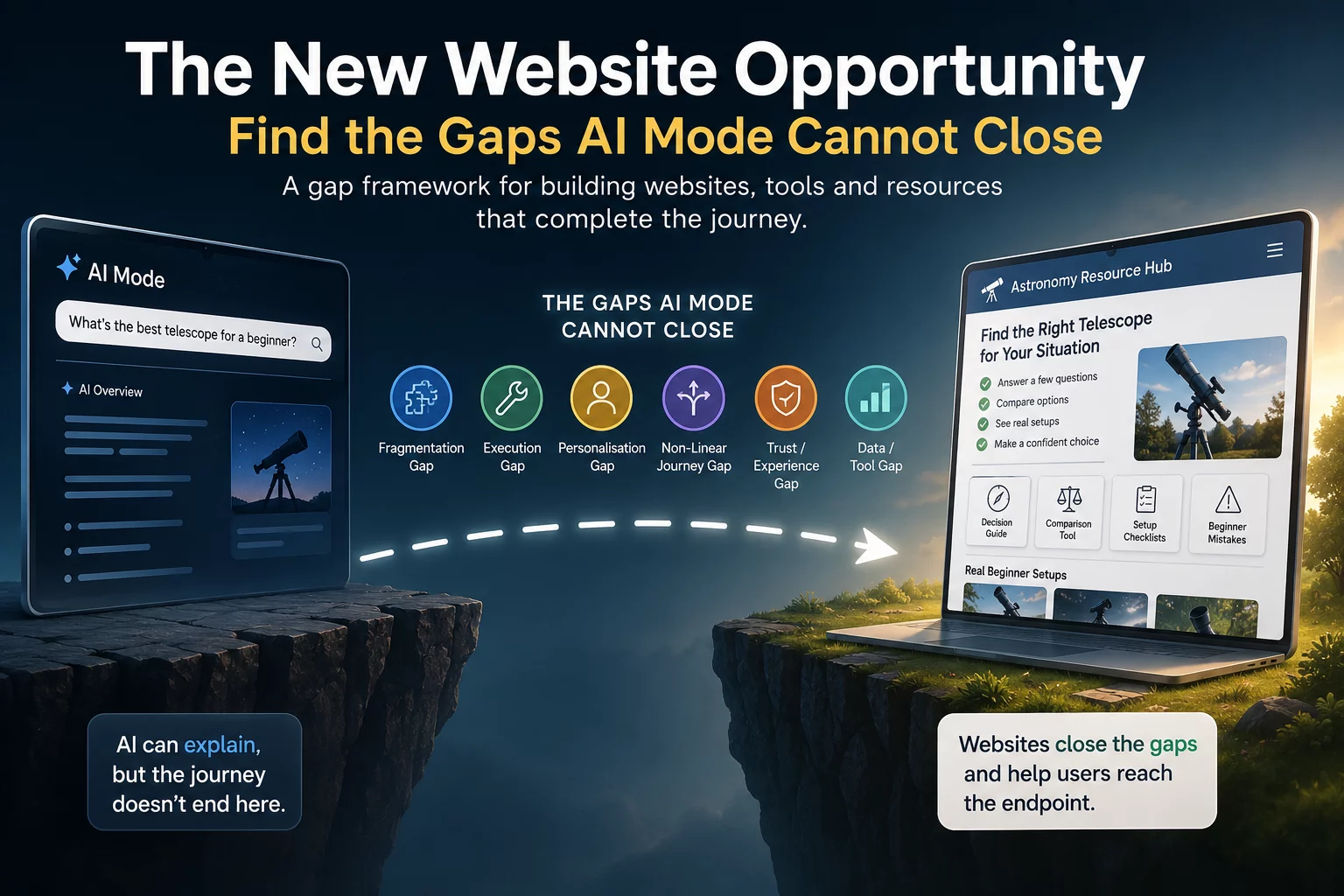
A useful website is changing.
For years, a lot of website content was built around a fairly simple idea:
Find a question people are searching for, write a page that answers it, and hope Google sends visitors.
That model is now under pressure.
Not because questions have disappeared.
Not because people no longer need help.
But because AI Mode can now handle more of the journey inside the search window itself.
A user can ask a question, receive an answer, ask follow-up questions, clarify their situation, compare options, and move much closer to a decision without clicking through to a website.
That changes the role of a website.
A useful modern website is no longer just a page that answers a question.
It is a resource that helps complete a journey AI Mode cannot complete by itself.
That is where the opportunity is.
The challenge for website owners is no longer simply:
“What question can I answer?”
The better question is:
“Where does the AI-assisted journey break down?”
Because when AI Mode cannot get the user all the way to the endpoint, there may still be a real opportunity for a website, tool, template, checklist, calculator, comparison system, workflow, or trusted human example.
This is what I think of as the gap framework.
AI Mode Can Answer More, But It Cannot Complete Everything
AI Mode is very good at explaining things.
It can summarise.
It can compare.
It can ask follow-up questions.
It can expand a simple query into a wider set of related questions.
It can often give a user a clear first answer without the user visiting another site.
That is why basic informational content is becoming more exposed.
If a page only exists to answer something simple, and AI Mode can answer it clearly in a few paragraphs, the user may not need that page.
But many real-life journeys do not end with a paragraph of explanation.
The user may still need to make a decision.
They may need to complete a task.
They may need to process data.
They may need to compare options.
They may need to see examples.
They may need reassurance from someone who has actually done the thing.
They may need a tool that performs the work.
That is where websites still matter.
The opportunity is not to compete with AI Mode by writing slightly longer explanations.
The opportunity is to build the missing piece that helps the user finish the journey.
The Gap Framework
A gap appears when AI Mode can move the user part of the way along the path, but cannot fully close the journey.
There are several types of gap.
This article introduces six of them:
- The Fragmentation Gap
- The Execution Gap
- The Personalisation Gap
- The Non-Linear Journey Gap
- The Trust and Experience Gap
- The Data and Tool Gap
These categories overlap.
A strong website idea may contain several gaps at once.
For example, a chess repertoire tool could involve personalisation, non-linear exploration, data, and trust.
A small business planning resource could involve fragmentation, execution, and personal judgement.
The point is not to put every idea into one neat box.
The point is to look at search differently.
Instead of asking, “Can I write an article about this?” ask, “What part of the user’s journey is still unfinished?”
1. The Fragmentation Gap
The fragmentation gap appears when the information exists, but it is scattered across different places, formats, products, databases, communities, or organisations.
AI Mode can summarise a topic, but it may struggle to gather all the practical moving parts into one usable resource.
A simple example would be someone asking:
“How do I start selling handmade crafts at local markets?”
AI Mode can give a decent overview.
It might mention choosing products, pricing, stall presentation, payment systems, and promoting yourself.
That is useful.
But the real journey is more fragmented than that.
The person may need to understand local council rules, market organiser requirements, stall fees, public liability insurance, card payment options, packaging suppliers, stock planning, display stands, weather preparation, and local craft fair calendars.
That information is not necessarily missing.
It is just scattered.
A strong website could bring it together into one practical resource.
It could include:
- a craft stall setup checklist
- local market research templates
- insurance questions to ask
- simple pricing calculators
- examples of stall layouts
- beginner mistakes
- photos of real setups
- printable stock planning sheets
That is much more useful than another generic article called “How to Sell Crafts at a Market.”
The website wins because it reduces the user’s effort.
It gathers the scattered pieces and turns them into a usable pathway.
That is the fragmentation gap.
2. The Execution Gap
The execution gap appears when AI Mode can explain what to do, but the user still needs a tool or workflow to actually do it.
This is one of the most important gaps.
AI can give instructions.
But instructions are not the same as completion.
For example, imagine a WordPress user who wants to prepare an image for a blog post.
AI Mode can tell them to:
- convert the image to WebP
- compress the image
- rename the file
- write alt text
- add a caption
- upload it to WordPress
- insert it into the post
That advice may be correct.
But the user still has to carry out several separate actions, possibly using several separate tools.
A website, plugin, or workflow that lets them do the whole job in one place is more valuable than another explanation.
It could allow the user to upload a PNG, convert it to WebP, set the filename, add alt text, add a caption, and save it properly inside WordPress.
That is not just content.
That is execution.
The same principle applies across many niches.
AI can explain how to create a lead magnet.
But a template builder helps the user make one.
AI can explain how to calculate a product margin.
But a calculator gives the user the number.
AI can explain how to write a client onboarding email.
But a structured generator can produce a draft based on the user’s business.
AI can explain how to plan a beginner fitness routine.
But a printable tracker or progress planner helps the user follow it.
The execution gap is where the website stops being a page and becomes a useful working object.
That could be a tool.
It could be a plugin.
It could be a spreadsheet.
It could be a calculator.
It could be a checklist.
It could be a downloadable template.
It could be a guided workflow.
The key question is simple:
“What does the user still have to do after reading the answer?”
That leftover work may be the opportunity.
3. The Personalisation Gap
The personalisation gap appears when the right answer depends heavily on the user’s exact circumstances.
AI Mode can ask follow-up questions.
That makes it stronger than old-style search.
But personalisation is still difficult when the decision depends on many real-world details, preferences, constraints, and trade-offs.
Take beginner astronomy.
A user might ask:
“What telescope should I buy as a beginner?”
A basic article might list popular beginner telescopes.
AI Mode might do better by asking about budget, observing goals, space, and experience level.
But the real answer can still depend on many practical details:
- Does the user have a garden, balcony, or only a window?
- How much light pollution is there?
- Do they mainly want to see the Moon, planets, or deep-sky objects?
- Do they need to carry the telescope downstairs?
- How much storage space do they have?
- Will children use it?
- How patient are they with setup and alignment?
- Do they want something quick and casual or more serious?
- Are they likely to keep using it after the first month?
This is where a website can become more than a product list.
A strong resource could show different beginner situations.
For example:
- “Best setup for a small balcony”
- “Best beginner telescope if you only want the Moon and planets”
- “Best option if storage space is limited”
- “Best choice for children and family use”
- “Best setup if you live in a light-polluted town”
It could include photos, decision paths, comparison tables, mistakes to avoid, and real examples.
That is much more useful than a simple “best telescope” article.
The personalisation gap appears whenever the user’s circumstances matter deeply.
This could apply to:
- choosing home gym equipment
- selecting accounting software
- planning a hobby website
- choosing a first chess opening repertoire
- deciding which camera lens to buy
- selecting tools for a small craft business
- planning a fitness comeback after a long break
In each case, the best answer is not universal.
It depends.
A website can win by helping the user understand what it depends on.
4. The Non-Linear Journey Gap
Some journeys do not move in a straight line.
The user does not simply ask a question, receive an answer, and finish.
They compare.
They change their mind.
They go down one path, realise it is wrong, and come back.
They filter options.
They explore alternatives.
They need to see how choices connect.
That is the non-linear journey gap.
Choosing a chess opening repertoire is a good example.
A player might start by asking:
“What opening should I play as White?”
AI Mode can suggest a few options.
It might say the Italian Game is good for beginners, the London System is solid, or the Queen’s Gambit teaches classical principles.
That may be helpful.
But choosing a repertoire is not a simple answer.
The player may need to think about:
- rating level
- playing style
- common replies from opponents
- how much theory they want to learn
- tactical versus positional preferences
- rapid/blitz/classical time controls
- sample games
- typical middlegame plans
- move-order traps
- whether the opening still feels enjoyable after testing it
That journey is exploratory.
The user may need to click around, compare lines, go back to earlier choices, and build a repertoire gradually.
A website could provide a visual repertoire tree.
It could let the user explore branches.
It could show typical plans.
It could compare openings by style.
It could include sample games and training positions.
It could allow users to save choices and return later.
That is very different from a static article.
The same gap appears in many areas.
Choosing a business idea is non-linear.
Planning a website is non-linear.
Designing a garden is non-linear.
Choosing a career path is non-linear.
Learning a complex hobby is non-linear.
AI Mode can guide the thinking, but a structured resource may still be better for exploration.
This is where interactive maps, decision trees, comparison hubs, filters, and guided pathways become useful.
A website can win by giving the journey a shape.
5. The Trust and Experience Gap
The trust and experience gap appears when the user needs more than information.
They need judgement.
They need reassurance.
They need examples.
They need proof that someone understands the situation.
They may want to know what happened in real life, not just what should happen in theory.
Fitness over 50 is a good example.
AI Mode can explain strength training, walking, flexibility, recovery, protein, sleep, and safe progression.
That is useful.
But someone returning to fitness after a long break may want something more human.
They may want to know:
- what it actually feels like to start again
- how slow progress can feel at first
- what mistakes are easy to make
- what aches are normal and what should be checked
- what changed after two weeks, six weeks, or three months
- how confidence improves
- what helped someone keep going
- what advice came from a trainer or medical professional
That kind of content cannot be replaced by a generic answer.
The value is in the lived experience.
It is in the honesty.
It is in the detail.
It is in the sense that a real person has been through the problem and is not just rearranging information from elsewhere.
The same applies to many topics:
- beginner astronomy
- affiliate marketing
- building a small website
- accountancy practice growth
- recovering confidence after illness
- learning a new skill later in life
- starting a hobby from scratch
- making money from a craft business
In these areas, people do not only want instructions.
They want confidence.
They want to know what the journey really looks like.
They want to trust the person helping them.
AI Mode can summarise advice.
But it cannot provide your actual experience.
That is still a website opportunity.
6. The Data and Tool Gap
The data and tool gap appears when the answer depends on current, structured, or user-specific data that needs to be processed.
AI Mode can explain a concept.
But it may not be able to process the user’s own data, apply a specific calculation, search a live database, or create a structured output in the exact form the user needs.
A chess PGN analysis tool is a good example.
AI Mode can explain a pawn structure.
It can describe the minority attack.
It can explain typical plans in the French Defence.
But if the user has a database of thousands of games, they may want more than an explanation.
They may want to know:
- how often a pawn structure appears
- which plans score best
- where a knight usually moves
- how strong players handle the position
- what mistakes appear repeatedly
- which move orders lead to the structure
- whether a plan works better at one rating level than another
That requires data processing.
A website or app that lets the user upload PGN files, filter games, detect patterns, and display practical insights is much harder to replace with a generic AI answer.
The same applies in other areas.
A mortgage calculator is more useful than a paragraph explaining mortgages.
A VAT deadline tool is more useful than a general article about VAT dates.
A product comparison tool is more useful than a list of features.
A budgeting spreadsheet is more useful than a blog post about saving money.
A keyword clustering tool is more useful than an explanation of keyword research.
The data and tool gap is powerful because it turns the website into a working system.
The user does not just read.
They use it.
The Best Opportunities Often Combine Several Gaps
These gaps are not separate boxes.
The strongest website ideas often combine several of them.
For example, a beginner telescope resource could involve:
- personalisation, because the best telescope depends on the user’s situation
- trust, because beginners need reassurance from someone who understands the confusion
- non-linear exploration, because users compare different setups
- execution, if the site includes a setup checklist or buying decision tool
A craft stall planning resource could involve:
- fragmentation, because the information is scattered
- execution, because users need templates and checklists
- trust, because real stall photos and beginner stories matter
- data, if the site includes pricing calculators or stock planners
A chess repertoire explorer could involve:
- non-linear exploration
- personalisation
- data processing
- trust and experience
This is important.
A weak website may answer one small question.
A stronger website helps the user move through a bigger journey.
That is the shift.
How to Use the Gap Framework
The gap framework gives website owners a different way to think about content ideas.
Instead of starting with keywords only, start with the user’s journey.
Ask:
“What is the user trying to reach?”
That endpoint might be:
- a decision
- a purchase
- a completed task
- a finished document
- a comparison
- a plan
- a diagnosis of their situation
- a personalised recommendation
- a working file
- a useful calculation
- a practical next step
Then ask:
“Can AI Mode get them all the way there?”
If the answer is yes, the opportunity may be weak.
If AI Mode can fully answer the query inside the search window, a basic article may struggle.
But if the answer is no, look closely.
Why does the journey fail?
Is the information scattered?
Does the user need to execute a task?
Does the answer depend on personal circumstances?
Does the journey require comparison and exploration?
Does the user need lived experience and trust?
Does the answer depend on data or a tool?
That failure point may be the content opportunity.
Not just for an article.
For a resource.
This Does Not Mean Every Website Must Become a Software Company
It would be easy to take this too far.
Not every website needs to build complicated tools.
A useful resource can be simple.
A checklist can close an execution gap.
A comparison table can close a personalisation gap.
A real case study can close a trust gap.
A downloadable spreadsheet can close a data gap.
A curated directory can close a fragmentation gap.
A clear topic hub can close a non-linear journey gap.
The important point is not that every website must become a full app.
The important point is that website owners need to think beyond basic answers.
A plain article can still be useful.
But it needs to do something AI Mode does not already do well.
It needs to add structure, judgement, experience, tools, examples, data, or practical completion.
The New Website Question
The old website question was:
“What are people searching for?”
That still matters.
But it is no longer enough.
The new question is:
“Where does the AI-assisted search journey remain unfinished?”
That is where the opportunity sits.
AI Mode may answer the first part of the journey.
It may clarify the problem.
It may explain the options.
It may even recommend a direction.
But if the user still needs a tool, a workflow, a personal decision path, a comparison system, a trusted example, or structured data, then there is still room for a website to help.
That is the new opportunity.
Not just answering questions.
Closing gaps.
Final Thought
AI Mode will make weak informational content harder to defend.
If a page only repeats what AI can already explain, it may have very little reason to be visited.
But that does not mean websites are dead.
It means the role of websites is becoming more specific.
The best opportunities will belong to resources that help users complete journeys AI Mode cannot complete by itself.
So the real task for website owners is not to produce more ordinary content.
It is to find the gaps.
Then build the thing that closes them.
This post is part of my wider guide to AI Gap Resource Building.