
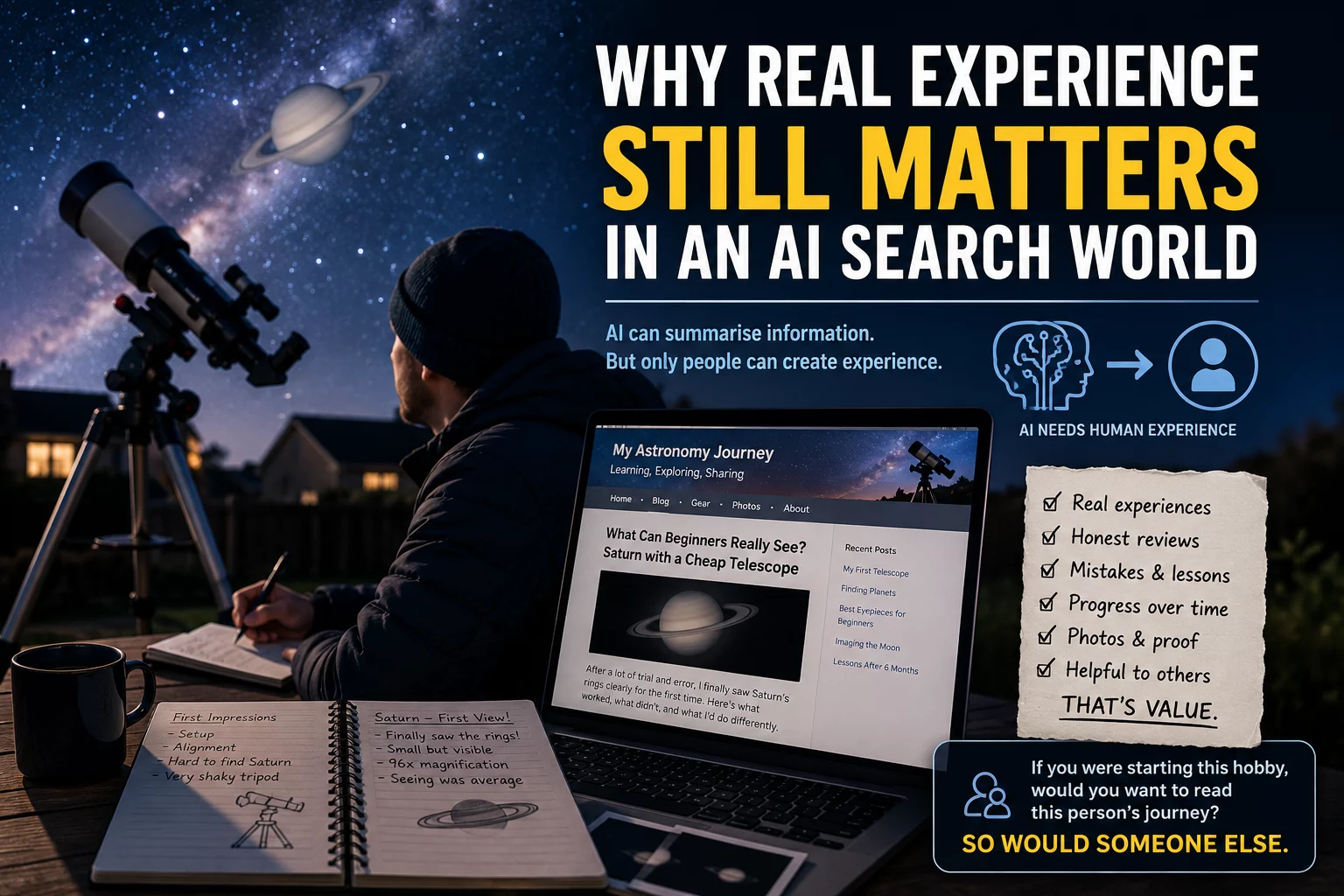
There is a lot of discussion now about AI search, Google AI Mode, technical SEO, structured content, crawlability, schema, query fan-out, internal links, headings, entities and all the other signals that might help a website be understood.
Those things do matter.
A website still needs to be accessible. Search engines need to be able to crawl it. Pages need clear titles, useful headings, relevant images, sensible internal links and a structure that helps both humans and machines understand what the page is about.
But there is a bigger point that should not be lost.
A website still needs to contain something worth finding.
And for many hobby websites, that “something” is real human experience.
A Simple AI Mode Test
I recently tested a query around beginner astronomy:
Can beginners see Saturn’s rings with a cheap telescope?
That is a brilliant example of a hobby query because it looks simple, but it is not really asking for a textbook answer.
The person asking probably does not just want to know whether Saturn’s rings are theoretically visible.
They want to know what will actually happen if they buy a cheap telescope, take it outside and point it at the sky.
Will they really see the rings?
Will Saturn look anything like the photos online?
Is a cheap telescope good enough?
What magnification do they need?
Will the tripod shake?
What will disappoint them?
What should they avoid buying?
The interesting thing was that Google AI Mode leaned heavily on real-experience sources. It referred to Facebook astronomy groups, Reddit’s r/telescopes, YouTube, Quora and astronomy discussion sources. Those sources were used to explain what beginners can actually expect to see, what cheap telescopes can and cannot do, and why practical issues like magnification and shaky mounts matter.
That matters.
AI Mode did not just need a manufacturer specification sheet.
It did not just need a retailer saying, “This telescope is ideal for beginners.”
It needed people who had actually looked through telescopes.
It needed people who had tried cheap scopes, dealt with poor mounts, managed their expectations, observed Saturn in real conditions and explained what the experience was really like.
AI Can Summarise Experience, But It Cannot Have the Experience
This is the bigger point.
AI can summarise what people have said.
AI can combine ideas from forums, videos, product pages, blogs and discussion threads.
AI can produce a neat answer.
But AI cannot personally buy a beginner telescope, stand in a cold garden, struggle to find Saturn, discover that the tripod shakes every time the focus knob is touched, try a different eyepiece, upgrade to a better scope, take a photo and explain what finally worked.
A human can.
That human experience is the original material.
AI can only synthesise it after someone else has lived it, documented it, photographed it, tested it, explained it or discussed it.
That is why hobby websites still matter.
Imagine a Properly Documented Hobby Website
Now imagine someone starts learning astronomy.
Not as a full-time media company.
Not as a professional publisher.
Just as a real person with a genuine interest.
They spend evenings and weekends learning the hobby. Over 12 months, they write about what they do.
They document their first telescope.
They explain why they chose it.
They show what arrived in the box.
They describe how confusing the instructions were.
They write about their first failed attempt to find Saturn.
They explain what light pollution was like from their garden.
They photograph the Moon.
They compare two eyepieces.
They explain why high magnification claims on cheap telescopes can be misleading.
They write about the first night they finally saw Saturn’s rings.
They show the difference between what beginners expect and what they actually see.
They explain what they would buy differently.
They write about the accessories that helped and the ones that were a waste of money.
They create a simple beginner guide based on what they learned the hard way.
After 12 months, is that just “content”?
I do not think it is.
That is a real resource.
Would Another Beginner Want to Read It?
This is the human test I keep coming back to.
Forget rankings for a moment.
Forget AI citations.
Forget the technical language.
Ask a simple question:
If you were interested in getting into astronomy, would you want to read a website written by someone who had spent the last year learning astronomy from scratch and documenting the whole process?
I think most people would.
You would want to know what telescope they bought.
You would want to know what went wrong.
You would want to see their photos.
You would want to understand what Saturn actually looked like through their scope.
You would want to know whether they regretted buying the first telescope.
You would want to know what finally helped them make progress.
You would want to know what they would recommend to a beginner now.
That is not because the site has discovered a clever SEO trick.
It is because the site contains something genuinely useful.
This Is Stronger Than Generic Content
There is a massive difference between these two articles:
10 Best Beginner Telescopes
and:
I Spent a Year Learning Astronomy From My Garden — Here Is What Actually Helped Me See Saturn’s Rings
The first article might be useful if it is well researched.
But the second article has something much harder to fake.
It has lived experience.
It has progression.
It has mistakes.
It has judgement.
It has context.
It has proof.
It has a person behind it.
That is exactly the kind of content that becomes valuable to another human being.
And in a developing AI search world, that matters more, not less.
Experience Compounds Over Time
One post about seeing Saturn is helpful.
Ten connected posts are better.
Fifty posts built from a year of real experience become something much stronger.
For example, a beginner astronomy site might eventually include:
- My first telescope: what I bought and why
- What I could see on my first night
- Why I struggled to find planets at first
- How I finally found Saturn
- What Saturn’s rings actually looked like
- Why my cheap tripod was a problem
- The eyepiece that made the biggest difference
- What I wish I knew before buying a telescope
- Beginner telescope mistakes I made
- My best photos from the first year
- My beginner astronomy setup after 12 months
- What I would recommend to another beginner now
That is not a random collection of articles.
That is a documented journey.
It is a body of experience.
It is a beginner-friendly resource created by someone who has actually gone through the process.
A forum thread can be useful, but it is often messy.
A Facebook discussion may contain excellent advice, but it can be difficult to follow later.
A Reddit thread may answer one question well, but rarely gives the full journey.
A well-built hobby website can take real experience and organise it clearly.
That is the opportunity.
The Part-Time Website Argument
This is why I still believe part-time, evening and weekend hobby websites can make sense.
Not because ranking is easy.
Not because AI search guarantees traffic.
Not because publishing alone is enough.
But because a person who is genuinely immersed in a hobby can create something that generic content cannot match.
They can document what they are doing.
They can show their progress.
They can explain their mistakes.
They can photograph their results.
They can compare products they actually used.
They can answer the questions they had when they started.
They can build trust with readers who are a few steps behind them.
That is valuable.
And valuable things have a chance of earning attention.
That attention might come from Google.
It might come from AI Mode citations.
It might come from Pinterest.
It might come from YouTube.
It might come from forums.
It might come from Facebook groups.
It might come from returning readers who simply enjoy following the journey.
There is no guaranteed path to ranking.
But there is a very clear path to creating something that deserves to be found.
This Is Not About Gaming AI
The wrong lesson from the Saturn example would be:
“AI Mode cited Reddit and Facebook, so I need to copy Reddit and Facebook.”
That misses the point.
AI Mode leaned on those sources because the query needed real human experience.
It needed people who had actually looked through telescopes, struggled with beginner equipment, managed expectations and explained what they could really see.
The opportunity for a hobby website owner is not to game AI.
It is not to mass-produce generic articles.
It is to create the kind of experience-led resource that genuinely helps someone else make progress.
A good hobby website can say:
“I tried this. Here is what happened. Here is what I learned. Here is what I would do if I were starting again.”
That is powerful because it is human.
The Simple Test
Before writing a hobby post, ask one simple question:
Would this help someone who is genuinely trying to make progress in this hobby?
If the post includes something you actually did, saw, tested, bought, photographed, compared, fixed or learned, then it has a reason to exist.
If it saves the reader time, money, confusion or disappointment, then it has value.
If you would have wanted to read it when you were starting out, then another beginner probably would too.
That is the real foundation of a part-time hobby website.
Not tricks.
Not shortcuts.
Not pretending there is a guaranteed ranking formula.
Just a serious effort to document a real hobby in a way that helps other people.
Final Thought
A part-time hobby website should not be dismissed as “just another small blog.”
If someone spends 12 months properly documenting a hobby, they can create a significant number of experience-led posts.
That can become a genuine resource.
A human resource.
A practical resource.
A resource another beginner may want to follow, bookmark, share, return to and trust.
In an AI world, that may matter more than ever.
Because AI still needs real human experience to work from.
And humans still want to learn from other humans who have actually done the thing.