
Google AI Mode is new, powerful and slightly confusing.
That makes it a perfect subject for a small experiment.
If someone wants to build a useful online resource explaining Google AI Mode, could they simply ask Google AI Mode what that resource should include?
That sounds circular.
But it is also very interesting.
So I tested it.
I asked Google AI Mode how it would build a complete online resource for people wanting to understand Google AI Mode.
The answer was impressive. It gave me a full structure for a website. It suggested user guides, creator guides, prompting advice, query fan-out explanations, interactive tools, safety warnings and update tracking.
At first glance, it looked like a very sensible blueprint.
But then I looked more closely at the citations.
That is where the real lesson appeared.
The first prompt
The first prompt was broad.
I asked Google AI Mode to suggest a complete online resource for people wanting to understand AI Mode in Google.
The answer suggested a site structure with sections such as:
- a plain English guide to AI Mode;
- a user track for ordinary searchers;
- a creator track for website owners;
- a section explaining query fan-out;
- prompting examples;
- interactive tools;
- a rollout tracker;
- safety warnings;
- advice about appearing in AI-powered search results.
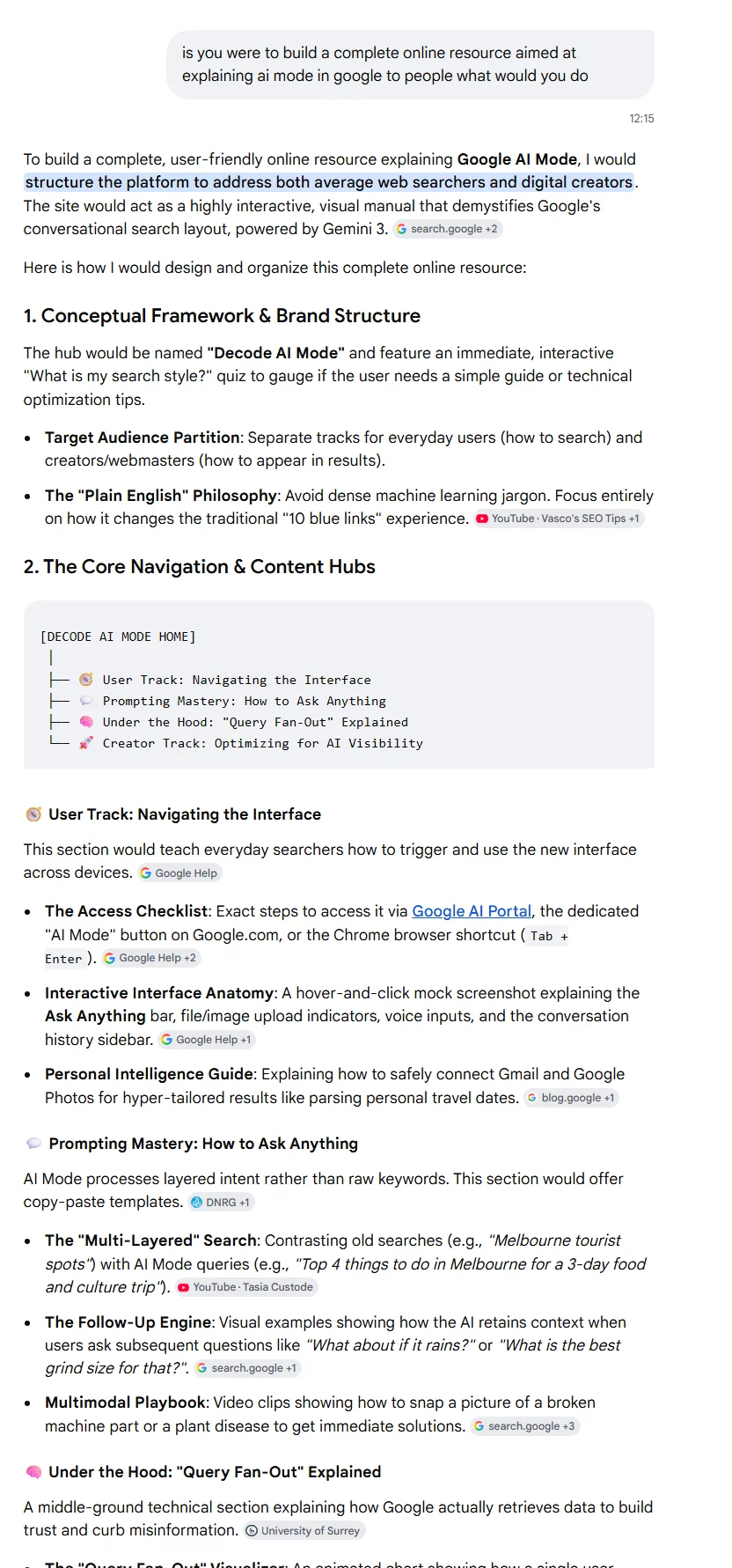
As a planning tool, this was useful.
It gave a map of the topic.
It showed the kinds of areas AI Mode thought belonged inside a complete resource about itself.
But the question was not just:
“Was the answer useful?”
The better question was:
Where did the answer come from?
Looking at the sources
The AI Mode answer included 36 citations.
I separated those citations into two broad groups:
- Official Google sources.
- Non-Google sources, commentary, media, SEO blogs, community sources and social platforms.
For this exercise, I counted domains such as search.google, support.google.com, blog.google, developers.google.com and business.google.com as official Google sources.
I did not count YouTube links as official Google guidance. YouTube is owned by Google, but a YouTube URL on its own does not prove that the content is official Google documentation.
Source mix from the first prompt
Broad prompt result
- Total citations: 36
- Official Google sources: 12
- Wider web sources: 24
- Official source share: 33.3%
That was the first important finding.
Only around one third of the citations were clearly official Google sources.
Around two thirds came from the wider web.
The wider web sources used in the first answer
The non-Google sources used in the first AI Mode answer included:
grandcrudigital.com.au, extremetech.com, youtube.com, bbc.co.uk, digitalnrg.co.uk, txwes.pressbooks.pub, ncl.ac.uk, standard.net, surrey.ac.uk, bristolcreativeindustries.com, wired.com, finseo.ai, nogood.io, imarketing.my, vformation.co.uk, hackernoon.com, neilpatel.com, bigeyeagency.com, reddit.com, radicalcandor.com, stackmatix.com and facebook.com.
This is not a criticism of those sources.
Some of them may be useful. Some may contain good commentary. Some may include practical experience. Some may be reporting real developments. Some may offer sensible interpretation.
The point is simply that they are not all official Google guidance.
That matters.
A reader could easily look at a polished AI Mode answer about Google AI Mode and assume:
“This is what Google says.”
But that is not quite right.
The answer was a synthesis of official Google material and wider web commentary.
That is both the strength and the weakness of AI search.
It is a strength because AI Mode can quickly bring together a wide view of a subject.
It is a weakness because the final answer can sound more settled than the underlying source mix really is.
What the first test showed
The first test showed that AI Mode can be a useful planning assistant.
If you ask it how to build a complete resource, it can give you a strong outline. It can identify subtopics. It can show what different audiences may need. It can suggest sections, tools and examples.
That is valuable.
But it also showed that the answer should not be treated as pure official guidance.
It was not simply Google explaining Google.
It was Google AI Mode producing an answer from Google sources, SEO websites, media sites, universities, social platforms and commentary.
That does not make the answer bad.
It does mean the user needs to understand what kind of answer they are reading.
The second prompt
For the second test, I made the prompt stricter.
I asked:
“Build me a complete online resource explaining Google AI Mode, but only use official Google sources. Do not use SEO blogs, news articles, Reddit, Facebook, YouTube videos, agency websites or general commentary. If a claim is not supported by an official Google source, say that it is not confirmed by Google.”
This was a much more controlled prompt.
The aim was simple.
Could I force the answer to rely only on official Google sources?
The result was very interesting.
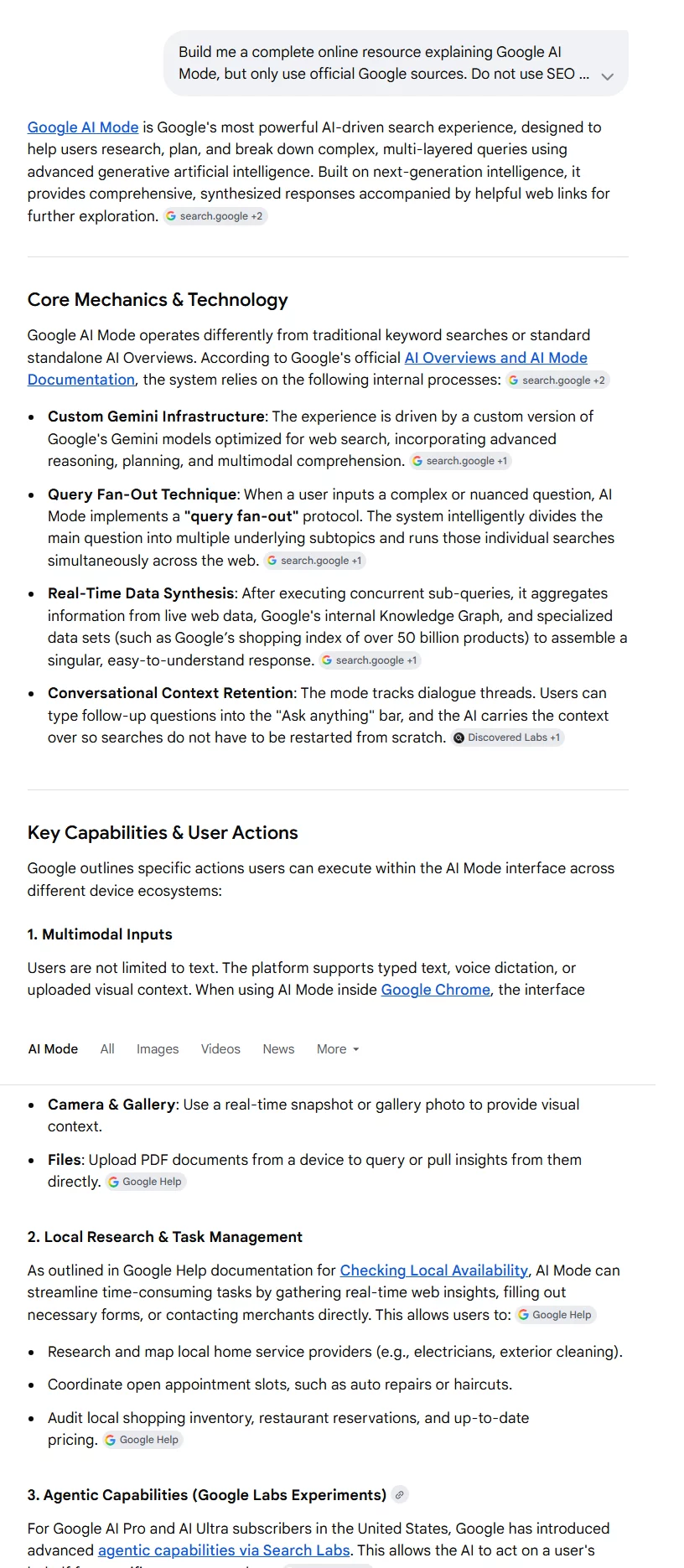
The answer did become more Google-focused.
But it still did not fully follow the instruction.
Source mix from the second prompt
Official-source-only prompt result
- Total citations: 23
- Official Google sources: 16
- Non-Google or disallowed sources: 7
- Official source share: 69.6%
So the second prompt made a big difference.
It moved the source mix from around one third official Google sources to around 70% official Google sources.
That is a clear improvement.
But it did not produce a completely clean official-only answer.
Comparing the two tests
| Prompt type | Official source share |
|---|---|
| Broad prompt | 33.3% |
| Official-source-only prompt | 69.6% |
This small comparison is the heart of the experiment.
The stricter prompt improved the source quality.
But it did not fully control the answer.
The non-Google or disallowed sources in the second test
Even after being told to use only official Google sources, AI Mode still cited some sources that were either non-Google sources or specifically disallowed by the prompt.
Here are the key examples.
youtube.com
Citations: 7 and 16
This matters because the prompt specifically said not to use YouTube videos.
discoveredlabs.com
Citation: 9
This appears to be a third-party commentary source.
thatware.co
Citation: 18
This appears to be an SEO or agency-style source.
ipullrank.com
Citation: 20
This is search industry commentary.
ethanlazuk.com
Citation: 22
This is independent commentary.
seroundtable.com
Citation: 23
This is search industry news and commentary.
Again, this is not source-shaming.
The point is not that these sources are bad.
The point is that the answer did not fully obey the instruction.
That is a very useful finding.
The second answer was harder to read
There was another difference too.
The second answer was more technical.
It used phrases such as:
- custom Gemini infrastructure;
- multimodal comprehension;
- real-time data synthesis;
- agentic capabilities;
- personal intelligence integrations;
- standard infrastructure rather than isolated systems.
That kind of wording may be accurate or partly accurate, but it is not especially easy for an ordinary reader.
That creates another important lesson.
Official sources may be more reliable, but they are not always the easiest to understand.
The first AI Mode answer was broader and more reader-friendly.
The second answer was more official-source-focused, but also more technical and harder to follow.
That leaves a gap.
And that gap is where a useful website owner can add real value.
The useful role for a website owner
A helpful website does not need to copy Google’s documentation.
It can translate it.
The job is not simply to say:
“Here is what Google says.”
The better job is:
“Here is what Google says, here is what it means in plain English, here is what I tested, here are the screenshots, here are the limitations, and here is what I would do next.”
That is where human value appears.
AI Mode can create a map.
But a website owner can walk the route, take notes, check the signs, and explain the journey to someone else.
What this experiment says about AI answers generally
This experiment is about Google AI Mode, but the wider point applies to AI answers generally.
AI answers often look complete.
They have headings.
They have bullet points.
They have confident wording.
They may even have citations.
That makes them feel authoritative.
But a polished answer is not the same as a verified answer.
In the first test, the answer looked like a complete guide to Google AI Mode. But only around one third of the citations were official Google sources.
In the second test, I specifically asked for official Google sources only. The answer improved, but around 30% of the citations still came from sources that were not official Google documentation or were specifically disallowed by the prompt.
That is the lesson.
You cannot judge an AI answer only by how well-written it looks.
You also need to look at the source trail.
The practical workflow I would use next time
This experiment suggests a better way to use AI Mode for research.
Step 1: Ask the broad question
Start with a wide prompt.
For example:
“Build me a complete online resource explaining Google AI Mode.”
This gives you the broad map.
It shows the topic clusters, possible audience groups, useful sections and common angles.
Step 2: Ask for official sources only
Then ask a stricter version.
For example:
“Build me a complete online resource explaining Google AI Mode, but only use official Google sources. Do not use SEO blogs, news articles, Reddit, Facebook, YouTube videos, agency websites or general commentary. If a claim is not supported by an official Google source, say that it is not confirmed by Google.”
This gives you a cleaner version.
It should be closer to confirmed guidance.
Step 3: Compare the answers
Look at what changed.
Which sections appeared in both answers?
Which claims disappeared when you restricted the sources?
Which claims became more cautious?
Which claims still used non-official sources?
That comparison is extremely useful.
Step 4: Check the citations
Do not just read the answer.
Inspect the sources.
Ask:
- Are these official sources?
- Are they expert sources?
- Are they news reports?
- Are they SEO opinion pieces?
- Are they community discussions?
- Are they sales pages?
- Are they affiliate pages?
- Are they out of date?
- Do they actually support the claim being made?
The citations are not decoration.
They are part of the answer.
The main conclusion
My conclusion from this experiment is not that AI Mode is bad.
The opposite is true.
AI Mode was very useful.
It gave me a strong map of what a complete resource might include. It helped organise a complicated topic quickly. It showed the main areas a reader might need to understand.
But it also showed why AI answers need checking.
The first answer was broad and useful, but only around 33% of the citations were official Google sources.
The second answer was more controlled, but even after I asked for official Google sources only, it still included some non-Google or disallowed sources.
So the sensible conclusion is this:
AI Mode is excellent for creating the first map of a topic.
But the map is not the finished journey.
If the answer matters, check the sources.
If the topic is technical, check official guidance.
If the topic affects your website, your business, your money, your health, your legal position or any important decision, do not rely on the polished summary alone.
Use AI as a research assistant.
Use the citations as evidence.
Use your own judgement as the final filter.
The simple takeaway
Ask AI for the map.
Then check where the map came from.
That may be the most important skill in using AI search well.