
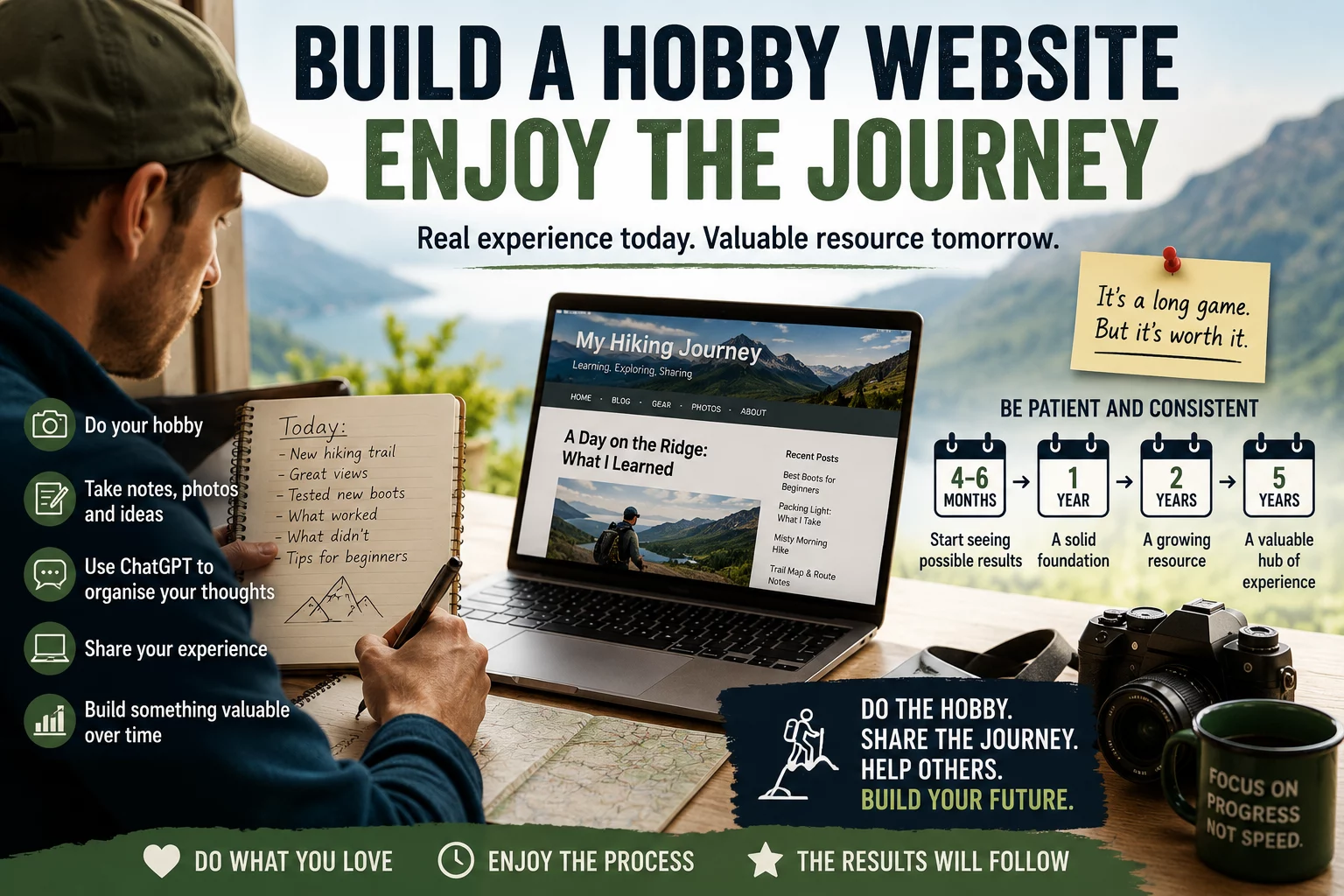
One of the biggest worries people have when thinking about starting a side hustle or part-time website is time.
How long will it take?
How much work will it need?
When will it start making money?
Those are fair questions, but they need realistic answers.
You are probably not going to start a hobby website and be earning a fortune within a few months. You may not earn anything at all in the early stages. The internet is huge, competitive and full of websites covering almost every subject imaginable.
But those websites do not cover your experience.
They do not cover what you tried, what you learned, what went wrong, what surprised you, what you bought, what you regretted, what improved, or what you would now recommend to someone starting where you started.
That is the opportunity.
Document the Hobby, Do Not Force the Content
A good hobby website should not begin with the question:
“What can I write about today?”
It should begin with the hobby itself.
If you go somewhere, write about it.
If you buy new equipment, write about it.
If something breaks, write about it.
If you make progress, write about it.
If you waste money, write about it.
If you finally understand something that confused you at the start, write about it.
The content comes from doing the hobby.
That is what makes it natural.
You are not sitting there trying to invent articles from nothing. You are documenting a journey that is already happening.
ChatGPT Can Help Organise Your Thoughts
You do not need to be a polished writer before you begin.
You can scribble rough thoughts into a note on your phone.
You can record a voice note after doing something connected with your hobby.
You can write messy bullet points about what happened.
Then you can ask ChatGPT to organise those thoughts into a clearer post.
That does not remove your experience. It helps present it better.
The value is still coming from you.
ChatGPT can tidy the structure, improve the flow and make the post easier to read, but it cannot replace the fact that you actually did the thing.
Give It Time
A hobby website should be seen as a long-term project.
It is sensible to give yourself at least four to six months before expecting any income at all, and even then, nothing is guaranteed.
The better mindset is to enjoy the process and look further ahead.
After six months, you may have a useful collection of posts.
After a year, you may have documented a real journey.
After 18 months, your site may include dozens of practical lessons, reviews, mistakes, comparisons and personal observations.
After two years, it could become a genuinely useful resource for someone entering the same hobby.
After five years, imagine the depth of experience you could have online.
That is the real power of this approach.
Build Something You Would Want to Read
The simple test is this:
If you were starting your hobby today, would you want to read a site written by someone a few steps ahead of you?
Would you want to know what they bought first?
Would you want to know what they got wrong?
Would you want to see their photos, examples, notes and progress?
Would you want their honest advice before spending your own money?
Most people would.
That is why documenting your own experience matters.
Enjoy the Journey
A hobby website should not become a punishment.
It should not feel like homework.
It should be a natural extension of something you already enjoy.
You do the hobby.
You notice things.
You learn.
You take photos.
You make notes.
You share what happened.
Over time, those small posts build into something much bigger.
The income may come later, through affiliate links, recommendations, products, emails, services or other opportunities. But the foundation is not money first.
The foundation is enjoyment, consistency and useful experience.
Final Thought
Starting a hobby website is not a quick route to easy money.
But if you enjoy the subject and are willing to document your progress honestly, you can build something valuable over time.
You are not trying to cover the whole internet.
You are building a record of your own journey.
And after months or years of doing that, you may have created a resource that another human being would genuinely want to read.