
Key points:
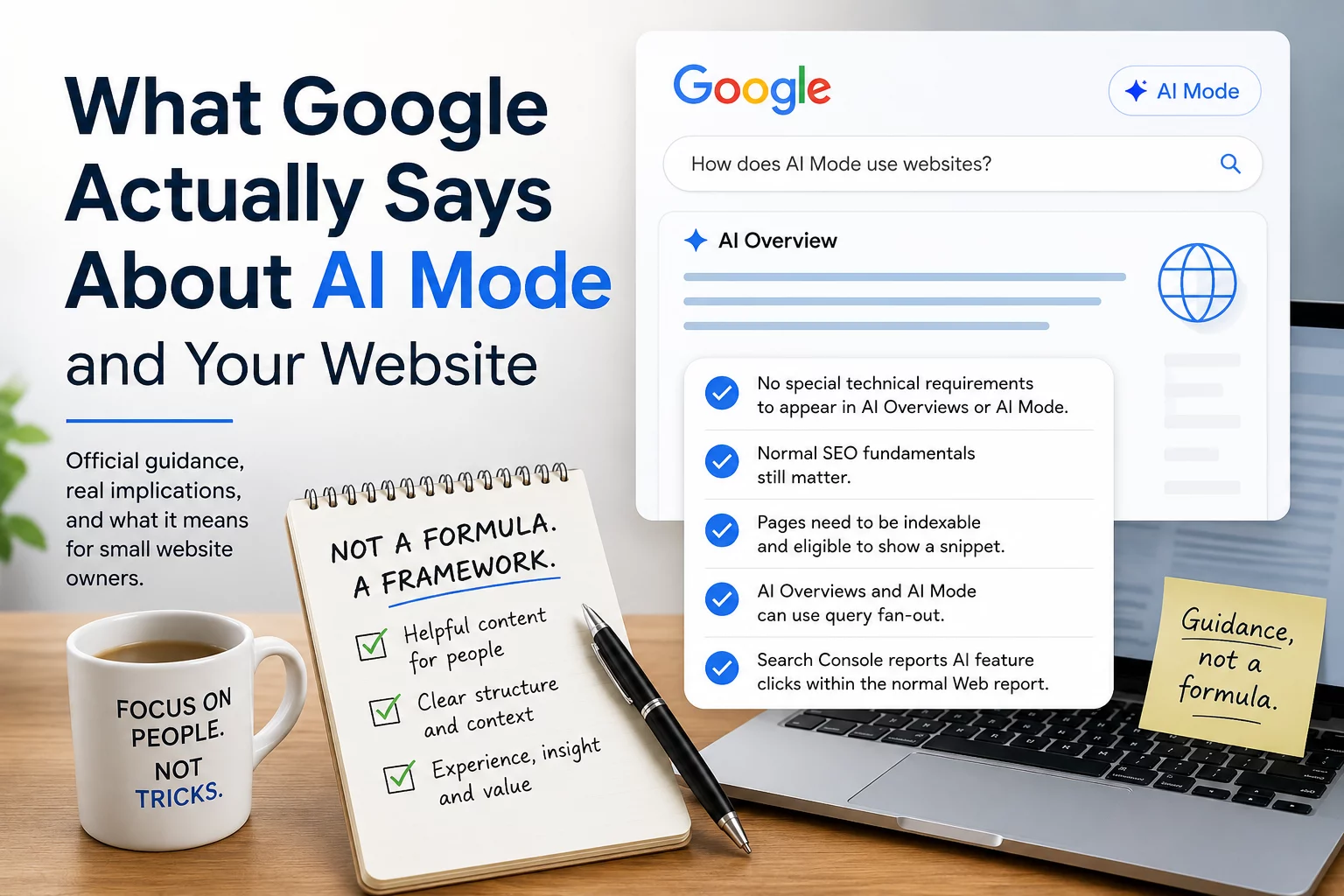
Google’s guidance on AI Mode does not suggest that website owners need a completely new SEO formula. Pages still need to be crawlable, indexable, clear and useful, but there is no special AI Mode file, markup or magic technical switch.
The bigger lesson is that guidance should not become a mechanical checklist. Keywords, headings, internal links and anchor text can all help readers and search engines, but they become a problem when they are used mainly to manipulate rankings.
AI Mode also changes the question small website owners should ask. It is no longer just, “How do I rank for this keyword?” A better question is, “What can I add that is still useful after AI has summarised the basics?”
That might mean first-hand experience, screenshots, examples, comparisons, checklists, tools, templates or practical resources that help the reader make progress.
The opportunity is not to find a new formula. The opportunity is to become more useful than the formula.
Whenever Google changes search, website owners naturally start looking for the new method.
What should we do now?
What should we change?
What should we add to our pages?
How do we get mentioned, cited, shown or clicked?
That is understandable. If you run a website, you need to pay attention to how search is changing. But there is also a danger here, and I think it is the same danger that has existed throughout the history of SEO.
Guidance can quickly turn into formula.
A sensible idea becomes a mechanical method.
A useful signal becomes something people try to exploit.
That is why I wanted to look at what Google has actually said about AI Mode and generative AI features in Search, rather than jumping straight into “AI Mode SEO tricks”.
Because if we are not careful, we will repeat the same mistake again.
The old problem: guidance became a formula
For years, website owners were taught certain SEO basics.
Put your main phrase in the title.
Use a clear H1.
Mention the topic early.
Use descriptive headings.
Use internal links.
Use descriptive anchor text.
None of that was bad advice.
In fact, most of it is still sensible. A reader should be able to understand what a page is about. A search engine crawler should also be able to understand the subject of the page quickly.
The problem was not the guidance itself.
The problem was what people did with it.
Instead of using keywords naturally, many people turned the advice into a formula. They put the exact phrase in the title, the first paragraph, several headings, the conclusion and anywhere else they thought might help.
That may have signalled the topic, but it often made the content worse.
The page stopped sounding like one person helping another person. It started sounding like a page built to satisfy a checklist.
Google’s own helpful content guidance makes the distinction very clearly. It says people-first content is content created primarily for people, not content created to manipulate search engine rankings.
That distinction matters even more now.
The friend test
One way I think about this is very simple.
If I was explaining a topic to a friend, would I deliberately repeat the exact phrase “best telescope for a beginner” four times in the first three minutes of the conversation?
Of course not.
I might say the phrase once because that is the topic. Then I would naturally talk about budget, what they want to see, whether they are interested in the Moon or planets, whether a reflector or refractor is easier, what mistakes beginners make, and what I would personally choose.
That is how useful content should feel.
The page still needs structure. The title should make sense. The headings should help. The introduction should confirm what the page is about. Internal links should connect related resources.
But structure is not the same as repetition.
The aim is not to force a keyword into the page as many times as possible.
The aim is to make the topic clear enough for search engines and useful enough for real people.
The anchor text example
Anchor text is another example of the same problem.
Descriptive anchor text is useful. If I link to a page using words that explain what the page is about, that helps the reader. It also helps Google understand the destination page. Google’s own link guidance says link text helps users and Google make sense of the content being linked to.
But that useful signal can be abused.
If lots of unrelated websites all link to the same page using exactly the same commercial anchor text, that does not look like natural recommendation. It looks like someone is trying to control the signal.
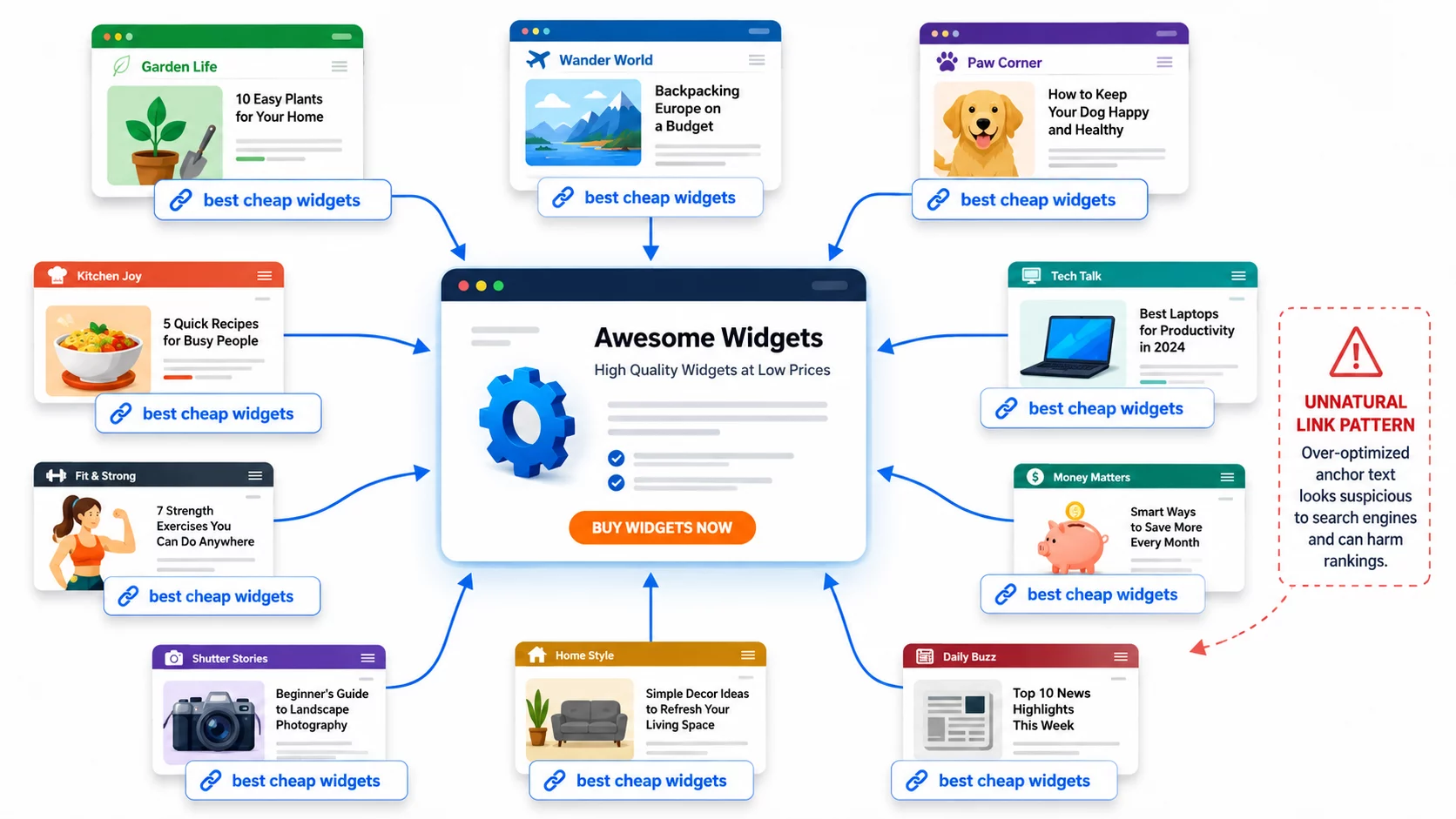
Natural links vary.
One person might link with “this beginner telescope guide”.
Another might write “a useful article for new stargazers”.
Someone else might say “John’s page about choosing your first telescope”.
That variation is normal because real people write in different ways.
When everything looks too perfect and too consistent, it can become a sign of manipulation.
Google’s spam policies specifically warn against links intended to manipulate rankings. They also say spammy behaviours can cause pages or entire sites to rank lower or be omitted from Search.
That is the wider lesson.
Signals are not bad.
Manufacturing signals purely to rank is the problem.
Why Google updates happen
It is easy for website owners to think about Google updates only from the publisher’s point of view.
A site loses traffic.
Rankings change.
A method stops working.
That is frustrating, especially if someone has spent years building a site.
But Google is not primarily serving website owners. Google is serving people who use Google to search for things.
If those people search for help and keep landing on pages that are thin, repetitive, unhelpful or built mainly to exploit ranking signals, Google has a problem.
The searcher is not happy.
The result did not satisfy the task.
The trust in Google’s results is reduced.
So Google has to keep adjusting its systems.
This is why I think it is important to understand the pattern. A technique may work for a while. Lots of people copy it. The web fills up with formulaic pages. Search quality suffers. Then Google has to find ways to reduce the impact of that behaviour.
That is not new.
What is new is that AI Mode gives people a fresh set of ideas to potentially turn into formulas.
What Google says about AI Mode and technical requirements
Google’s guidance on AI features is surprisingly straightforward.
To be eligible to appear as a supporting link in AI Overviews or AI Mode, a page needs to be indexed and eligible to appear in Google Search with a snippet. Google also says there are no additional technical requirements for appearing in AI Overviews or AI Mode.
That is important.
It means there is not currently a special “AI Mode file” or magic technical switch that small website owners need to add.
Google’s generative AI optimisation guide says the same basic thing: SEO best practices continue to matter because Google’s generative AI features are rooted in its core Search ranking and quality systems.
My interpretation is this:
We do not need to panic and invent a completely new playbook.
But that does not mean nothing has changed.
It means the foundation is still the foundation.
Your pages still need to be crawlable, indexable, understandable and useful.
But being technically eligible is only the starting point.
It does not mean the page will be selected, cited, clicked or valued by a reader.
Eligibility is not the same as usefulness
This is where I think small website owners need to be careful.
It is possible to have a page that is technically fine.
It can have a clear title.
It can have headings.
It can be indexed.
It can follow the basic rules.
But if the page only repeats information that already exists everywhere else, what reason does a reader have to click it after AI Mode has already summarised the basics?
That is the real issue.
The question is not only:
“Can Google understand my page?”
The better question is:
“Does this page add anything worth discovering?”
That might mean:
- first-hand experience;
- original photos;
- a real test;
- a worked example;
- a comparison based on actual use;
- a checklist;
- a template;
- a calculator;
- a small tool;
- a clear decision path;
- a personal observation;
- a practical resource that helps the user complete the task.
This is where I think the conversation about AI Mode gets interesting.
The old question was often, “How do I rank for this keyword?”
The new question may be, “What can I provide that is still useful after AI has explained the easy part?”
What Google says about query fan-out
Google says AI Overviews and AI Mode may use a technique called query fan-out. This means Google can issue multiple related searches across subtopics and data sources to help develop a response.
That is a very important idea for website owners.
A person may type one search, but AI Mode may explore several connected angles before presenting an answer.
For example, a simple search about a beginner telescope might involve related questions around:
- budget;
- what the user wants to see;
- Moon viewing;
- planets;
- reflector vs refractor;
- telescope mounts;
- common beginner mistakes;
- whether binoculars are a better starting point;
- what accessories are actually needed.
This can be very useful for content planning.
But again, there is a danger.
The wrong lesson would be:
“Find every query fan-out term, turn each one into a heading, generate sections around them, and publish lots of similar articles.”
That is just the old formulaic behaviour in a new form.
The better lesson is:
“Use query fan-out to understand the shape of the user’s problem.”
What are they really trying to do?
What might they need to know next?
Where are they likely to get stuck?
What decision are they trying to make?
What would help them move forward?
Query fan-out should guide understanding.
It should not become a content factory.
What Google says you do not need to do
Google’s generative AI optimisation guide also pushes back against some of the new AI search myths.
For example, Google says website owners do not need to create special machine-readable files, AI text files, special markup or Markdown to appear in Google Search’s generative AI features.
That does not mean technical SEO is irrelevant.
It means we should be careful about chasing every new shortcut that appears.
Whenever search changes, new terms appear. AEO. GEO. AI visibility. AI citation strategies. AI Mode optimisation.
Some of those discussions may contain useful ideas.
But the risk is that small website owners are encouraged to chase another formula before they have built something genuinely helpful.
Google’s own guide says that from Google Search’s perspective, optimising for generative AI search is still optimising for the search experience.
That is an important sentence.
It points us back to the reader.
Not to tricks.
Not to artificial mentions.
Not to special files.
Not to mechanical rewriting.
To the search experience.
What this changes for my own site
The main lesson I take from Google’s guidance is not that I need a secret AI Mode tactic.
It is that I need to be more deliberate about usefulness.
On my own site, that means I am thinking less about isolated blog posts and more about connected resources.
For example:
- Can a reader follow a clear path through related posts?
- Does a category page work like a useful hub rather than just a blog archive?
- Does each article add a new point, or am I repeating the same idea?
- Have I added my own thinking, testing or observation?
- Can I include screenshots, examples, checklists or practical steps?
- Is there a point where AI Mode can explain the topic but cannot complete the task?
- Could I build the missing resource that helps the reader move forward?
That is a different way of thinking.
It is not “ignore SEO”.
It is “use SEO structure to make a genuinely useful resource easier to understand”.
There is a big difference.
Search Console and AI Mode measurement
Measurement is also changing.
Google’s AI feature guidance says traffic from AI features is included in Search Console reporting under the Web search type.
Google has also announced Search Generative AI performance reports in Search Console, designed to give dedicated views of impressions within generative AI features such as AI Overviews and AI Mode. At the time of that announcement, these reports were being introduced as a new feature rather than something every small site owner should assume they already have.
So I would be careful about drawing big conclusions from limited data.
Search Console may show impressions, clicks and queries, but it may not always explain exactly how AI Mode treated a particular search.
That is why I think manual testing still matters.
If you run a small website, you can keep your own simple AI Mode test log:
- What query did I test?
- What did AI Mode answer well?
- What sources did it show?
- What did it miss?
- Could the user complete the task inside AI Mode?
- Where would a website still help?
- What type of resource could fill that gap?
That kind of testing gives you practical insight.
It also keeps you focused on the user’s task, not just on rankings.
A practical checklist before publishing
Before publishing content in this new AI search environment, I think these are useful questions to ask:
- Is the topic clear from the title and opening?
- Would a human reader immediately understand who this page is for?
- Am I using natural language, or am I forcing phrases into the page?
- Would I explain this topic this way to a friend?
- Have I added anything from my own thinking, testing or experience?
- Does the page help the reader understand, decide or do something?
- Could AI Mode summarise the whole page without the user needing to click?
- If so, what extra value does the page provide?
- Does this page connect clearly to other useful pages on my site?
- Am I using guidance as a framework, or am I turning it into a formula?
That last question may be the most important one.
Because the danger is not guidance.
The danger is when guidance becomes a mechanical method used mainly to manipulate rankings.
The real lesson from Google’s AI Mode guidance
My reading of Google’s guidance is not that old SEO is dead.
It is also not that AI Mode requires a brand-new secret formula.
The real lesson is more balanced than that.
Clear structure still matters.
Helpful titles still matter.
Crawlability still matters.
Internal links still matter.
Descriptive anchor text still matters.
But all of those things should support the reader’s experience. They should not replace it.
The same applies to AI Mode.
Query fan-out is useful, but it should help us understand the user’s journey.
It should not become a machine for creating thin articles.
AI Mode citations may matter, but we should not build pages purely to chase citations.
Search Console data matters, but we should not obsess over every tiny movement before understanding the bigger picture.
The direction of travel seems clear enough.
Formulaic content is becoming weaker.
Useful resources are becoming more important.
And for small website owners, that may actually be encouraging.
Because a small site may not be able to produce content at the scale of a large publisher. But it can still produce something specific, practical, honest and genuinely useful.
A real example.
A real test.
A clear explanation.
A comparison based on experience.
A tool.
A checklist.
A hub that helps someone make progress.
That is where I think the opportunity is.
Not in finding a new formula.
In becoming more useful than the formula.