
There is a big difference between explaining an idea and showing it.
I could write a perfectly competent article explaining what “consensus opinion” means.
I could say that consensus opinion is the set of common ideas that appears again and again across search results, AI summaries, forum discussions and mainstream articles.
That would be accurate.
But it would also be fairly ordinary.
So instead of only explaining the idea, I decided to test it.
I searched Google for a real phrase and looked at what ideas appeared across the search results.
The phrase I tested was:
“how to stop condensation on windows overnight”
This was a useful test phrase because it is practical, common and likely to produce a mixture of AI advice, forum discussion, business content, retail content and general information.
Quick Overview Of The Test
Date tested: 26 June 2026
Search phrase tested: “how to stop condensation on windows overnight”
Results reviewed:
- Google AI Overview
- Google “Forums and discussions” Reddit result
- Organic result 1: Todi & Boys Joinery
- Organic result 2: Screwfix
- Organic result 3: EnviroVent
- Organic result 4: BBC Weather
Main conclusion:
The same core ideas appeared again and again.
The consensus was clear:
Condensation happens when moist indoor air meets cold glass. To reduce it, you need to reduce indoor humidity, improve ventilation, keep the glass warmer, remove moisture sources and use tools such as dehumidifiers where needed.
But the most interesting finding was not just that the same ideas repeated.
The interesting finding was that each result reshaped the same consensus through its own lens.
The AI Overview compressed the consensus.
Reddit debated it.
Todi & Boys turned it into a window-repair article.
Screwfix turned it into a tools and materials guide.
EnviroVent turned it into a whole-house ventilation problem.
BBC Weather turned it into a science explainer.
That is what consensus content looks like in the wild.
Why I Ran This Test
I have been thinking a lot about four connected ideas:
- consensus opinion
- commodity content
- information gain
- query fan-out
These ideas are becoming more important because AI can now summarise ordinary information very quickly.
If an article only repeats the common advice already found everywhere else, it becomes easy for AI to compress.
That does not mean the article is wrong.
It may be perfectly competent.
But it may not add much.
That is what I mean by commodity content.
Commodity content is content that could have been written by almost anyone. It follows the same broad structure, includes the same tips and reaches the same safe conclusion.
So the question becomes:
How do you create content that adds something new?
My answer is simple:
You have to do something.
Test something.
Compare something.
Document something.
Show what happened.
That is where information gain comes from.
The Method
This was a simple test.
I searched the phrase:
“how to stop condensation on windows overnight”
I then reviewed the AI Overview, the forum/discussion result and four organic results.
For each result, I looked for the main ideas being repeated.
I was not trying to decide which result was “best”.
I was trying to see what ideas appeared across the SERP.
The question was:
Do the same ideas keep appearing, and if so, what does that tell us about consensus content?
The Main Ideas Found
To help keep the table readable on mobile, I have used short source labels.
AIO = Google AI Overview
Forum = Reddit discussion
O1 = Todi & Boys Joinery
O2 = Screwfix
O3 = EnviroVent
O4 = BBC Weather
| Idea found | Where it appeared | What this shows |
|---|---|---|
| Reduce indoor humidity | AIO, Forum, O1, O2, O3, O4 | This is the core consensus idea. |
| Improve ventilation | AIO, Forum, O1, O2, O3, O4 | Almost every source agrees that moisture needs a way out. |
| Open windows or use vents | AIO, Forum, O1, O2, O3, O4 | Common advice, but the forum discussion showed more debate around timing, heat loss and damp outdoor air. |
| Use extractor fans | AIO, Forum, O1, O2, O4 | Especially linked to bathrooms and kitchens. |
| Use a dehumidifier | AIO, Forum, O1, O2, O4 | Very common advice, but Reddit added practical concerns about cost, noise and real use. |
| Stop drying clothes indoors | AIO, Forum, O1, O2, O3, O4 | A repeated source-of-moisture point. |
| Keep curtains or blinds open | AIO, Forum, O1, O2, O4 | Common advice, but also one of the more debatable points. |
| Keep the room or glass warmer | AIO, Forum, O1, O2, O3, O4 | This links to the science of dew point and cold glass. |
| Improve insulation or glazing | AIO, Forum, O1, O2, O4 | Appears often, but each source handles it differently. |
| Seal windows or fix failed glazing | AIO, Forum, O1, O2 | Common in window and repair-focused results. |
| Wipe water away or use a window vac | Forum, O2, O4 | Less central in the AI Overview, but very practical in human discussion. |
| PIV or MVHR ventilation systems | Forum, O3 | Strong in Reddit and EnviroVent, weak or missing elsewhere. |
| Humidity monitoring | Forum | A strong real-world detail from discussion, but not prominent in the main advice articles. |
| Inside vs outside condensation | O2, O4 | BBC and Screwfix added useful nuance: outside condensation can be normal. |
| Damp, mould and health risk | Forum, O1, O2, O3, O4 | Common consequence, but EnviroVent pushed this angle most strongly. |
What The Table Shows
The consensus is very clear.
Most results are not saying completely different things.
They are circling around the same central explanation:
There is too much moisture in the air, the glass is too cold, or the room is not ventilated well enough.
That is the base layer of the SERP.
But the table also shows something more interesting.
Different types of result place different emphasis on the same problem.
How Each Source Framed The Same Consensus
| Source | How it framed the answer |
|---|---|
| Google AI Overview | Compressed the broad consensus into a quick summary. |
| Reddit forum result | Added messy human experience, disagreement, costs, exceptions and practical trade-offs. |
| Todi & Boys Joinery | Turned the issue into a window, repair, sealing and joinery problem. |
| Screwfix | Turned the issue into a tools, materials, dehumidifier, mould and ventilation guide. |
| EnviroVent | Framed condensation as a whole-house ventilation issue, especially around PIV and MVHR systems. |
| BBC Weather | Explained the science, especially humidity, temperature and dew point. |
This is the important point.
Consensus opinion is not just a list of repeated ideas.
It is also shaped by the source presenting it.
A window company naturally talks about windows, seals and repairs.
A retailer naturally talks about products and tools.
A ventilation company naturally talks about ventilation systems.
A weather site naturally explains the science.
A forum naturally brings out real-life problems, disagreements and practical workarounds.
The same broad answer is being filtered through different lenses.
The AI Overview Was The Compressed Consensus
The AI Overview did exactly what you would expect.
It pulled together the main advice:
- reduce indoor humidity
- increase ventilation
- use trickle vents
- use a dehumidifier
- keep curtains open
- stop drying clothes indoors
- maintain room temperature
- improve insulation
- seal windows properly
That is a competent answer.
For many readers, it may be enough.
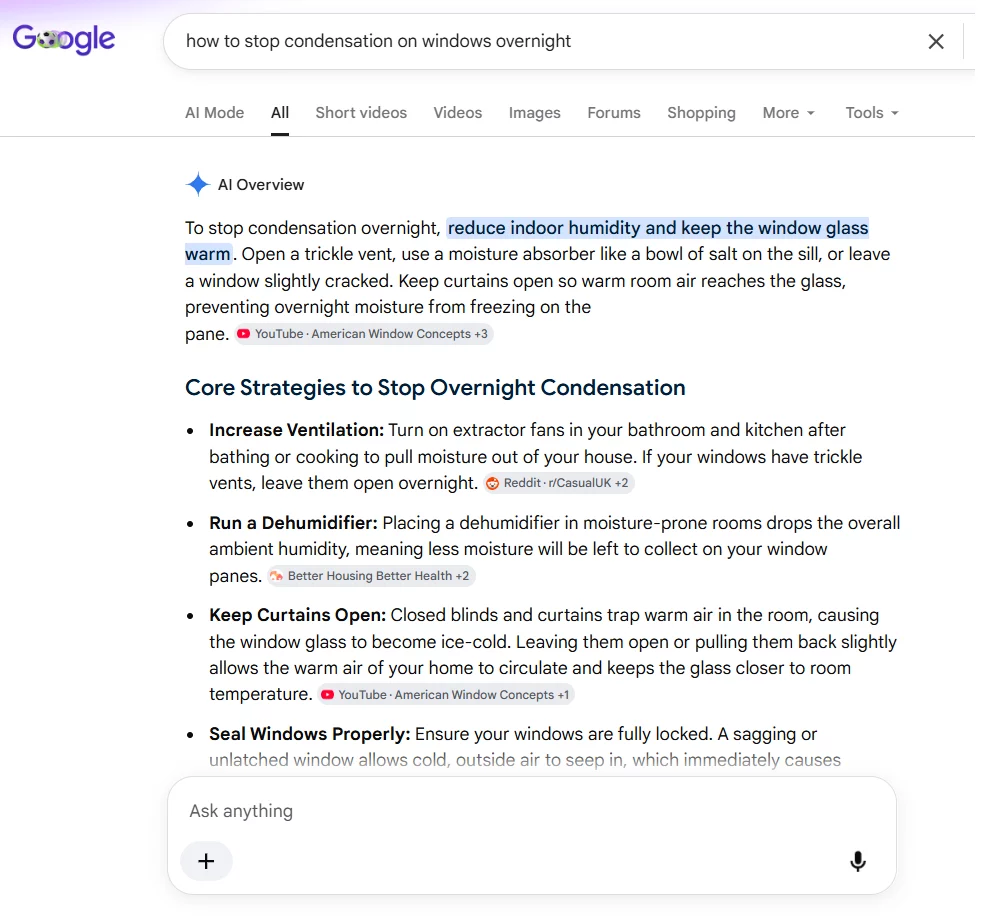
But it is also compressed.
It does not show much of the argument behind the advice.
It does not deeply explore trade-offs.
It does not fully show where the advice might fail.
That is where the other results become useful.
The Forum Result Added The Messy Reality
The Reddit result was especially interesting because it showed the human side of the problem.
People were not just saying “ventilate” or “use a dehumidifier”.
They were debating:
- whether trickle vents waste heat
- whether opening windows helps on humid rainy nights
- whether dehumidifiers cost too much to run
- whether dehumidifier energy is partly returned as heat
- whether PIV or MVHR systems are a better long-term solution
- whether window vacs are a cure or just a practical way to prevent mould
- what humidity readings actually mean
- whether the problem is the window, the room, the heating, the moisture or the ventilation
That is exactly the sort of detail that often gets lost when advice is compressed into a clean summary.
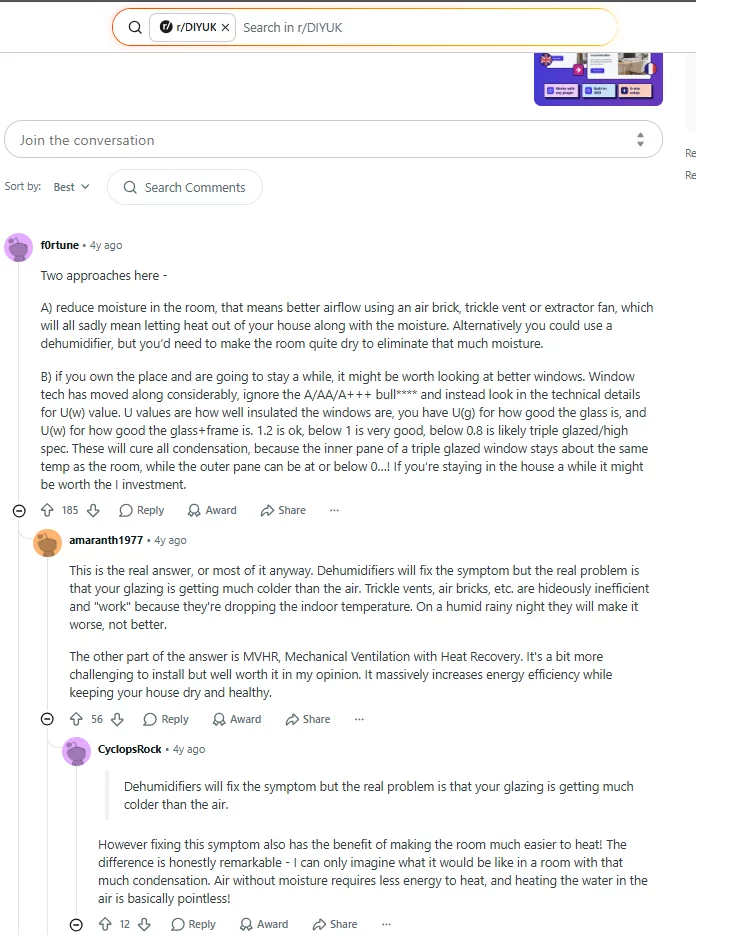
The forum did not provide the neatest answer.
But it did provide something valuable:
real experience.
The Organic Results Expanded The Consensus
The organic results mostly repeated the same core advice, but each did it in a different way.
Todi & Boys gave a broad guide focused around double-glazed windows, moisture control, ventilation, sealing, insulation and when to call a professional.
Screwfix gave a more product-led guide, including window vacs, dehumidifiers, ventilation materials, mould sprays, damp treatment, failed glazing and insulation.
EnviroVent pushed the problem towards whole-house ventilation, especially PIV and MVHR.
BBC Weather focused on the science of condensation, dew point, indoor versus outdoor condensation and why outside condensation can actually be a sign that efficient windows are working.
So the organic results did not completely reinvent the topic.
They expanded and reshaped the consensus.
What This Tells Us About Commodity Content
This is where the lesson for website owners becomes clear.
If I wanted to appear for the phrase:
“how to stop condensation on windows overnight”
I would not want to write another general article that simply says:
- open a window
- use a dehumidifier
- keep curtains open
- stop drying clothes indoors
- use extractor fans
- wipe the windows
- improve insulation
That article might be accurate.
It might even be helpful.
But after running this test, it is obvious that those ideas are already everywhere.
That would be commodity content.
It would be another version of the consensus.
The better opportunity would be to add something the existing results do not clearly show.
Where The Information Gain Could Be
The search results gave plenty of advice.
What they did not provide was much measured proof.
That creates the content opportunity.
Instead of writing:
“How to stop condensation on windows overnight”
a stronger article would be:
“I Tested 6 Ways To Stop Condensation On Windows Overnight”
That article could include:
- photos of the window each morning
- humidity readings before bed and after waking
- temperature readings
- outside weather conditions
- whether it rained
- whether curtains were open or closed
- whether the door was open or closed
- whether a dehumidifier was used
- how much water was collected
- comfort level in the room
- noise level
- whether the room felt colder
- what actually worked best
That would move the article away from repeating the consensus.
It would test the consensus.
That is a massive difference.
Possible Follow-Up Test Article
Based on this SERP analysis, the best follow-up article would be something like:
I Tested 6 Overnight Window Condensation Fixes In A Real Bedroom
The test could run over seven nights:
| Night | Test |
|---|---|
| 1 | Baseline: no change |
| 2 | Curtains open |
| 3 | Window slightly open |
| 4 | Bedroom door slightly open |
| 5 | Dehumidifier running |
| 6 | Moisture absorber on windowsill |
| 7 | Best combined setup |
The results could then be shown in a simple table:
| Test | Morning result | Comfort | Worth repeating? |
|---|---|---|---|
| Baseline | Heavy condensation | Normal | No |
| Curtains open | To be tested | To be tested | To be tested |
| Window open | To be tested | To be tested | To be tested |
| Door open | To be tested | To be tested | To be tested |
| Dehumidifier | To be tested | To be tested | To be tested |
| Moisture absorber | To be tested | To be tested | To be tested |
| Combined setup | To be tested | To be tested | To be tested |
That article would have obvious proof of life.
It would not just say what should work.
It would show what happened.
The Bigger Lesson
This small test shows why information gain matters.
The SERP already contains plenty of competent content.
The AI Overview already gives a decent summary.
The organic results already explain the standard advice.
The forum result already shows practical debate.
So a new article has to do more than repeat the basics.
The useful path is:
- Identify the consensus.
- Study how the SERP presents it.
- Look for the gaps, disagreements and untested claims.
- Run a real test.
- Document what happened.
- Share the results clearly.
That is how you move from commodity content to evidence-led content.
Final Conclusion
This experiment confirmed the original idea.
The best way to create content that stands out in an AI search world is not to write another perfectly polished version of the same article everyone else has written.
The better approach is to actually try something.
Document it.
Measure it.
Photograph it.
Show the messy process.
Then reach a conclusion based on what happened.
That is the difference between explaining consensus opinion and demonstrating it.
A generic article can tell readers what the consensus says.
A stronger article can show the consensus, test it, and then add something new.
That is where information gain lives.