
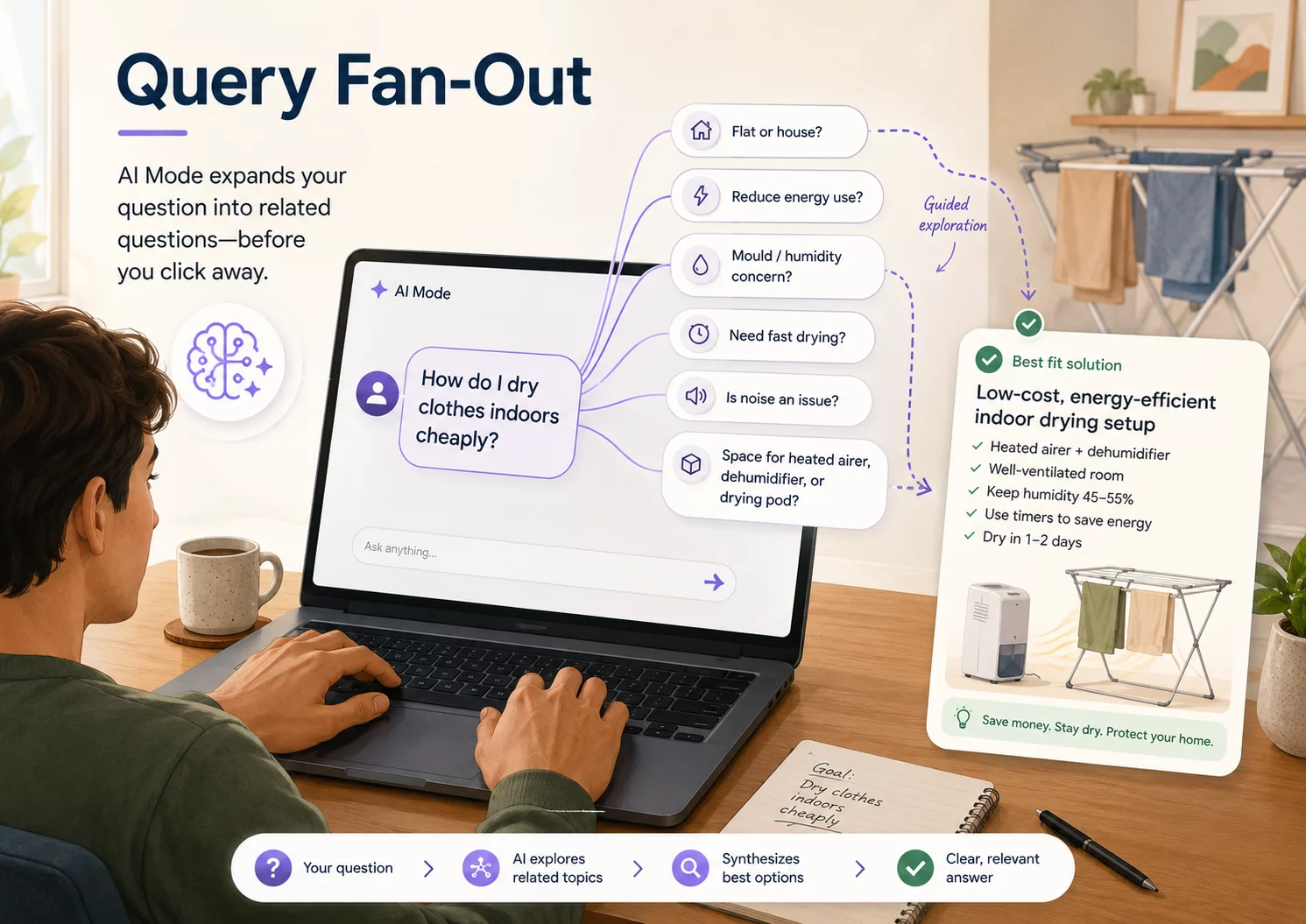
In traditional search, the user typed a query and Google returned a list of pages.
The user then had to do the work.
They clicked a result, scanned a page, went back, clicked another result, compared advice, changed their search, tried again, and slowly moved towards the answer they needed.
AI Mode changes that process.
It does not simply respond to the exact words typed into the search box. It can expand the search into related questions, hidden assumptions, missing details, follow-up choices, and practical next steps.
That process is often called query fan-out.
In plain English, query fan-out means this:
The AI does not treat your original search as the whole problem. It treats it as the starting point of a wider investigation.
That is a very important shift for website owners.
Because many websites used to win traffic by answering one small part of the journey. AI Mode can now absorb more of that journey inside the search window itself.
The Old Search Journey Was More Fragmented
In old-style search, the user often had to break the problem down manually.
For example, someone might search:
How do I dry clothes indoors cheaply?
Then they might search separately for:
Are heated airers expensive to run?
Is a dehumidifier good for drying clothes?
How do I stop mould when drying clothes indoors?
Best way to dry clothes in a flat
Cheapest alternative to a tumble dryer
Each search might lead to a different website.
One site might explain heated airers.
Another might review dehumidifiers.
Another might talk about mould.
Another might compare drying pods.
Another might give general indoor drying tips.
The user had to act as the organiser.
They had to work out which questions mattered, which answers applied to their situation, and which possible solution made the most sense.
That fragmentation created lots of opportunities for websites.
A website did not always need to solve the whole problem. It could attract visitors by answering one small question within the wider search journey.
AI Mode changes that.
AI Mode Can Expand the Search Itself
When someone asks:
How do I dry clothes indoors cheaply?
AI Mode can immediately recognise that the real problem may not be just “drying clothes”.
It may involve cost, space, speed, humidity, noise, safety, convenience, and the type of home the person lives in.
So the search can fan out into questions like:
Are you in a flat or a house?
Are you trying to reduce energy use?
Is mould or condensation a concern?
Do you need clothes dry quickly?
Is noise an issue?
Do you have space for a heated airer, drying pod, or dehumidifier?
Are you drying clothes for one person or a family?
Are you trying to avoid using a tumble dryer completely?
This is powerful because AI Mode can do something many websites used to do.
It can help the user clarify the problem.
The user may start with a vague search, but the AI can guide them towards a more specific situation.
Instead of the user needing to search ten separate phrases, AI Mode can pull those related issues into one conversation.
That is query fan-out in practical terms.
It is not just a wider search.
It is a guided exploration.
Sometimes the User Does Not Know the Endpoint Yet
This is one of the most important points.
Not every search starts with a clear endpoint.
Sometimes the user knows exactly what they want. They may be looking for a specific product, a specific tool, a specific plugin, or a specific instruction.
For example:
Best heated airer under £100
That user already has a likely endpoint in mind. They are probably close to comparing products or making a purchase.
But other searches begin with uncertainty.
The user may not even know what the problem really is.
They may search something like:
Feed pages are appearing in my Google Search Console
At the start, the user may not know what feed pages are.
They may not know whether the pages matter.
They may not know whether they should leave them alone, noindex them, remove them from reports, block them, or ignore them.
In old search, they might have clicked around several SEO articles trying to understand the issue.
In AI Mode, the conversation can develop differently.
The AI might explain:
Feed pages are automatically generated pages, often created by WordPress or another content management system. They are designed to let readers or services access recent content through RSS or similar feeds.
Then it may continue:
They are not always a problem, but they can sometimes appear in reports and create confusion. In many cases, website owners do not need them indexed in search results.
Then the AI might ask:
Do you want to remove them from Google’s index, or are you mainly trying to clean up what appears in Search Console?
That is a key moment.
The user did not begin with:
How do I noindex WordPress feed pages?
They arrived there through the conversation.
The endpoint emerged during the search process.
That is why query fan-out matters so much.
It is not only about expanding one query into several related queries.
It is about helping the user discover what they should have been asking in the first place.
AI Mode Turns Search Into a Conversation
Traditional search was often a sequence of separate searches.
AI Mode is more like a conversation.
The user starts somewhere.
The AI responds.
The user adds more detail.
The AI narrows the advice.
The user asks a follow-up question.
The AI adjusts the answer.
The pathway develops step by step.
This matters because many real-world searches are not neat and tidy.
People often begin with incomplete knowledge.
They may know the symptom but not the cause.
They may know the frustration but not the solution.
They may know the broad goal but not the exact route.
A person might search:
Why is my website showing strange pages in Google?
That could lead to discussions about archive pages, tag pages, feed pages, author pages, pagination, duplicate content, indexing settings, sitemap settings, or Search Console reports.
The original query is vague.
But AI Mode can fan it out into possibilities.
It can ask clarifying questions.
It can explain the options.
It can help the user move from confusion to a more defined problem.
This is very different from old keyword-based search.
The original keyword becomes less important than the journey that follows.
Why This Weakens Old-Style SEO Thinking
Old-style SEO often encouraged website owners to think in terms of individual keywords.
Find a keyword.
Write an article for that keyword.
Optimise the title, headings, meta description, and content.
Hope the page ranks.
That approach worked especially well when Google acted mainly as a doorway to websites.
But AI Mode makes this weaker because the user’s path may no longer depend on one keyword and one click.
The AI can take the original query and expand it into many related ideas.
It can answer small supporting questions itself.
It can compare options.
It can explain trade-offs.
It can ask for more context.
It can move the user towards a more specific endpoint without the user needing to click a separate article for each step.
This means a website that only answers one tiny part of the journey may become more vulnerable.
For example, an article titled:
What Is a Heated Airer?
may have been useful in traditional search.
But if AI Mode can explain what a heated airer is in two sentences, compare it with a dehumidifier, explain when it makes sense, and ask about the user’s home situation, that simple article may lose its role in the journey.
The same applies to many basic informational pages:
What is an RSS feed?
What is a drying pod?
What is a noindex tag?
What is a sitemap?
What is affiliate marketing?
What is a beginner telescope?
These pages are not necessarily useless.
But if their only job is to define a term or answer one simple step, AI Mode can often do that inside the search window.
The user may not need to click.
The Journey Matters More Than the Keyword
This is why website owners need to think beyond keywords.
The better question is not just:
What keyword am I targeting?
The better question is:
What journey is the user on, and where does AI Mode fail to complete it?
For the indoor clothes drying example, the journey may include:
- Understanding the real problem
- Comparing possible methods
- Considering space, cost, noise, and humidity
- Choosing between products
- Working out running costs
- Setting up a practical drying routine
- Avoiding mould and condensation
- Finding a solution that fits a specific home
AI Mode may handle the early explanation very well.
It may help the user clarify the situation.
It may even suggest likely options.
But that does not mean it can always finish the journey.
There may still be a gap between advice and action.
For example, the AI might say:
A dehumidifier can help dry clothes indoors while reducing humidity.
That may be true, but the user may still need:
- A calculator comparing running costs
- A room-size guide
- A product comparison based on current prices
- A printable drying routine
- A mould-risk checklist
- A tool that recommends the best setup based on their home
- Photos or videos showing real setups in small flats
- A tested personal case study
That is where websites may still have an opportunity.
Not by simply repeating what AI Mode can already explain.
But by doing something AI Mode cannot fully deliver inside the search window.
Query Fan-Out Can Reveal Better Content Opportunities
This is where AI Mode becomes useful for website owners.
Instead of only using keyword tools, you can follow the AI Mode conversation and watch where it goes.
Start with a broad query.
Then observe what the AI asks next.
Notice what assumptions it makes.
Notice what extra information it needs.
Notice where the answer becomes vague.
Notice where it gives general advice but no working solution.
That is where opportunities appear.
For example, if you search:
Feed pages are appearing in Google Search Console
AI Mode might explain what feed pages are.
Then it might suggest that many WordPress site owners do not need feed pages indexed.
Then it might mention noindex settings.
Then it might talk about SEO plugins.
Then it might describe how to change settings.
But the user may still be left thinking:
Which exact setting do I change in my plugin?
How do I know if this applies to my site?
Will this damage anything?
What should I check afterwards?
How do I test whether the feed pages are actually noindexed?
That is a content opportunity.
Not necessarily another generic article saying “What are feed pages?”
The better opportunity may be a practical resource:
WordPress Feed Page Noindex Checklist: How to Decide Whether to Remove Feed URLs From Search Results
Or even better:
A simple tool or decision tree that helps a site owner decide whether feed pages should be indexed, ignored, or noindexed.
That is much harder for AI Mode to replace with a short answer.
Query Fan-Out Makes Weak Content More Exposed
This is the uncomfortable part.
If a website exists mainly to answer small, isolated informational queries, AI Mode is a direct threat.
A basic article that answers one simple question may be absorbed into the AI response.
A list of generic tips may be summarised.
A definition page may become unnecessary.
A shallow comparison may be replaced by a conversational answer.
This does not mean all content is dead.
But it does mean the old model is weaker.
In the old model, a website could attract traffic by sitting somewhere along the pathway.
In the AI Mode model, more of that pathway can happen before the user ever clicks.
The user can move from confusion to clarity inside the AI window.
They can refine the problem.
They can compare options.
They can ask follow-up questions.
They can get a suggested direction.
That reduces the number of clicks needed.
And if fewer clicks are needed, fewer websites get visited.
But AI Mode Still Has Limits
The important conclusion is not that websites no longer matter.
The better conclusion is this:
AI Mode can guide the thinking, but it cannot always deliver the actual working solution.
It can explain.
It can compare.
It can ask useful questions.
It can help the user discover what they really need.
But there are still points where the user needs something more concrete.
They may need a tool.
They may need a calculator.
They may need a template.
They may need current product data.
They may need expert judgement.
They may need a step-by-step workflow.
They may need a visual demonstration.
They may need a downloadable resource.
They may need someone to actually execute the task.
This is where the future opportunity for websites may sit.
Not in answering every small keyword query.
Not in rewriting information that AI Mode can already summarise.
But in identifying where the AI conversation reaches its limit.
Query fan-out helps reveal those limits.
It shows the path the user is travelling.
It shows the questions that arise along the way.
It shows where the user’s endpoint becomes clearer.
And most importantly, it shows where AI Mode can guide the user towards a solution, but cannot quite deliver it.
That is where the next article needs to go.
Because if AI Mode is absorbing more of the search journey, website owners need to understand the places where that journey still breaks down.
Those places are the gaps.
And those gaps may become the new opportunities.