
For many years, search worked in a fairly simple way.
A person had a question.
They typed that question into Google.
Google showed a page of results.
The person clicked through to a website.
The website then had the job of answering the question, explaining the topic, recommending a product, or helping the user take the next step.
That was the old search pathway.
It was not always perfect, but it was easy to understand.
Search was a doorway.
Google helped the user find the door, but the website was where the real journey usually happened.
That is now changing.
With AI Mode and AI-generated search experiences, Google is no longer just pointing people towards possible answers. It is increasingly trying to carry the user along the pathway itself.
The user asks a question.
The AI gives an answer.
The user asks a follow-up question.
The AI refines the answer.
The user adds more context.
The AI gives a more specific suggestion.
In many cases, the user may reach a good enough answer, decision, or next step without visiting a website at all.
That is the major shift website owners need to understand.
Search is no longer just a doorway to websites.
Search is becoming part doorway, part adviser, part explainer, part comparison tool, and part problem-solving assistant.
The Old Search Path
Under traditional search, the basic journey often looked like this:
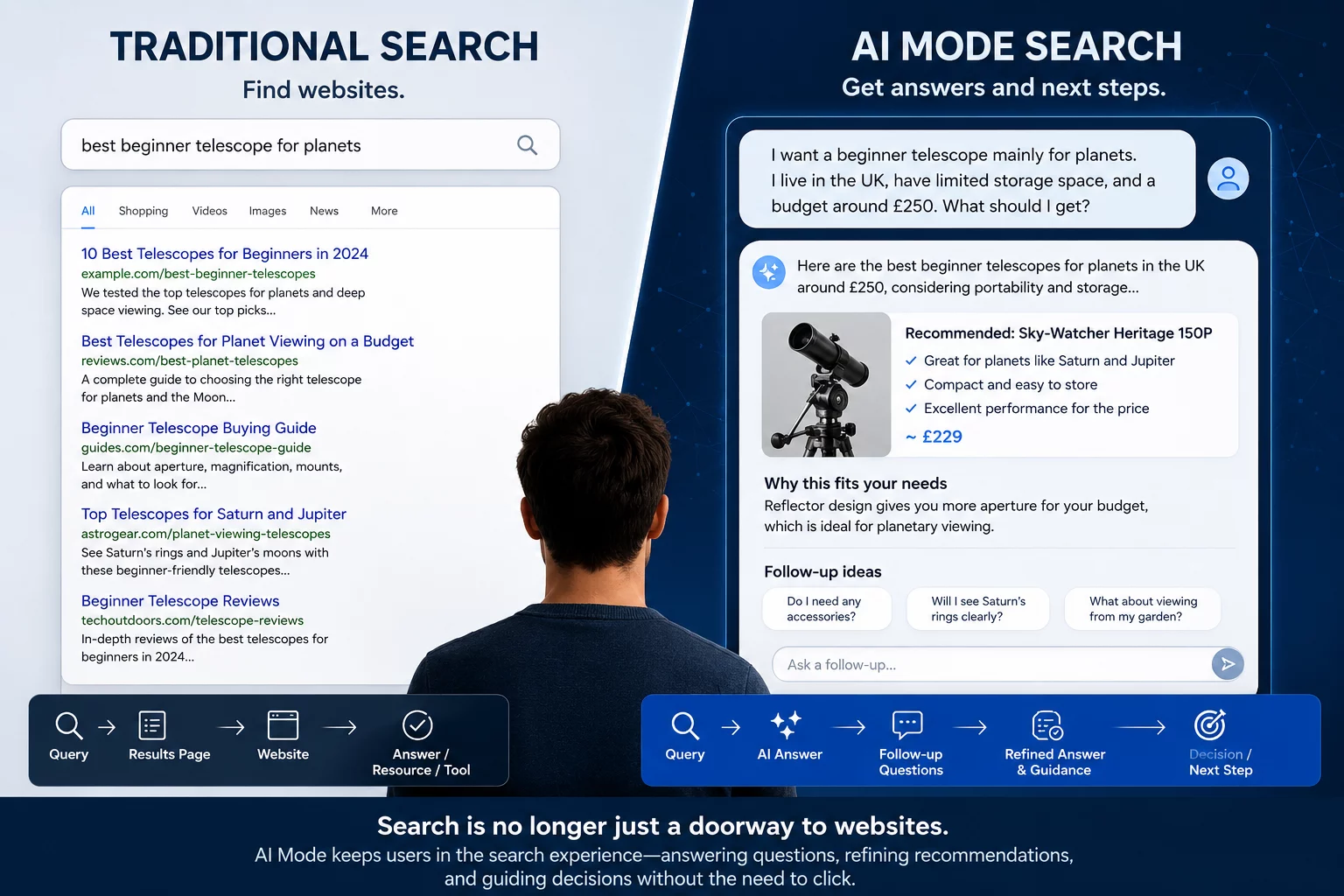
Query → search results → website → answer
For example, someone might search:
best beginner telescope for planets
Google would show a list of review articles, buying guides, videos, forum threads, and product pages.
The user might click five different websites.
One site might explain aperture.
Another might explain why magnification is not everything.
Another might compare reflectors and refractors.
Another might recommend a specific telescope.
Another might contain real user comments from people who had bought one.
The user had to assemble the answer by moving from website to website.
That was inconvenient for the user, but it created an opportunity for website owners.
If you could write a helpful guide, answer the question clearly, and build trust, you had a chance of winning the click.
The search engine helped the user find you.
Your website then did the job of helping the user.
That was the model many websites were built around.
The AI Mode Search Path
AI Mode changes the shape of that journey.
The pathway can now look more like this:
Query → AI answer → follow-up question → refined answer → further context → possible decision
The user does not need to start with a neat keyword phrase.
They can start with a messy real-life problem.
Instead of typing:
best beginner telescope for planets
They might type:
I want to buy my first telescope mainly for looking at the Moon and Saturn. I live in a small house, I do not have much storage space, and I do not want anything too complicated to set up. I am in the UK and my budget is around £250. What should I be looking for?
That is not a traditional keyword.
It is closer to a conversation.
AI Mode can then respond with a narrowed explanation. It might explain that the user probably wants something portable, beginner-friendly, and suitable for lunar and planetary viewing. It may compare reflector and refractor telescopes. It may warn against cheap telescopes that advertise unrealistic magnification. It may suggest what specifications to prioritise.
The user can then continue:
I would mostly use it from a small garden. Does that change your recommendation?
Then:
Would I need a tripod or mount?
Then:
Can I actually see Saturn’s rings with this sort of telescope?
At each stage, the user is moving further along the pathway.
In the old model, those might have been four, five, or six separate Google searches, each creating chances for different websites to win a click.
In the AI Mode model, those stages can all happen inside the search window.
That is what I mean by AI Mode taking over more of the search pathway.
It is not just answering the first query.
It is absorbing more of the follow-up journey.
Search Queries Are Changing Too
This does not only affect what happens after someone searches.
It also changes what people type in the first place.
Traditional SEO was built around short keyword phrases:
best x for y
how to do x
x vs y
cheap x for beginners
Those searches still exist, but AI search encourages a different style of query.
People can now type longer, more detailed, more personal questions because the search engine is better able to interpret them.
A person does not need to reduce their problem into a neat keyword.
They can explain the situation.
They can include constraints.
They can add background.
They can say what they have already tried.
They can ask the question in the same way they might ask a knowledgeable friend.
For example, instead of searching:
noindex wordpress feed pages
someone might now ask:
I want to stop feed pages from being indexed by Google on my WordPress site because I have seen them appearing in Google Search Console. How do I fix this?
That is a very different kind of query.
It contains the problem, the platform, the reason, and the desired outcome.
AI Mode is well suited to that kind of search because it can treat the query as a situation rather than just a string of keywords.
A Simple WordPress Example
Imagine a website owner opens Google Search Console and notices strange feed URLs appearing.
They do not know what those URLs are.
Their first search might be:
what is a feed page
In the old search model, they might click an article explaining RSS feeds.
Then they might search:
why are feed pages indexed in Google
Then:
should WordPress feed pages be indexed
Then:
how to noindex feed pages WordPress
Then:
how to noindex feeds using The SEO Framework
Each of those searches could lead to a different website.
Each one was a separate doorway.
Now imagine the same journey inside AI Mode.
The user asks:
What is a feed page? I have seen some feed URLs showing in Google Search Console for my WordPress site.
The AI explains what a feed page is.
It then recognises the likely concern and may effectively guide the user towards the next question:
Are you trying to stop these feed pages appearing in Google?
The user says yes.
The AI may then ask what SEO plugin the user uses.
The user says they use The SEO Framework, Yoast, Rank Math, or another plugin.
The AI can then explain where the relevant setting is, what it does, and what the user should check.
The pathway has moved from basic definition to diagnosis to practical action.
In the old model, several websites might have been visited during that process.
In the AI Mode model, much of that journey may happen without the user leaving Google.
That is the important point.
AI Mode is not only answering questions.
It is helping the user move from confusion to action.
Why This Creates More Zero-Click Behaviour
Zero-click behaviour means the user searches but does not click through to an external website.
This was already happening before AI Mode.
Featured snippets, knowledge panels, maps, calculators, weather results, sports scores, and quick answers all reduced the need to click in certain situations.
AI search pushes this further because it can handle more complex questions.
A weather box can answer:
What is the weather today?
But AI Mode can answer something closer to:
I am planning a weekend garden project and the weather looks changeable. What jobs could I realistically do in short dry periods?
That is not just a fact.
It is advice.
It is interpretation.
It is planning.
And that is why website owners need to pay attention.
When the search engine can give a useful enough answer inside the search window, the user has less reason to click.
This is especially true when the user only wants a simple explanation, a definition, a list, a basic comparison, or a straightforward set of steps.
If the AI can satisfy the user’s need, the external website becomes optional.
Basic Informational Articles Are Most Exposed
This does not mean every website is equally threatened.
The most exposed pages are basic informational articles where the main value is simply explaining something that is already widely known.
For example:
What is an RSS feed?
What is affiliate marketing?
What is aperture in a telescope?
What is a meta description?
How often should you water tomato plants?
These topics can still be useful, but they are also easy for AI to summarise.
If hundreds or thousands of websites already explain the same thing in similar words, an AI system can absorb that information and present a general answer directly.
That creates a problem for websites whose main strategy is producing ordinary explanatory articles on widely covered topics.
The article may be accurate.
It may be readable.
It may even be helpful.
But if it does not add anything beyond the standard answer, it may struggle to earn the click.
The user may not need it.
The AI answer may be enough.
The Journey Matters More Than the Keyword
This is why website owners need to think beyond individual keywords.
A keyword is only one small part of the user journey.
The more important question is:
What is the user actually trying to achieve?
Someone searching what is a feed page may not really care about feed pages in an abstract sense.
They may be worried because strange URLs have appeared in Google Search Console.
They may want to know whether something is wrong.
They may want to know whether the pages should be indexed.
They may want to know which setting to change in WordPress.
They may want reassurance that they are not damaging their site.
The keyword is:
what is a feed page
The journey is:
I have found something confusing in Google Search Console, I do not know whether it matters, and I need help deciding what to do next.
Those are not the same thing.
AI Mode is built to move along that journey.
That is why website owners need to understand the full pathway, not just the initial search phrase.
The same applies in almost every niche.
A person searching best beginner telescope for planets is not just looking for a product list.
They may be trying to avoid wasting money.
They may be worried about buying something too complicated.
They may not know whether Saturn’s rings are realistic from their garden.
They may not understand the difference between a toy telescope and a genuine beginner telescope.
They may need help connecting their budget, storage space, observing goals, and expectations.
AI Mode can now gather those details conversationally.
So a website that only targets the keyword may be less useful than a website that understands the full beginner journey.
Websites Are Not Dead
It would be easy to take all of this and conclude that websites are finished.
That would be the wrong conclusion.
Websites are not dead.
But the role of websites is changing.
A basic article that simply repeats common information is more vulnerable than it used to be.
A generic buying guide is more vulnerable than it used to be.
A shallow “best products” post is more vulnerable than it used to be.
But AI Mode still has limits.
It can explain.
It can summarise.
It can compare.
It can suggest.
It can guide.
But it does not always get the user all the way to a satisfactory endpoint.
Sometimes the information is fragmented across too many places.
Sometimes the user needs a tool, calculator, template, checklist, database, plugin, or working example.
Sometimes the user needs real experience from someone who has actually done the thing.
Sometimes the user needs a visual walkthrough.
Sometimes the user needs judgement in a very specific situation.
Sometimes the user needs confidence, not just information.
Those are the places where websites still matter.
The opportunity is no longer simply to answer a keyword.
The opportunity is to understand where the AI-assisted search journey still breaks down.
Where does the user still get stuck?
Where does the answer become too generic?
Where does the AI explain what to do, but not actually help the user do it?
Where does the user need a real resource rather than another paragraph of advice?
Those are the gaps website owners need to look for.
The New Question for Website Owners
In the old search world, website owners often asked:
What keywords can I rank for?
That question still has some value, but it is no longer enough.
A better question is:
Where does the user’s journey begin, and where do they actually need to end up?
Then ask:
Can AI Mode already take them most of the way there?
If the answer is yes, a basic article may not be enough.
If the answer is no, there may be an opportunity.
For example, if AI Mode can explain what a WordPress feed page is, there is little point creating yet another basic article that says the same thing.
But if users are still confused about how to identify those URLs, whether they matter, what settings to check, how different SEO plugins handle them, and how to confirm the issue is fixed, then there may still be room for something genuinely useful.
That useful thing might be a detailed walkthrough.
It might be a decision tree.
It might be a plugin-specific guide.
It might be a checklist.
It might be a small tool.
It might be a video showing the exact steps.
It might be a resource that helps the user finish the job.
That is the shift.
The website needs to become more than a page that answers the first question.
It needs to help complete the journey.
Final Thought
Search used to be mostly about helping people find websites.
AI Mode is increasingly about helping people reach answers, decisions, and next steps inside the search experience itself.
That means more of the search pathway is being absorbed into the AI window.
It also means people are changing the way they search. They are asking longer, more detailed, more personal questions. They are not always typing neat keyword phrases. They are describing situations, problems, constraints, and goals.
For website owners, this changes the game.
The individual keyword matters less than the full user journey.
Basic informational content is more exposed.
Zero-click behaviour is likely to grow.
But websites are not dead.
They just need to work harder to justify their place in the journey.
The real opportunity is to understand where AI Mode still fails, where the user still gets stuck, and where a website can provide something more useful than a standard AI-generated answer.
That is where the next generation of helpful websites will need to focus.