
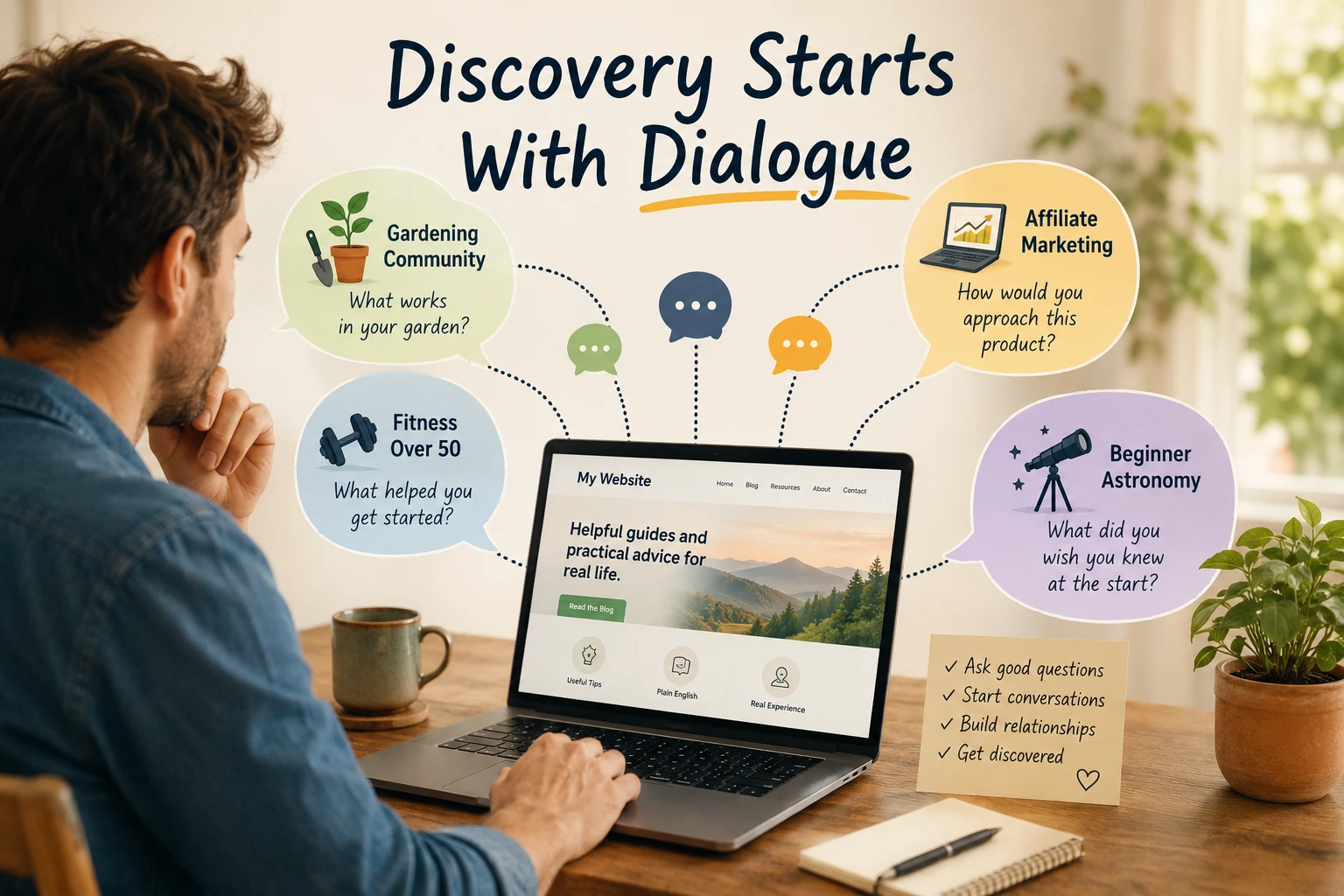
One of the hardest parts of building a small website is not creating the website.
It is getting people to discover it.
You can write helpful articles, choose a niche, publish regularly, and still find that very few people actually arrive.
That is especially difficult for a part-time website owner. You may not have a big budget, a large audience, or the time to publish endlessly. Relying only on Google can also feel risky, because search traffic can be slow, unpredictable, and vulnerable to algorithm changes.
So website discovery needs to be thought about more creatively.
One useful approach is this:
Instead of only trying to promote your website, start conversations with the people your website is meant to help.
That does not mean dropping links everywhere.
It means asking good questions in the right places.
Discovery Is Not Always About Links
When people think about getting traffic to a website, they often think about links.
Can I share my article?
Can I post my website?
Can I get people to click?
But in many communities, especially places like Reddit, starting with a link is often the wrong move.
It can look promotional.
It can feel forced.
It may even break the rules of the community.
A better approach is to start with conversation.
That means joining relevant communities and asking questions that people in that niche would naturally want to answer.
Not fake questions.
Not disguised adverts.
Not “I wrote this article, please read it.”
Just useful, interesting, well-framed questions.
This is a slower form of discovery, but it is also more human.
People may not click anything immediately. But they may recognise your name. They may reply to you. They may notice that you ask thoughtful questions. Over time, that can become the start of trust and familiarity.
For a small website owner, that matters.
The Question Has to Fit the Community
The important point is that the question must fit the community you are speaking to.
For example, if you are in an affiliate marketing community, it makes sense to ask a question about product angles.
You might say:
I’m trying to get better at finding different angles for products, because I think it is an important affiliate marketing skill.
For example, a heated clothes airer obviously dries clothes, but I started wondering how many different real-life problems it could solve.
So far I’ve got high tumble dryer costs, drying clothes in winter, small flats, odd working hours where noise matters, and possible caravan or glamping use.
What other situations can you think of where this product might genuinely help?
That works because the audience is interested in affiliate marketing, content, product positioning, and problem-led recommendations.
The question belongs there.
But if your website is about gardening, the question should feel like a gardening question.
If your website is about beginner fitness, it should feel like a fitness question.
If your website is about telescopes, it should feel like an astronomy question.
The aim is not to drag people towards your website.
The aim is to begin dialogue with people who care about the same subject your website covers.
A Gardening Example
Suppose someone is building a helpful gardening website.
They could go into a gardening community and ask:
What is one small gardening change that made a bigger difference than you expected?
That is a simple question, but it is easy for gardeners to answer.
Some might mention mulching.
Others might talk about watering at a different time of day, improving compost, labelling seedlings, choosing easier plants, or moving herbs closer to the kitchen door.
The exact answers are useful, but they are not the main point.
The main point is that the website owner has started a relevant conversation with gardeners.
They can reply.
They can ask follow-up questions.
They can share their own experience.
They can become part of the community instead of appearing only when they want traffic.
That is discovery in a more natural form.
A Fitness Example
Now imagine a website aimed at people over 50 who want to get fitter.
A good conversation-opening question might be:
If you started exercising again after a long break, what made it feel less intimidating?
That question fits the audience because it recognises the real issue.
For many people, the barrier is not simply knowing which exercise to do. It is confidence. It is embarrassment. It is fear of injury. It is feeling out of shape. It is not knowing how to restart.
A question like that invites honest answers.
People may talk about walking, exercising at home, joining a friendly class, starting with five minutes a day, using beginner videos, or tracking small improvements.
Again, the website owner is not promoting anything.
They are opening a conversation that belongs in the niche.
That is how relationships begin.
Why This Is a Website Discovery Technique
This matters because small websites often struggle to be seen.
A large website may be able to rely on authority, backlinks, paid promotion, a big email list, or a team of writers.
A small website owner often cannot.
But they can still be visible in smaller, more personal ways.
They can show up in relevant communities.
They can ask thoughtful questions.
They can contribute useful replies.
They can become known as someone who is genuinely interested in the topic.
That is not link-building in the traditional sense.
It is relationship-building.
And relationship-building can lead to discovery.
Someone may click your profile.
Someone may remember your name.
Someone may later ask what you are working on.
Someone may trust a link from you in the future because you did not start by pushing one.
This is not instant traffic.
It is not a shortcut.
But for a small, independent website, it may be a more realistic long-term strategy than simply publishing articles and waiting.
The Difference Between Promotion and Participation
There is a big difference between promotion and participation.
Promotion says:
I have something. Please look at it.
Participation says:
I am interested in this topic too. What do you think?
That difference matters.
People are much more open to someone who participates properly.
A good question gives people a reason to respond. It lets them share experience, opinions, mistakes, advice, or stories. It creates a conversation rather than demanding attention.
That is why creative discovery is not really about clever tricks.
It is about understanding the community well enough to ask questions that feel natural there.
A Simple Way to Use This
The process is straightforward.
Choose the niche your website serves.
Find where those people already talk.
Think about what they naturally enjoy discussing.
Ask a question that invites experience, not just yes-or-no answers.
Reply properly.
Keep showing up.
Over time, this creates familiarity.
The website can come later.
In fact, the website is more likely to be welcomed later if the relationship has started first.
That is the key point.
Creative discovery works best when the conversation comes before the link.
Final Thought
A small website owner cannot always compete with large websites on scale.
They may not be able to publish as much content, build authority as quickly, or appear everywhere at once.
But they can be more human.
They can ask better questions.
They can join real conversations.
They can build relationships with the exact people their website is trying to help.
That is why creative questions can be a genuine website discovery technique.
Not because they create instant clicks.
But because they open dialogue.
And for a small website, dialogue may be one of the most valuable forms of discovery there is.