
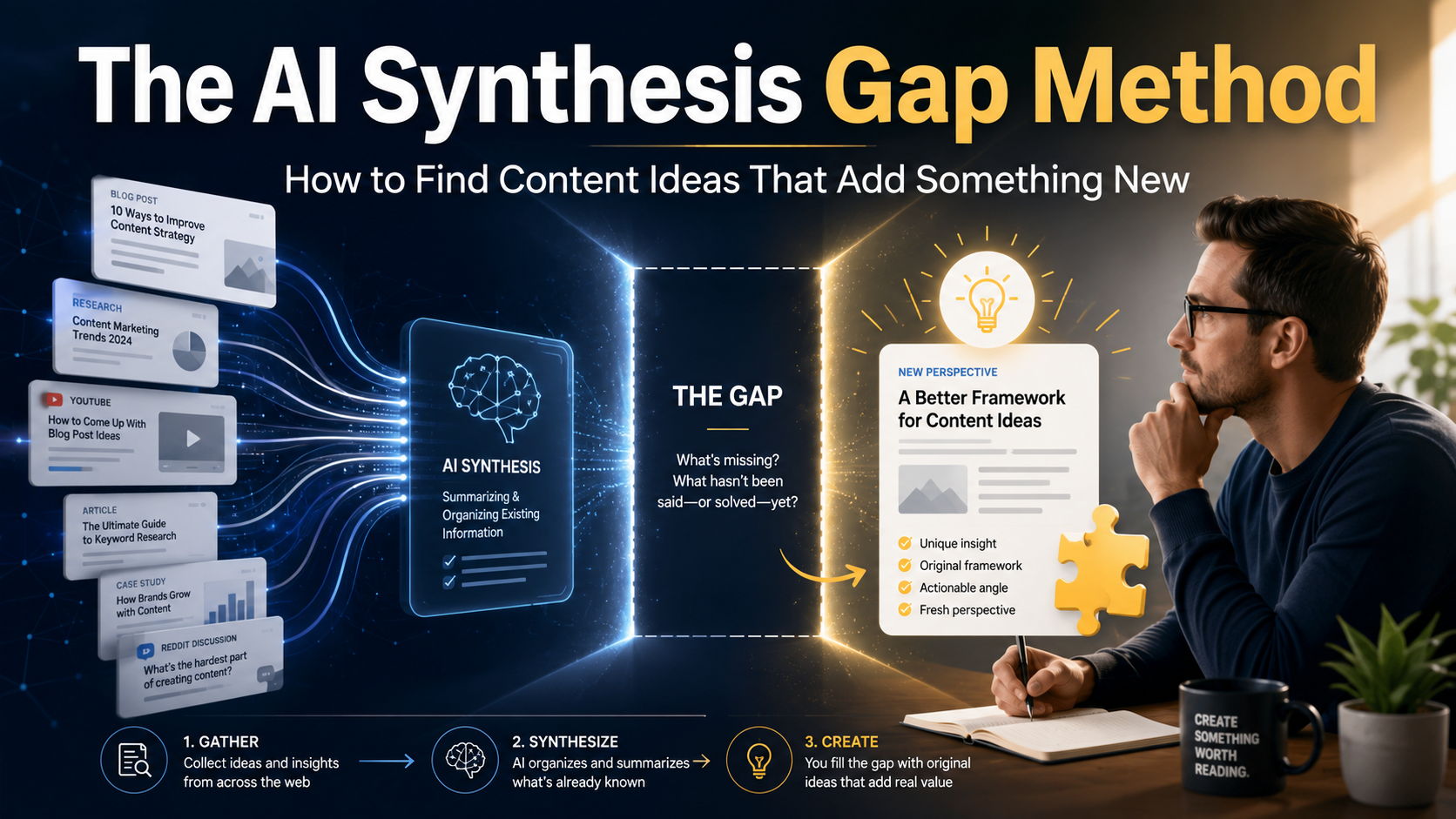
One of the hardest parts of building a hobby website is finding topics that genuinely deserve another article.
It is easy to ask an AI tool for 50 content ideas. It is equally easy to turn those ideas into 50 competent-looking posts.
The harder question is:
What would those articles add that readers cannot already find elsewhere?
A useful answer may come from an unexpected place: examining how Google AI Mode combines existing sources.
AI Mode often produces a clear, confident answer from several cited pages. But when those pages are opened and read individually, they may not agree nearly as much as the final answer suggests.
Some recommend different methods.
Some define success differently.
Some are written for different types of reader.
Some support individual facts without supporting the overall conclusion AI Mode builds from them.
The model may smooth these differences into one simple recommendation.
That smoothing can hide a valuable content opportunity.
By asking AI Mode a carefully chosen question, examining its citations and identifying what the synthesis has compressed or omitted, a hobby website builder may uncover topics where a new article could provide genuine additional value.
I call this the AI Synthesis Gap Method.
AI Mode gives us a compressed view of existing content
Google explains that AI Mode can use a process known as query fan-out. Rather than relying only on the precise wording typed by the user, it can issue related searches across connected subtopics and bring the resulting information together into one response.
This makes AI Mode useful for more than obtaining an answer.
Its response can also act as a compressed snapshot of how the existing web approaches a subject.
Imagine asking:
Should a complete beginner shoot photographs in RAW or JPEG?
AI Mode might retrieve pages discussing:
- the simplicity of JPEG;
- the editing flexibility of RAW;
- storage requirements;
- immediate sharing;
- image recovery;
- the value of learning editing;
- RAW+JPEG as a hybrid approach.
It then has to turn all that information into a useful response.
The result may look like a settled answer even when the sources represent several different schools of thought.
That is where the method begins.
What is AI smoothing?
AI smoothing happens when a model takes different opinions, criteria or recommendations and turns them into one coherent answer.
This does not always produce a false answer.
It often produces an answer that is broadly sensible but less revealing than the source material underneath it.
For example, one photography source might recommend JPEG because it lets beginners concentrate on composition and camera controls.
Another might recommend RAW because beginners should learn the full photographic process from the beginning.
A third might recommend RAW+JPEG so both files are available.
AI Mode could smooth those positions into:
Start with JPEG while learning the basics, then move to RAW once you are ready to edit.
That sounds practical.
However, it may not be the conclusion reached by any one source. The model has transformed a disagreement into a learning sequence:
- JPEG is for the beginner stage.
- RAW is for the later stage.
Sources arguing that beginners should use RAW immediately have not disappeared. Their arguments have simply been moved to a later point in the journey.
The disagreement has been resolved by the synthesis rather than by the evidence.
Our RAW-versus-JPEG experiment
We tested this by asking Google AI Mode:
I have just bought my first mirrorless camera and am learning photography. Should a complete beginner shoot RAW or JPEG? Give me one clear starting recommendation and explain why.
The first two runs produced the same answer:
Shoot in JPEG to start.
AI Mode explained that JPEG would allow a beginner to focus on composition and camera mechanics without becoming overwhelmed by editing.
It then offered a compromise:
Use RAW+JPEG so you can use the JPEG files now while retaining the RAW versions for later.
On the third run, the citations changed, but the central recommendation remained similar:
Shoot JPEG while you learn the basics of your new mirrorless camera.
It then included a separate section headed:
When to Switch to RAW Later
The source landscape underneath those answers was much less settled.
Some cited pages supported JPEG.
Some recommended RAW.
Some recommended RAW+JPEG.
Others said the correct format depended on the photographer’s aims and workflow.
At least one cited article specifically argued that new photographers should learn RAW processing from the beginning. Yet AI Mode placed it beneath a section explaining why JPEG was best for complete beginners.
The source supported facts about RAW and JPEG, but it did not support the recommendation beside which it appeared.
Across the runs, AI Mode repeatedly preserved the same basic narrative:
JPEG now, RAW later.
The model had not simply summarised the disagreement. It had reorganised it into a smooth progression.
Why this creates a possible content opportunity
A weak response to this discovery would be to publish another article listing the advantages and disadvantages of RAW and JPEG.
AI Mode can already do that.
Many existing photography sites already do that.
The stronger opportunity is to investigate why the recommendations differ.
Perhaps the sources are optimising for different things.
One source may define a good beginner experience as:
keeping photography as simple as possible.
Another may define it as:
retaining the highest-quality image data.
Another may believe:
editing is an essential part of learning digital photography.
Another may prioritise:
immediate sharing without additional work.
Once those criteria are separated, the apparent contradiction becomes understandable.
The more useful article is therefore not simply:
RAW versus JPEG: advantages and disadvantages.
It might be:
Why Photographers Disagree About Whether Beginners Should Start With RAW or JPEG
That article could explain:
- the different definitions of “best for beginners”;
- the assumptions behind each recommendation;
- who benefits from each approach;
- the disadvantages of the apparently perfect RAW+JPEG compromise;
- whether “JPEG first, RAW later” is actually the best learning sequence.
The AI synthesis identifies the possible gap.
The publisher still has to investigate it.
The AI Synthesis Gap Method
The method has five main stages:
Ask, inspect, uncover, investigate and contribute.
1. Ask AI Mode a question containing a real decision
The best questions usually contain competing methods, priorities or trade-offs.
Examples might include:
- Should a beginner buy a reflector or refractor telescope?
- Should tomato plants be watered deeply or little and often?
- Should a nervous speaker memorise the opening or use notes?
- Should a new runner focus on distance or speed?
- Should a beginner photographer shoot RAW or JPEG?
- Should a gardener start seeds indoors or sow them directly outside?
Simple factual questions are less likely to reveal useful tension.
There may be little to uncover in a question such as:
At what temperature does water freeze?
The method is better suited to subjects where the correct choice depends on goals, circumstances, evidence or competing ideas.
2. Ask for one clear recommendation
A useful test prompt is:
Give a complete beginner one clear recommendation and explain why.
This places pressure on AI Mode to resolve the question.
That matters because many people use AI in exactly this way. They do not ask for a detailed map of the debate. They ask:
- Which should I choose?
- What should I do?
- Which method is best?
- Give me a clear answer.
When the sources disagree, the model may have to select one view, combine several views or manufacture a compromise.
That makes the hidden tension easier to detect.
3. Inspect the cited sources
Copy the complete AI Mode answer, including its citation links, into ChatGPT and ask for a citation audit.
A useful prompt would be:
Review this Google AI Mode response and inspect the cited sources individually. For each source, explain what it actually recommends, who the advice is intended for, which criteria it uses and whether it directly supports the claim beside which AI Mode cited it. Then identify disagreements, missing conditions, combined criteria and compromises created by the synthesis.
This analysis should not be accepted blindly either.
Open the important sources yourself and confirm what they say.
Both AI Mode and ChatGPT can misunderstand or overstate source material. The purpose of AI assistance is to make the investigation more manageable, not to remove the need to verify it.
4. Uncover what was smoothed away
Look for several possible patterns.
Different recommendations
One source says to use RAW. Another says to use JPEG.
AI Mode presents one as the clear answer without revealing the extent of the disagreement.
Different criteria
One telescope is described as best for image quality.
Another is best for portability.
A third is best for ease of use.
AI Mode combines these into one general idea of the “best beginner telescope.”
Different readers
Advice for an experienced photographer may be combined with advice for someone who has just bought their first camera.
The final answer treats both people as though they have the same needs.
Conditional advice presented as universal
A source may say JPEG is suitable when immediate sharing matters.
AI Mode may turn that into:
Beginners should use JPEG.
The condition has disappeared.
A compromise created by the model
One source recommends A.
Another recommends B.
AI recommends doing both, even though neither source concluded that the compromise was best.
Timeline smoothing
One source recommends A.
Another recommends B.
AI resolves the disagreement by saying:
Start with A and move to B later.
This is what appeared to happen in our RAW-versus-JPEG test.
5. Investigate and contribute something useful
Finding a synthesis gap is not the same as filling it.
The next step is to do some work.
Depending on the subject, this could involve:
- testing both approaches;
- recording measurements;
- taking photographs or screenshots;
- comparing outcomes;
- interviewing experienced hobbyists;
- analysing a larger group of sources;
- creating a decision tree;
- documenting a beginner’s experience;
- separating the advice according to circumstances;
- identifying the hidden costs of a popular compromise.
For the photography example, someone might shoot RAW+JPEG for two weeks and record:
- the difference in file size;
- how often the JPEG was good enough;
- whether RAW rescued any mistakes;
- how long editing took;
- whether duplicate files became confusing;
- whether learning editing distracted from learning the camera;
- which approach they would recommend to different beginners.
That would produce evidence AI Mode could not create by merely combining existing articles.
A simple test before writing the article
Before committing to a topic, complete this sentence:
A reader who has already read the leading existing articles will still learn __________ from mine.
For example:
A reader will learn that RAW and JPEG recommendations differ because photographers use different definitions of what a beginner should prioritise, and they will receive a practical framework for choosing between them.
That is a plausible contribution.
This would be much weaker:
A reader will learn the advantages and disadvantages of RAW and JPEG.
That information already exists extensively and is already easy for AI systems to summarise.
The more precisely you can describe the additional value, the stronger the reason for the article to exist.
Turning the method into a connected portfolio
The method becomes particularly powerful when used repeatedly within one hobby area.
Imagine a beginner photography website using it to identify questions such as:
- Should beginners start with RAW or JPEG?
- Is RAW genuinely difficult to learn?
- Should photography and editing be learned together?
- Does shooting JPEG encourage better camera discipline?
- Is RAW+JPEG worth the extra storage?
- How much can RAW rescue a badly exposed photograph?
- When is an edited RAW file actually better than the camera JPEG?
- Should travel photographers use a different format from portrait photographers?
These articles are connected, but they are not simply rewrites of one another.
Each examines a different decision, assumption or trade-off.
Together they could become a meaningful resource covering the wider subject of how beginners capture, process and manage their photographs.
This is very different from asking AI to produce 50 generic photography titles.
The publisher is making 50 separate attempts to locate places where the existing explanation may be incomplete.
Not every article will become successful.
Some apparent gaps will turn out to have been covered well elsewhere.
Some topics will attract little interest.
Some experiments will merely confirm the standard advice.
But a connected portfolio built from genuine investigations gives the publisher repeated opportunities to contribute something useful.
The strength lies in the portfolio.
No single article has to carry the entire site.
Why 50 connected investigations could matter
As the publisher works through a connected group of topics, their understanding compounds.
After investigating several questions, they begin to recognise:
- recurring assumptions;
- repeated but unsupported claims;
- important differences between user groups;
- trade-offs routinely omitted from simple advice;
- questions that naturally lead to further questions.
The later articles should therefore become better than the earlier ones.
The publisher is not merely accumulating pages. They are building subject knowledge.
That knowledge also creates natural internal links.
An article about whether RAW is difficult can link to the RAW-versus-JPEG experiment.
An article about storage costs can link to the RAW+JPEG workflow test.
An article about editing software can link back to the question of whether editing should be learned from the beginning.
The website develops around real relationships between reader problems rather than artificially constructed keyword clusters.
Information gain without pretending there is a formula
It is tempting to call every slightly different article “information gain.”
That term should be used carefully.
We do not have a reliable score that tells us how much information gain a page contains, nor can we guarantee that Google will reward a particular article.
A more practical question is:
Does this page give the reader something materially useful that the existing leading resources do not explain clearly?
That additional value might be:
- new evidence;
- a clearer distinction;
- a practical test;
- a better explanation of disagreement;
- a decision framework;
- a documented experience;
- an overlooked limitation;
- a resource or tool.
Google’s current guidance for generative AI search encourages publishers to create unique, expert-led, non-commodity content that provides value beyond common knowledge.
The AI Synthesis Gap Method is one way to search for places where that additional value may be possible.
It is not a guarantee that a page will rank or receive an AI citation.
It is a disciplined way to avoid producing content with no clear reason to exist.
Do not turn the method into another content machine
There is an obvious danger.
Someone could automate the entire process:
- Generate hundreds of queries.
- collect AI Mode answers;
- identify superficial disagreements;
- generate “why experts disagree” articles;
- publish them without testing or editorial judgement.
That would miss the point.
Google says generative AI can be useful for researching topics and adding structure to original content. It also warns that generating many pages without adding value may violate its scaled content abuse policy.
The method is valuable because it directs the publisher towards real investigation.
It should not become another way to manufacture pages at scale.
The AI finds a possible crack in the existing explanation.
The human decides whether that crack matters, investigates it and produces something that helps the reader.
The method in one sentence
The full process can be summarised as:
Ask AI Mode for the clean answer, inspect the sources underneath it, find what the synthesis smoothed away, and investigate that missing distinction properly.
Or even more simply:
Use AI’s answer to discover where the answer may be incomplete.
That is the central value of the AI Synthesis Gap Method.
It does not ask AI to invent something new.
It uses AI synthesis as a map showing where different ideas may have been compressed into one.
Those hidden differences can reveal questions worth testing, explaining and documenting.
For a hobby website builder, that creates a much stronger starting point than simply asking for another list of article titles.
You are no longer asking:
What else could I write about?
You are asking:
Where does the existing explanation still leave the reader without a clear understanding?
That is a far better foundation for building a connected portfolio of genuinely useful content.