
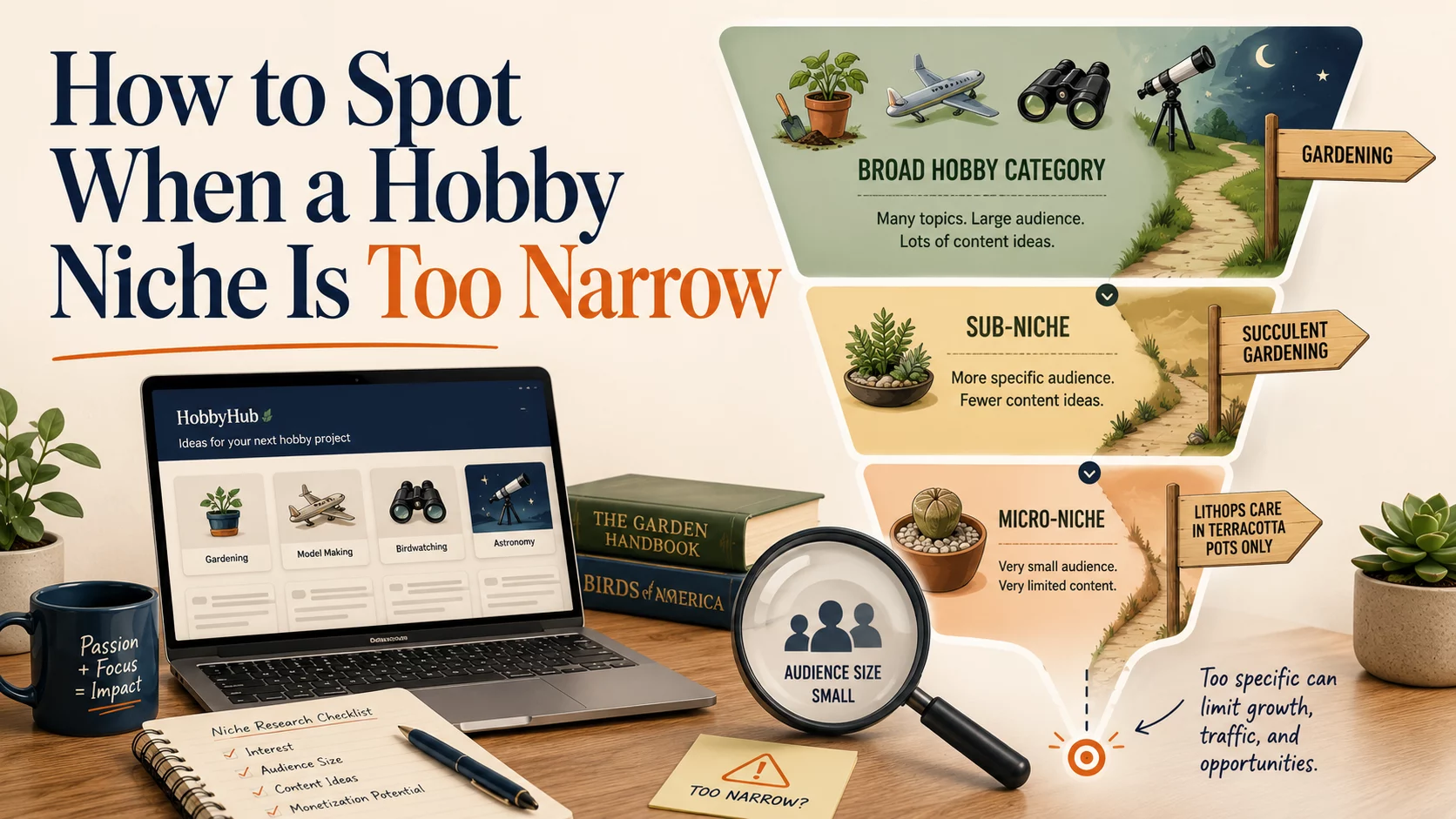
Choosing a narrow hobby niche can be a good thing.
A website about “fitness” is probably too broad.
A website about “gardening” is probably too broad.
A website about “gaming” is probably too broad.
Those topics are huge. They have too many possible directions and far too much competition for most new hobby website builders.
So narrowing the topic makes sense.
It gives your site focus. It helps readers understand who the site is for. It makes the project feel more manageable.
But you can narrow too far.
A niche can become so specific that there is not enough audience, not enough content depth, not enough earning potential, and not enough room for the website to grow.
The trick is to find the middle ground.
Focused enough to be clear.
Wide enough to build around.
The square of paper analogy
Imagine taking a square piece of paper.
You draw a line across the middle and divide it into two halves.
Then you take one of those halves and divide it again.
Then you take one of those smaller sections and divide that again.
Then again.
And again.
Each time, the piece you are working with gets smaller.
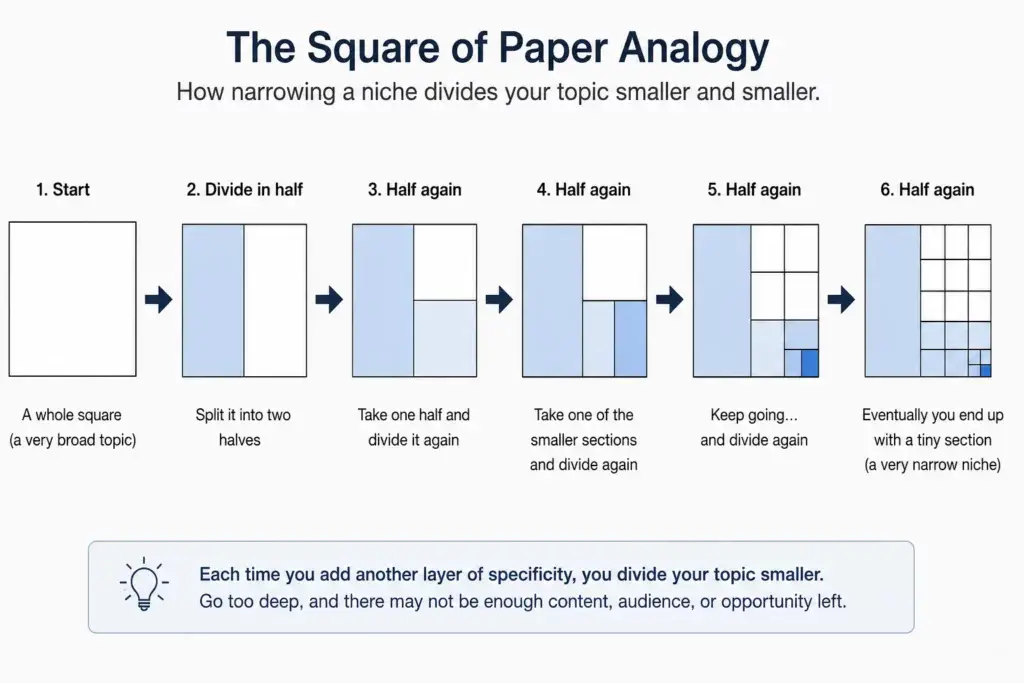
That is what can happen when you keep narrowing a hobby niche.
You start with a big topic like fitness.
Then you narrow it to fitness for people over 50.
Then strength training for people over 50.
Then dumbbell strength training for men over 50.
Then dumbbell strength training for men over 50 at home.
Then dumbbell strength training for men over 50 at home with limited space.
Then dumbbell arm workouts for men over 50 at home with limited space.
At first, the narrowing helps.
It gives the website a clearer audience.
But if you keep dividing the square, you eventually leave yourself with something tiny.
There may not be enough to write about.
There may not be enough people searching.
There may not be enough products connected to the topic.
There may not be enough room for the site to grow.
Narrowing helps you focus.
Over-narrowing traps you.
The library shelf analogy
Another way to think about this is to imagine your hobby niche as a city library.
If you walked into a huge library and said, “My website is going to be about all of the fiction books,” the topic would be far too broad.
There would be hundreds of shelves.

Crime novels.
Fantasy novels.
Romance.
Historical fiction.
Science fiction.
Classics.
Children’s books.
Modern literary fiction.
You would have so much to cover that the site would have no clear focus.
So you narrow it.
Instead of all fiction, you choose crime fiction.
That is better.
Then maybe you narrow it again to British detective fiction.
Still workable.
Then maybe you narrow again to one particular author.
Possibly still workable, depending on the author, the audience, and the depth of interest.
But if you keep narrowing, you might eventually end up with one book.

At that point, you have the opposite problem.
Trying to build a whole website around one book would be very difficult.
You might write a review, a character guide, a plot summary, a few opinion pieces, and some background notes.
But fairly quickly, you would run out of things to say.
A good hobby website usually needs the middle ground.
Not the entire library.
Not one single book.
A manageable shelf.
Enough focus that readers know what the site is about, but enough depth that you can keep creating useful content over time.
The clearest warning sign: not enough to create
A hobby website is not usually built from one article.
It grows from lots of useful pieces of content.
Beginner guides.
Common questions.
Mistakes to avoid.
Product comparisons.
Personal experiences.
Troubleshooting posts.
Checklists.
Photo examples.
Buying guides.
Glossaries.
Resources.
Tools.
If your niche is too narrow, you may run out of useful things to create very quickly.
A simple warning sign is this:
If your first ten article ideas already seem to cover most of the topic, the niche may be too small.
A strong hobby niche should leave you thinking:
“I could create a lot around this.”
A too-narrow niche leaves you thinking:
“What else is there to say?”
Other signs your niche may be too narrow
Your niche may be too narrow if most of your article ideas sound almost the same.
It may be too narrow if there are very few beginner questions.
It may be too narrow if you cannot find many people discussing it online.
It may be too narrow if there are hardly any products, tools, books, courses, accessories, or services connected with it.
It may be too narrow if you would need to move outside the niche almost immediately to keep writing.
It may be too narrow if monetisation would feel forced.
It may be too narrow if the audience is so specific that only a handful of people would ever care.
It may be too narrow if the site cannot naturally form different sections or content clusters.
One major warning sign is repetition.
If you find yourself planning near-duplicate articles just to make the site look bigger, the niche may not have enough depth.
For example:
Best dumbbell curls for men over 50.
Best dumbbell curls for men over 51.
Best dumbbell curls for retired men.
Best dumbbell curls for beginners at home.
Those are not really different ideas.
They are variations of the same idea.
A healthier niche gives you genuinely different things to cover.
Low competition can be misleading
A very narrow niche may look attractive because there is not much competition.
You may search online and think:
“There are hardly any good websites about this. This could be a great opportunity.”
Sometimes that may be true.
You may have found an underserved topic.
But low competition can also mean low demand.
It can mean not many people are searching.
It can mean the audience is tiny.
It can mean there are not many products or services connected to the topic.
It can mean the subject is interesting to you, but not active enough to support a full website.
So low competition is not enough on its own.
The better question is:
Is there low competition and real demand?
If people are asking questions, buying products, joining groups, watching videos, reading guides, and looking for help, then low competition could be interesting.
If almost nobody is doing any of those things, the niche may simply be too small.
Can the niche support content clusters?
A strong hobby website usually has more than isolated article ideas.
It has clusters.
A content cluster is a group of related articles, guides, or resources around one part of the hobby.
For example, a beginner astronomy site might have clusters around telescopes, binoculars, Moon viewing, planet viewing, eyepieces, light pollution, beginner mistakes, first-night observing, and accessories.
A baking troubleshooting site might have clusters around cakes, bread, biscuits, oven temperature, ingredients, equipment, common mistakes, and beginner techniques.
A chess improvement site might have clusters around openings, tactics, endgames, game review, time controls, training routines, and common beginner mistakes.
If your niche cannot form any meaningful clusters, it may be too narrow.
You may only have a few isolated posts rather than a proper website topic.
A simple test for a narrow niche
Before committing to a very narrow hobby niche, ask yourself:
Can I think of at least 30 to 50 useful content ideas?
Are there different branches inside the topic?
Are beginners asking questions?
Are people actively discussing the hobby online?
Are there products, tools, books, courses, accessories, or services connected to it?
Can I create different types of content, such as guides, comparisons, checklists, examples, reviews, and resources?
Could the site grow naturally later?
Would I need to repeat myself after the first few posts?
Is this a clear corner of a hobby, or just a tiny fragment?
If several answers are weak, the niche may be too narrow.
That does not mean the idea is useless.
It may simply mean you need to move one level wider.
Final thought
A hobby website needs focus, but it also needs oxygen.
If the topic is too broad, the site can feel vague and overwhelming.
If the topic is too narrow, the site can quickly run out of space.
The aim is not to make your niche as small as possible.
The aim is to make it clear enough to be useful and wide enough to keep building.
Too broad is the whole library.
Too narrow is one lonely book.
The sweet spot is the manageable shelf: a topic readers can recognise, you can explain, and the site can grow around.
If the niche feels too small, move one level wider and test again.