

Choosing a narrow niche can be sensible.
It gives your website focus.
It helps you understand who you are writing for.
It stops the project feeling too big.
But sometimes you choose a niche, write a few articles, and realise the topic may be too narrow.
That does not always mean the idea is wrong.
It may simply mean you need to move one level wider.
A Narrow Niche Usually Sits Inside a Bigger Topic
Most narrow hobby niches are part of a wider subject.
The trick is to find the wider topic that still feels connected to your original interest.
For example:
Woodworking joints could become furniture making.
Growing daffodils on a balcony could become balcony gardening.
Organic carrots could become organic vegetable growing.
One historical naval battle could become naval history or naval warfare.
Choosing a first telescope could become beginner astronomy.
In each case, the original idea is not abandoned.
It becomes one useful section of a broader site.
The Problem With Very Narrow Domain Names
This is why it is worth thinking carefully before buying a very specific domain name.
A domain such as:
GrowingDaffodilsOnBalconiesInLondon.com
is extremely limiting.
It may describe the original idea perfectly, but it gives you little room to expand.
If you later want to write about balcony herbs, container compost, small-space vegetables, wind protection, watering, or shade-loving plants, the domain starts to feel awkward.
A broader name around balcony gardening, small-space gardening, or urban growing would give you more flexibility while still staying relevant.
The narrower the domain name, the more certain you need to be that the topic has enough depth.
A Simple Niche-Widening Exercise
Before buying a domain, write down your niche idea and ask:
What is this part of?
Then move one level wider.
For example:
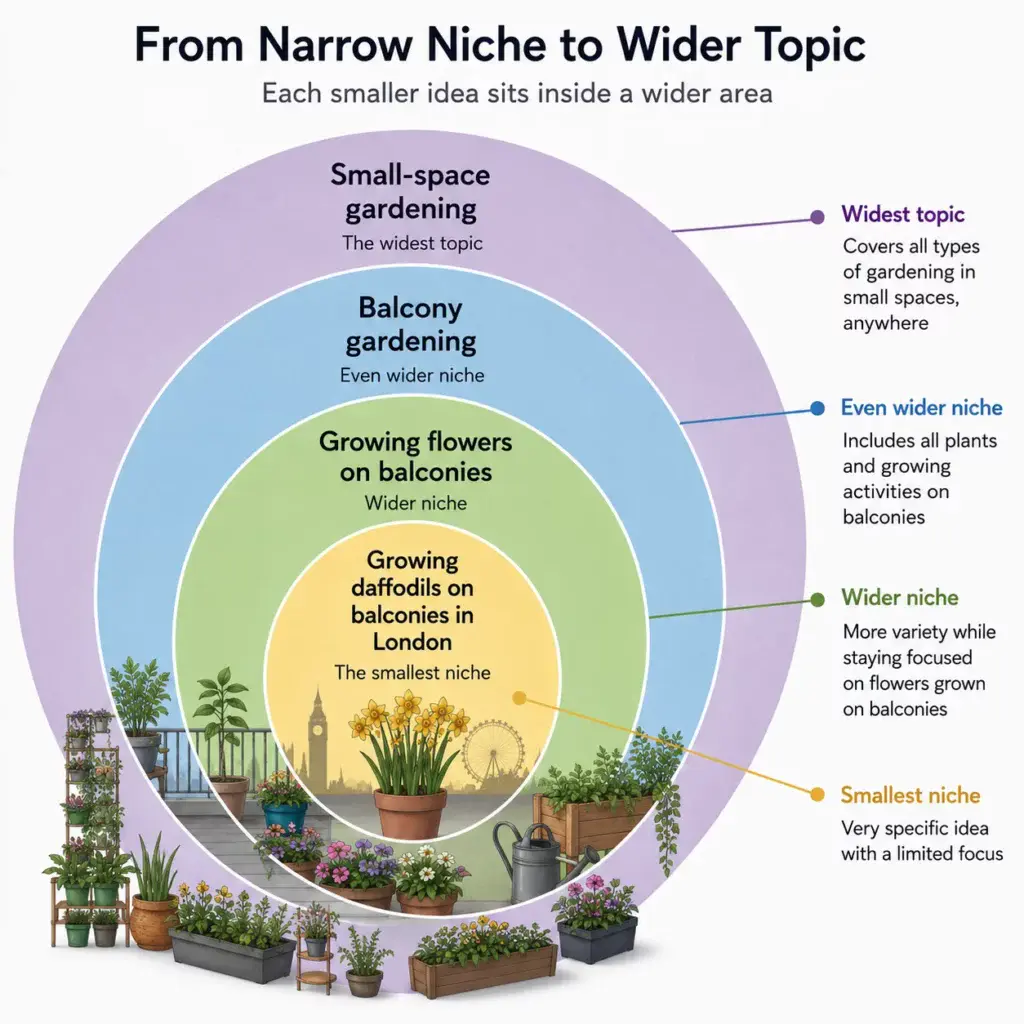
Growing daffodils on balconies in London
becomes
Growing flowers on balconies
becomes
Balcony gardening
becomes
Small-space gardening
You do not always need to keep widening.
The aim is not to make the topic as broad as possible.
The aim is to find the level where the niche has enough content potential without becoming vague.
Good Expansion Still Serves the Same Reader
A sensible niche expansion should feel natural to the original audience.
Someone interested in growing daffodils on a balcony may also care about pots, compost, watering, spring bulbs, shade, wind, small-space growing, and other balcony plants.
That is a natural expansion.
But they may not care about general lifestyle content, random product reviews, or unrelated topics added only because they might make money.
A good test is this:
Would the original reader still recognise this website as useful?
If the answer is yes, the expansion probably makes sense.
If the answer is no, you may be drifting too far from the original idea.
Keep the Original Niche as a Strong Section
Broadening a niche does not mean deleting the original idea.
The original topic can become one strong section of the site.
A balcony gardening site can still have a detailed section on daffodils and spring bulbs.
A furniture-making site can still have a detailed section on woodworking joints.
A naval history site can still have a detailed section on the battle that first interested you.
A beginner astronomy site can still have a detailed section on choosing a first telescope.
This gives the site both depth and room to grow.
Check the Content Potential Before You Commit
Before starting a site, try to list 30 to 50 genuinely useful article ideas.
Look for different types of content:
beginner questions, mistakes, comparisons, tools, projects, problems, examples, and personal experiences.
If you can only think of five or six articles, the niche may be too narrow.
If the ideas become repetitive very quickly, you may need to move one level wider.
Also ask whether the domain name would still make sense if the site expanded slightly.
That simple check can prevent you from building a site that feels boxed in after a few posts.
The Aim Is Room Without Losing Relevance
A good hobby website niche needs balance.
Too broad, and the site becomes vague.
Too narrow, and you run out of useful things to say.
The best position is usually somewhere in the middle: focused enough for a clear audience, but wide enough to support content over time.
So if your niche feels too small, do not abandon it immediately.
Ask what wider topic it belongs to.
Check whether that wider topic still helps the same reader.
Then broaden carefully.
You may not need a completely new idea.
You may just need a bigger container for the idea you already had.