
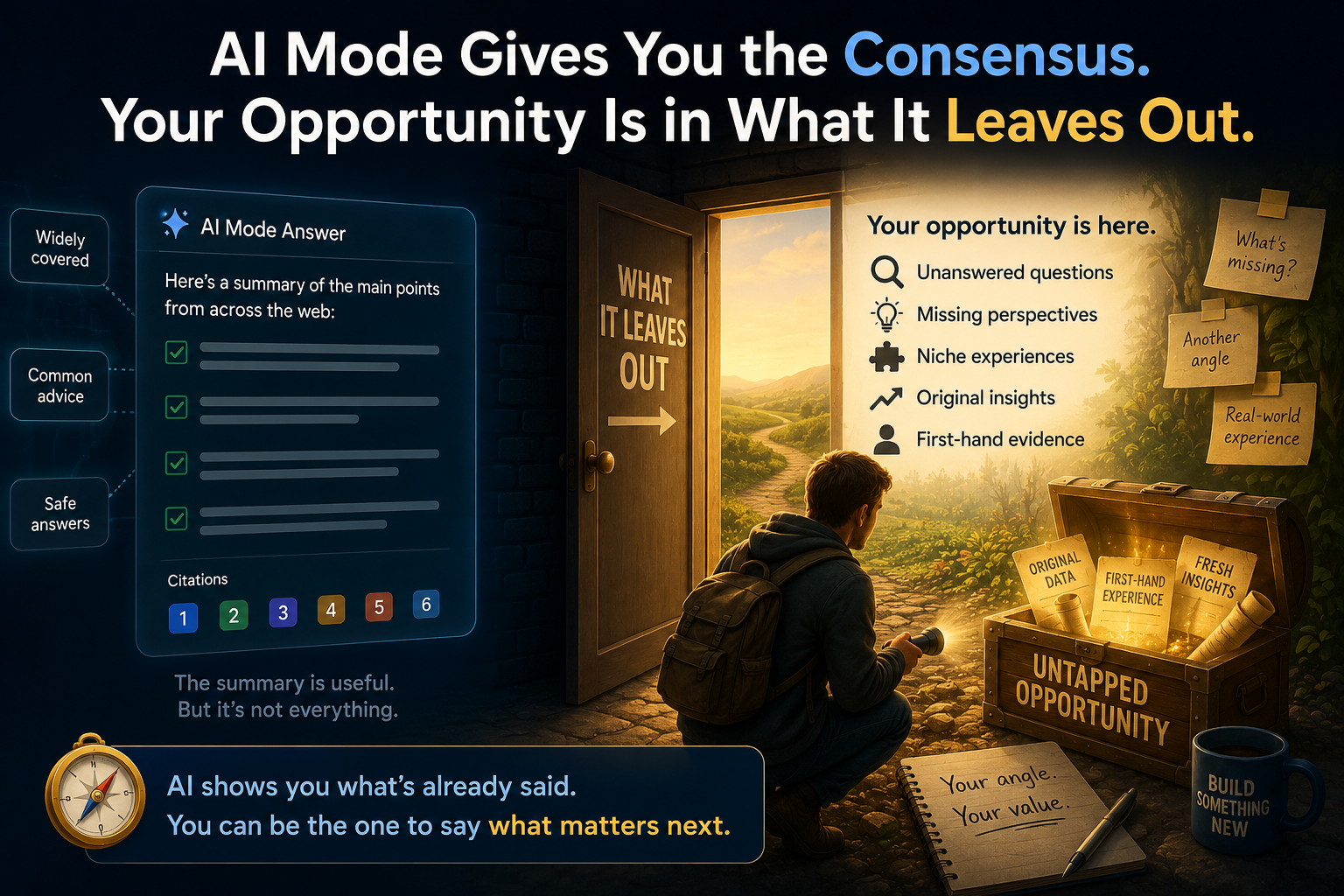
AI Mode can produce an impressively complete answer within seconds.
It can search across numerous sources, identify the broad agreement and turn it into a clear set of instructions.
That creates an obvious problem for website owners.
If AI Mode can already summarise what the internet says, what reason does anyone have to visit another article that repeats the same advice?
I recently ran a small experiment that helped clarify the answer.
The opportunity may not lie in repeating the consensus more clearly.
It may lie in finding what the synthesis has smoothed over, left unresolved or failed to examine.
Testing the same question five times
I started with a deliberately simple query:
What is the easiest way to clean the inside of a microwave?
I chose microwave cleaning because almost anyone can understand the subject. There is no specialist terminology, and the success of the method can be observed directly.
I asked the identical question five times in separate AI Mode conversations.
The core answer hardly changed.
Every response broadly recommended:
- putting water in a microwave-safe bowl;
- adding vinegar or lemon;
- heating it for three to five minutes;
- leaving the door closed so the steam could loosen the grime;
- wiping the microwave clean;
- removing or washing the turntable.
The informational consensus was extremely stable.
The citations were not.
The answer was stable. The citations were not.
Across the five responses, AI Mode displayed 83 citation references.
Those references included approximately:
- 67 different pages;
- 53 different domains;
- numerous articles, videos and social-media posts.
Around 84% of the individual pages appeared in only one response.
No page appeared in all five.
Some well-known sources appeared more than once, but the overall source pool changed considerably from one run to another.
One response cited publishers and appliance manufacturers. Another relied more heavily on cleaning companies, social posts and video creators. A later response reused several pages from an earlier result.
The selection was not completely random, but it was far from a stable ranking.
A tracking tool running the prompt once might therefore report one group of “leading cited sources.”
Run the same prompt again and it could report a substantially different group.
Both reports would accurately describe the response captured by the tool.
Neither would reveal a fixed AI citation position.
What citation tracking can and cannot tell us
This does not make citation tracking useless.
Repeated prompt monitoring can show:
- whether a website ever appears;
- how often it appears within a controlled sample;
- which competitors appear frequently;
- whether visibility appears to be increasing;
- which types of questions trigger particular pages.
But one AI response is still only one sample.
It would be more accurate for a tool to say:
This page appeared in three of ten sampled responses.
That is very different from saying:
This page ranks for this AI prompt.
AI Mode does not appear to behave like a conventional search result where one page holds a relatively stable numbered position.
The same question can produce the same practical conclusion from a changing pool of broadly interchangeable sources.
That matters for website owners paying hundreds of pounds or dollars each month for AI visibility software.
The dashboard may be measuring something real, but the number should not be mistaken for a complete view of what every user sees.
AI Mode smooths differences into one practical answer
I then looked more closely at how well one microwave-cleaning answer matched the pages cited beneath it.
The broad method correlated well.
Most of the accessible sources recommended using steam to loosen food splatters before wiping the microwave clean.
The precise instructions were less consistent.
Different sources suggested different:
- amounts of vinegar;
- quantities of water;
- heating times;
- resting times;
- treatments for stubborn stains.
AI Mode turned these variations into a neat recommendation such as:
Heat for three to five minutes and leave the door closed for five to ten minutes.
That is a sensible synthesis.
It does not mean every cited source gave those exact instructions.
AI Mode appears to recognise the overall pattern, smooth the differences and present one convenient answer. Where the underlying sources vary, it may express that variation as a range or select a representative method.
This is often helpful.
It can also hide the interesting part of the topic.
Some subjects contain more hidden nuance than others
Microwave cleaning is a relatively constrained task.
There is a clear goal, a limited range of sensible methods and an outcome that can be physically observed.
The broad answer is unlikely to change dramatically:
Create steam, allow it to loosen the grime and wipe the microwave clean.
There may still be useful questions to test:
- Does vinegar work better than plain water?
- Does lemon improve cleaning or mainly change the smell?
- Is five minutes of heating necessary?
- How much resting time actually makes a difference?
- Which method requires the fewest wipes?
But the main procedure is reasonably settled.
A subject such as stage fright is very different.
What happened with the stage-fright query
I asked AI Mode for advice about managing stage fright.
The response included preparation, breathing, exercise, posture, audience interaction and mindset techniques.
I then asked a very similar question using slightly different wording about being terrified of public speaking.
The broad consensus remained similar:
- prepare properly;
- practise aloud;
- regulate your breathing;
- slow down;
- focus on helping the audience;
- accept that nervousness is normal.
But the details and emphasis changed.
One response recommended:
Memorise the first 60 seconds.
The other warned:
Do not memorise your presentation word for word.
At first, those recommendations appear to contradict one another.
The contradiction becomes more useful when the underlying advice is examined.
The fuller explanation is closer to this:
Do not memorise the entire presentation so rigidly that forgetting one word causes you to freeze. Learn the structure and speak from prompts, but consider rehearsing the opening particularly thoroughly because anxiety is often strongest at the beginning.
That nuance was distributed across different sources and different AI Mode answers.
Neither individual synthesis exposed the tension properly.
Uncovering the tension is new content
A website owner does not necessarily need to discover a completely new scientific fact to contribute something valuable.
The contribution can come from identifying an unresolved tension and explaining it.
In the public-speaking example, a useful article could ask:
Should you memorise a presentation, or should you avoid memorising it?
It could then distinguish between:
- memorising every word;
- knowing the structure;
- rehearsing key transitions;
- learning the opening particularly well;
- relying completely on a script.
That would give the reader a more useful answer than either isolated instruction.
It would not merely copy all the existing sources into one longer article.
It would uncover a disagreement that the AI synthesis had hidden, investigate why the disagreement exists and explain the circumstances in which both recommendations can be correct.
That is information gain through analysis.
The type of subject changes the opportunity
Different topics create different routes to original content.
Practical and procedural subjects
Examples include cleaning appliances, repairing objects, cooking methods and gardening tasks.
These usually have:
- observable results;
- a limited number of variables;
- methods that can be compared;
- claims that can be physically tested.
The strongest contribution may come from doing the task and documenting the result.
For microwave cleaning, that might mean comparing plain water, vinegar and lemon under the same conditions.
Human and judgement-based subjects
Examples include public speaking, motivation, confidence, career decisions and managing criticism.
These usually involve:
- different personalities;
- different symptoms;
- different environments;
- advice that works for some people but not others;
- recommendations that depend on context.
The strongest contribution may come from recovering the nuance:
- When does memorising help?
- When does eye contact make anxiety worse?
- Is physical exercise calming or overstimulating?
- Which techniques address a racing heart, and which address forgetting your words?
- When is ordinary nervousness becoming a more serious problem?
These subjects are less likely to have one universal procedure.
A smooth AI summary can therefore make them look more settled than they really are.
Not every original contribution requires a controlled experiment
Evidence-based testing is a powerful way to create non-commodity content, but it is not the only route.
A contribution might also include:
- a documented personal case study;
- interviews with people who hold different views;
- a comparison of expert recommendations;
- an audit of how well common claims are supported;
- a framework showing when different advice applies;
- a decision tool based on the reader’s situation;
- an explanation resolving an overlooked contradiction.
The evidence must fit the claim.
A physical cleaning claim invites physical testing.
A question about stage fright may be better explored through expert guidance, personal experience, symptom-specific analysis and documented case studies.
The important point is that the writer does something beyond rewriting the existing consensus.
Why AI crawlability scores miss the central issue
Many AI visibility tools offer scores for crawlability, readiness or citation potential.
Some technical checks are worthwhile.
A page cannot be selected if it cannot be accessed, indexed or understood.
But a perfect technical score does not answer the most important question:
Does this page contribute anything that the existing sources do not already provide?
A site could have:
- excellent headings;
- flawless schema;
- fast loading pages;
- clear internal links;
- highly structured summaries;
- a perfect proprietary AI score;
and still contain nothing but interchangeable information.
Crawlability helps a system reach the page.
It does not create a reason to select it.
The danger of turning AI visibility into another green score
Website-building communities are naturally attracted to templates and checklists.
Before AI, people often spent hours trying to turn every SEO plugin indicator green.
They changed sentences, repeated phrases and rearranged headings to satisfy a formula, sometimes without noticing that the page had become worse for the human reader.
AI optimisation could easily repeat the same pattern:
- divide every answer into tiny citation-friendly blocks;
- manufacture first-person experience statements;
- add unnecessary FAQs;
- insert artificial summaries;
- copy the structure of currently cited pages;
- chase a crawlability score from 92 to 100.
The result may look optimised without contributing anything useful.
Optimising the signals is easier than doing the work.
That is precisely why it is dangerous.
A better way to use AI Mode for content research
AI Mode can still be an extremely useful research tool when it is used as a starting point rather than a template.
A stronger process is:
1. Identify the question
Choose a real question your audience is trying to answer.
2. Establish the broad consensus
Run the question and several close variations.
Look for the advice that remains stable.
3. Inspect the underlying sources
Do not rely only on the synthesis.
Check whether the sources agree on the precise details and whether the citations genuinely support the claims beside them.
4. Find the tension or gap
Look for:
- contradictory recommendations;
- unexplained ranges;
- assumptions nobody has tested;
- missing circumstances;
- weak evidence;
- advice that applies only to certain people;
- important follow-up questions the synthesis does not answer.
5. Decide what work would resolve it
That might involve:
- testing competing methods;
- gathering measurements;
- documenting personal experience;
- interviewing experts;
- building a comparison;
- designing a decision framework;
- creating a practical resource.
6. Preserve the evidence
Use photographs, screenshots, recordings, notes, test conditions, dates and honest limitations.
7. Present the result clearly
Only then should headings, summaries and page structure be optimised.
The structure communicates the contribution.
It is not the contribution itself.
Consensus is the beginning, not the finished article
AI Mode is very good at showing what the existing web broadly agrees upon.
That is useful.
It gives a website owner a map of the commodity information already available.
But the map also reveals where to dig.
For a simple practical subject, the opportunity may be to test the competing methods.
For a complex human subject, the opportunity may be to recover the disagreements and explain when each position applies.
Either way, the aim should not be to produce another polished version of the consensus.
It should be to improve the information environment.
Research what already exists.
Find what the synthesis has hidden or left unresolved.
Do the work needed to investigate it.
Preserve the evidence.
Then communicate the result as clearly as possible.
AI Mode can tell us what the internet already says.
Our opportunity is to contribute what it does not yet know how to say.