
I used to attend a few business networking clubs.
One memory that came back to me recently was how referrals sometimes worked.
In one particular group, members were expected to pass a referral each week.
That sounds good in theory.
The whole point of a networking club is that people build relationships, understand each other’s businesses, and then pass genuine opportunities when they arise.
But if everyone has to produce a referral every week, whether a natural one exists or not, the system can become a little artificial.
So some referrals were very small and easy.
For example, if there was someone in the room who sold office supplies, another member might say:
“I need two reams of copier paper.”
Technically, that was a referral.
But it was not exactly a deep business introduction.
It was not someone saying:
“I trust you enough to introduce you to my best client.”
It was not someone saying:
“I want you to advise my family on their finances.”
It was just copier paper.
And that is where the idea becomes useful for affiliate marketing and helpful websites.
Because not every recommendation requires the same amount of trust.
Buying copier paper is easy
Buying copier paper is a low-risk decision.
It is inexpensive.
It is familiar.
Most people understand what they are buying.
If the paper is not quite perfect, it is not a disaster.
Nobody’s life, business, health, savings, or long-term future depends on it.
So you do not need a huge amount of trust before making that purchase.
You might buy it from someone you have only just met.
You might buy it because the price is reasonable.
You might buy it because it is convenient.
That is completely different from choosing a financial adviser.
With a financial adviser, the stakes are much higher.
You are not just buying a simple product.
You may be trusting someone with savings, investments, pensions, retirement plans, tax consequences, and long-term financial security.
That requires a completely different level of confidence.
You would want to know who they are.
You would want to know whether they are qualified.
You would want to understand their experience.
You would want reassurance that they are acting in your best interests.
You would not usually make that decision on the basis of one quick recommendation from someone you barely know.
And this same principle applies online.
Affiliate recommendations are not all equal
One mistake people can make with affiliate marketing is to treat every recommendation as though it works in the same way.
Write an article.
Add a link.
Recommend the product.
Hope someone buys.
But the amount of trust needed depends heavily on what is being recommended.
A craft website recommending a packet of buttons is very different from a classic car website recommending a specific engine part.
The buttons are cheap, simple, and low risk.
If the reader buys the wrong buttons, it is annoying but not catastrophic.
But a car part is different.
The buyer may need to know whether it fits their model.
They may need to understand quality differences.
They may need installation guidance.
They may need warnings about common mistakes.
They may need to know when to speak to a specialist.
So the content required is different too.
A simple paragraph and a product link may be enough for a low-risk craft item.
But for a higher-risk recommendation, the reader needs more than that.
They need evidence that the writer understands the subject.
They need explanation.
They need context.
They need confidence.
Trust is not one-size-fits-all
This is why niche choice matters.
It is easy to ask:
“Is this niche profitable?”
That is a valid question.
But it is not the only question.
A better question is:
“How much trust would I need to build before someone should reasonably act on my recommendation?”
That changes the way you look at a niche.
Some niches are built around simple, low-risk purchases.
Examples might include basic craft supplies, small gardening accessories, stationery, children’s activity books, simple kitchen tools, or low-cost hobby items.
In these niches, helpful content still matters.
You still need to explain things clearly.
You still need to be honest.
You still need to help the reader make a good decision.
But the trust threshold is lower because the risk is lower.
Other niches sit in the middle.
For example, beginner telescopes, sewing machines, mountain bike helmets, garden power tools, cameras, website hosting, or paid software.
Here, the reader needs more help.
They may be confused.
They may be worried about wasting money.
They may not understand the terminology.
They may need comparisons, beginner explanations, mistakes to avoid, and clear guidance about which option suits which situation.
Then there are high-trust niches.
Classic car parts.
Specialist tools.
Expensive training courses.
Business services.
Advanced hobby equipment.
Here, the reader needs more than a casual recommendation.
They need to see real knowledge.
They need practical examples.
They need limitations explained.
They need to know what can go wrong.
And in some areas, the trust requirement is even higher.
Financial advice, legal advice, medical advice, tax planning, pensions, and investments are not casual recommendation areas.
They often require professional qualifications, regulation, and great care.
That does not mean nobody can write helpful content around those subjects.
But it does mean the content has to be handled very differently from a simple product recommendation.
The more serious the purchase, the more helpful the content needs to be
This is one of the most important lessons for anyone building a helpful niche website.
Your content has to match the seriousness of the decision.
If you are recommending something cheap and simple, the reader may only need a quick explanation.
If you are recommending something expensive, technical, or risky, they need much more.
They need to understand why the recommendation makes sense.
They need to know who it is right for.
They need to know who it is not right for.
They need to know the common mistakes.
They need to know the trade-offs.
They need to know what you have considered before making the recommendation.
That is where helpful websites can still be valuable.
A basic article might say:
“Here is the best product.”
A genuinely helpful article says:
“Here is the problem, here are the options, here is what matters, here is what can go wrong, and here is why this option may suit this type of person.”
That is a very different type of content.
It is also much harder to fake.
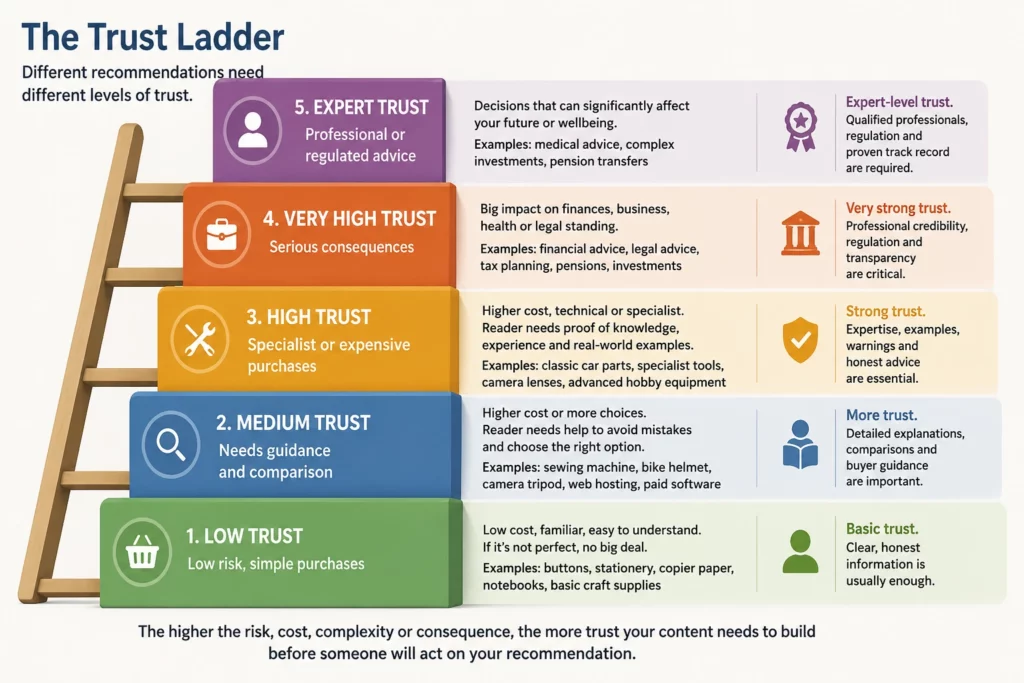
A useful trust ladder for niche websites
One way to think about this is as a trust ladder.
At the bottom are simple, low-risk products.
These need basic trust.
The reader wants clear information, fair recommendations, and a sensible explanation.
In the middle are products where the reader needs guidance.
These need more trust.
The content should educate the reader before recommending anything.
Higher up are specialist or expensive purchases.
These need strong trust.
The content should demonstrate experience, knowledge, examples, and careful judgement.
At the top are areas where the consequences of a bad decision are serious.
These need expert-level trust.
In some cases, they may not be suitable for casual affiliate-style recommendation at all.
This matters because a new website owner may look at two niches and think they are equally attractive.
But they may not be equally easy to succeed in.
A site about simple craft supplies might be able to build useful content fairly quickly.
A site about classic car restoration may need much deeper knowledge.
A site about personal finance may require a very high level of credibility before readers should rely on it.
The opportunity may still be there.
But the trust requirement is different.
Do not just chase commission rates
This is also why high commission rates can be misleading.
A product may pay a large commission because it is expensive.
But expensive products are often harder to recommend well.
The reader may need more reassurance.
The sales process may be longer.
The content may need to be more detailed.
The niche may require more expertise.
A cheap product with a lower commission may actually be easier to recommend naturally if it fits the reader’s problem and does not require a huge leap of trust.
That does not mean low-priced niches are always better.
It just means you need to understand the trust equation.
The question is not only:
“How much can I earn?”
It is also:
“How much trust must I earn first?”
Helpful content earns the right to recommend
This is where the idea of a helpful website becomes so important.
A helpful website does not begin with the product.
It begins with the reader’s problem.
What are they trying to do?
What are they confused about?
What are they afraid of getting wrong?
What do they need to understand before they can make a good decision?
Once you answer those questions properly, any recommendation becomes part of the help.
It does not feel forced.
It does not feel like a random affiliate link inserted into an article.
It feels like the natural next step.
But that only works when enough trust has been built for the type of recommendation being made.
For a packet of buttons, that may not take much.
For a telescope, it may take a detailed beginner guide.
For a classic car part, it may take genuine specialist knowledge.
For financial advice, it may take professional credibility.
Trust is not a single thing.
It depends on the decision.
The lesson for niche selection
So when choosing a niche, do not only think about traffic, commission rates, or product availability.
Think about the level of trust required.
Ask yourself:
Can I genuinely help this audience?
Can I explain the topic clearly?
Can I reduce their uncertainty?
Can I show enough understanding for the products I want to recommend?
Can I build the kind of content that matches the seriousness of the purchase?
If the answer is yes, that could be a strong niche.
If the answer is no, it may be better to choose a niche where your knowledge, experience, and content can realistically build enough trust.
Because affiliate marketing is not just about getting someone to click a link.
It is about helping someone make a decision.
And the bigger the decision, the more trust they need before they will act.
That is why trust is not one-size-fits-all.
A website recommending craft buttons does not need to prove the same things as a website recommending classic car engine parts.
A person buying copier paper does not need the same confidence as someone choosing a financial adviser.
The principle is simple:
The greater the risk, cost, complexity, or consequence of the recommendation, the more trust your content needs to build.
And once you understand that, you can choose niches more wisely, create better content, and make recommendations that actually fit the level of confidence your reader needs.