
I recently searched Google for “fitness at 50 male.”
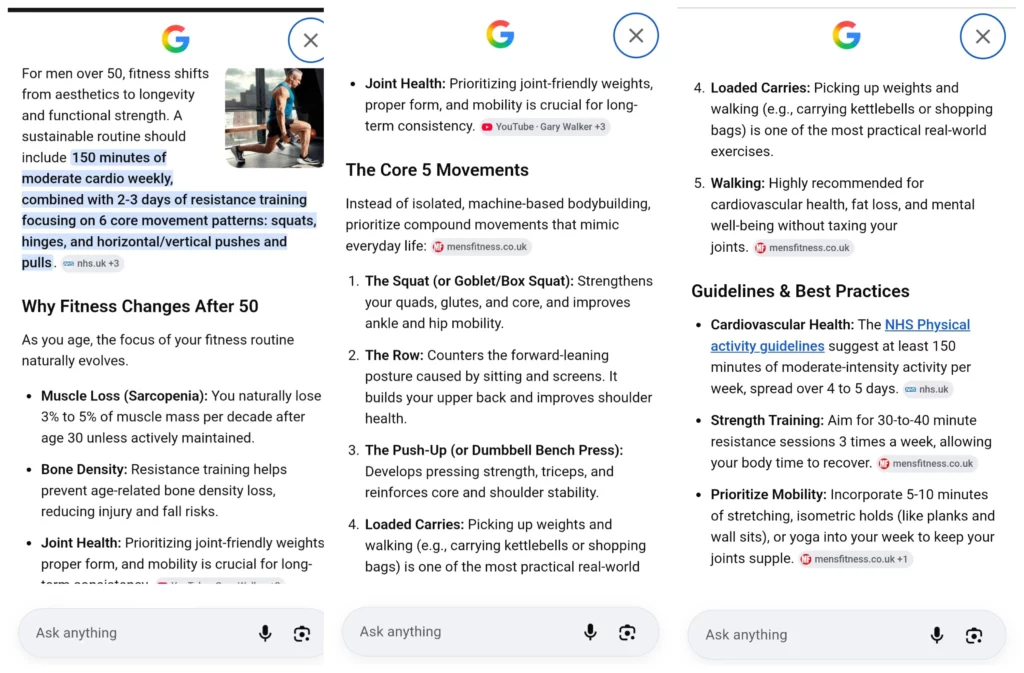
The AI overview I received was sensible.
It talked about strength training, walking, mobility, joint health, muscle loss, resistance training, and the importance of staying active as you get older.
Nothing in it struck me as wrong.
In fact, most of it was probably good general advice.
But the more AI overviews I read, the more obvious something becomes to me.
AI can give you the facts.
What it often cannot give you is the lived experience of trying to apply those facts in real life.
And I think that difference matters enormously if you are trying to build a helpful affiliate website.
The AI Answer Was Correct, But It Was Not Personal
The AI overview gave me the broad answer.
Men over 50 should focus on longevity, strength, mobility, walking, resistance training, and avoiding injury.
That is useful.
But it is also very general.
It does not know what it feels like to be 50, overweight, worried about long-term health, and wondering what happens if you do nothing.
That was much closer to where I was.
Around Christmas 2025, I started trying to improve my fitness.
I was not doing it because I wanted to look like a fitness model.
I was doing it because I was genuinely worried about where I might be in 20 years if I carried on as I was.
I could imagine myself becoming weaker, heavier, more hunched over, less mobile, and generally less able to do normal things.
That thought bothered me.
So I knew I had to start doing something.
What Actually Worked for Me
So far, dumbbells have probably been the best bit of equipment for me.
That does not mean dumbbells are the perfect answer for everyone.
It just means they worked for my situation.
I could start light.
I could use them at home.
I could gradually add more weight as I improved.
I did not need to join a gym.
I did not need to learn a complicated system.
I could just start.
When I began, I could barely do a press-up.
Six months later, I can do about 15.
That is not an extraordinary fitness transformation.
But it is real progress.
And it also taught me something important about expectations.
You do not lift a weight in the morning and see the benefit in the afternoon.
At least I did not.
For me, the first visible and physical benefits took months.
After three or four months, I started to notice that my chest felt firmer and that I had become stronger.
That is a very different message from the kind of instant-result feeling that can sometimes surround fitness content.
Progress was slow.
But it was real.
The Messy Middle Is Where the Useful Content Lives
The honest truth is that the fitness side has not been perfectly smooth.
I still get bored with it.
Sometimes I miss a week.
Then I feel tempted to do some kind of “hero session” to make up for it.
But I know that is probably the wrong instinct.
Consistent, decent-level effort over time is almost certainly better than stopping for a while and then trying to punish yourself with one big catch-up workout.
I am also very aware of injury risk.
My left outer elbow feels like I may have strained a tendon.
Sometimes I feel pain in my right knee when squatting.
So I know I need to be careful.
I am 50, not 18.
That means I have to listen to my body rather than pretend I can just blast through every ache and pain.
My diet is still not great either.
If I really want to lose weight, I know I need to sort that out.
So if I had to name my two biggest challenges, they would probably be consistency and diet.
Not knowing what exercises exist.
Not finding a list of movements.
Not understanding that walking and weights are useful.
The real problems are much more practical than that.
How do I keep going when I get bored?
How do I avoid stopping for a week?
How do I avoid overdoing it when I restart?
How do I improve my diet without making it feel impossible?
How do I train hard enough to improve, but not so hard that I injure myself?
That is where real experience becomes useful.
What This Has to Do With Affiliate Marketing
This is where the affiliate marketing point comes in.
Imagine two people decide to build a fitness-over-50 affiliate website.
The first person simply asks AI for article ideas and starts publishing generic posts:
“Best Dumbbells for Men Over 50”
“Top 10 Exercises for Men Over 50”
“How to Get Fit After 50”
“Best Home Workout Equipment for Older Men”
Those articles might be accurate.
They might even be well written.
But they will probably sound like hundreds of other articles.
They will contain information, but very little lived experience.
Now imagine a different version of the site.
This one is built around someone’s real journey.
The articles might be:
“I Started Trying to Get Fit at 50: Here’s What Actually Happened”
“I Could Barely Do a Press-Up — Six Months Later I Can Do 15”
“Why Dumbbells Worked Better for Me Than Joining a Gym”
“The Mistake I Made After Missing a Week of Exercise”
“Why Hero Sessions Are Probably a Bad Idea When You’re Starting Again”
“What My Sore Elbow and Knee Taught Me About Exercising at 50”
“The Two Things Still Holding Me Back: Diet and Consistency”
Those articles are still about fitness.
But they feel very different.
They are not just answering keywords.
They are showing a real pathway.
The Product Recommendation Feels Different
This also changes how affiliate recommendations work.
A weak affiliate article says:
“Here are the best dumbbells for men over 50.”
Then it lists products.
A more helpful article says:
“When I started trying to improve my fitness at 50, I needed dumbbells that were light enough to use safely, simple enough that I would actually use them, and adjustable enough that I could progress over time. Here is what I learned, what worked for me, what I would avoid, and what I would look for if buying again.”
That recommendation feels different.
The product is not being forced into the article.
It appears naturally because it is part of the solution.
The reader has already been helped before they are asked to consider buying anything.
That, to me, is a much better model for affiliate marketing.
A Qualified Trainer Could Take This Even Further
There is also an even stronger version of this idea.
Imagine a qualified personal trainer building a site for men and women over 50.
Instead of publishing generic fitness articles, they could create a site full of real client journeys.
They could show the problems people faced.
One person might have knee pain.
Another might be nervous about weights.
Another might have very poor starting strength.
Another might keep stopping and restarting.
Another might hate gyms but be willing to train at home.
The trainer could explain what worked for each person, what had to be adapted, what setbacks happened, what exercises were introduced at each stage, and what equipment helped.
Obviously, client privacy and consent would matter.
Stories would need to be anonymised or shared with permission.
And the trainer would need to avoid making unrealistic promises.
But as a content model, it is powerful.
Someone reading those stories might think:
“That sounds like me.”
And once they feel that, they are far more likely to trust the guidance.
If the trainer then recommends a simple set of dumbbells, resistance bands, walking shoes, a fitness tracker, or a beginner home workout plan, the recommendation has context.
It is not just an affiliate link.
It is part of a real journey.
The Community Style Website
This kind of website could almost become a community.
Not necessarily a forum, although it could be.
But a place where people see others like them making progress.
A person who is 50, overweight, unfit, embarrassed, and worried about injury may not relate to a polished fitness influencer.
But they may relate to someone who says:
“I could barely do one press-up.”
“I missed a week and struggled to restart.”
“I had to use lighter weights than I expected.”
“I had to change squats because of knee pain.”
“I did not see much progress for the first few months.”
That is real.
And real is often more useful than perfect.
Be Honest About Qualifications
There is one important point to make here.
Fitness is a health-related topic.
So if someone is not a qualified trainer, doctor, physiotherapist, dietician, or medical professional, they should not pretend to be one.
A personal fitness blog can still be valuable, but it should be honest about what it is.
For example:
“This is my personal experience of trying to improve my fitness at 50. It is not medical or professional fitness advice. If you have health concerns, injuries, or have not exercised for a long time, speak to a qualified professional before starting.”
That kind of statement does not weaken the content.
It strengthens it.
It tells the reader the truth.
And trust starts with telling the truth.
Why This Matters in the AI Age
AI can summarise the general answer.
It can explain that men over 50 should do strength training, walking, mobility work, and be careful with injuries.
That is useful.
But a helpful website can do something else.
It can show what that advice looks like when a real person tries to follow it.
It can show the boredom.
The missed weeks.
The slow progress.
The small wins.
The injury worries.
The equipment choices.
The mistakes.
The adjustments.
The emotional reason for starting.
That is the difference between information and experience.
And I think that is where small affiliate websites still have a chance.
Not by being bigger than AI.
Not by producing more generic content than everyone else.
But by being more specific, more useful, more honest, and more human.
The future of helpful affiliate websites is not just product recommendation.
It is experience-led guidance where the product appears naturally as part of the solution.
That applies to fitness.
But it also applies to gardening, baking, cycling, photography, chess, crafts, business tools, home improvement, and almost any other niche.
The pattern is the same:
Show the real problem.
Share the real experience.
Explain what helped.
Be honest about the limitations.
Then recommend the tool, product, or service only when it genuinely fits.
That is not just better affiliate marketing.
It is better content.
And in an online world full of generic AI answers, that kind of content may be exactly what readers are looking for.