
I recently searched Google for “hypertufa trough” because I am looking at making some planters for a garden project.
A hypertufa trough is basically a lightweight, stone-effect planter made from a mix such as cement, perlite and peat moss, or sometimes a more sustainable alternative such as coconut coir. It is the sort of practical topic where a searcher is not just looking for a definition. They probably want to know what materials to use, how to mix it, how to mould it, how long it takes to cure, and what can be planted in it afterwards.
The AI Overview I saw was actually quite good. It explained what hypertufa is, gave a recipe, covered the safety points, explained the moulding and curing process, and even mentioned suitable plants.
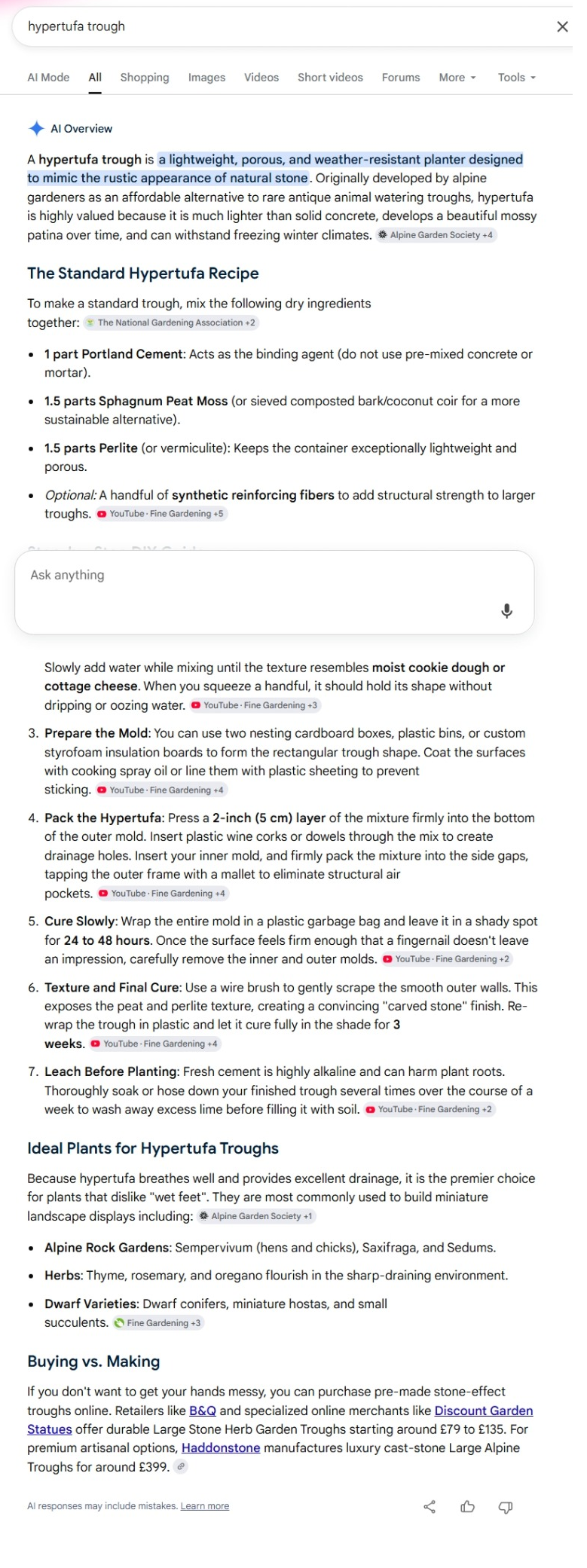
At first glance, that is helpful.
But it also made me think about something bigger.
The AI Overview Gives the Framework
One of the things I noticed was that the AI Overview seemed to follow a clear structure.
It did not just answer “what is a hypertufa trough?” It broke the topic down into a practical pathway:
What is it?
What is the recipe?
What materials are needed?
How do you make the mould?
How do you pack the mixture?
How long does it cure?
How do you finish it?
What plants can you use?
Should you make one or buy one?
That is more than an answer. It is a framework.
For someone creating content, that framework is useful. It shows the likely stages a beginner needs to understand. It shows the sub-questions sitting underneath the main query. It shows the path someone might need to follow if they want to complete the project.
But this is where I think there is a fine line.
There is a big difference between being guided by that framework and slavishly copying it.
The Video Timestamp Question
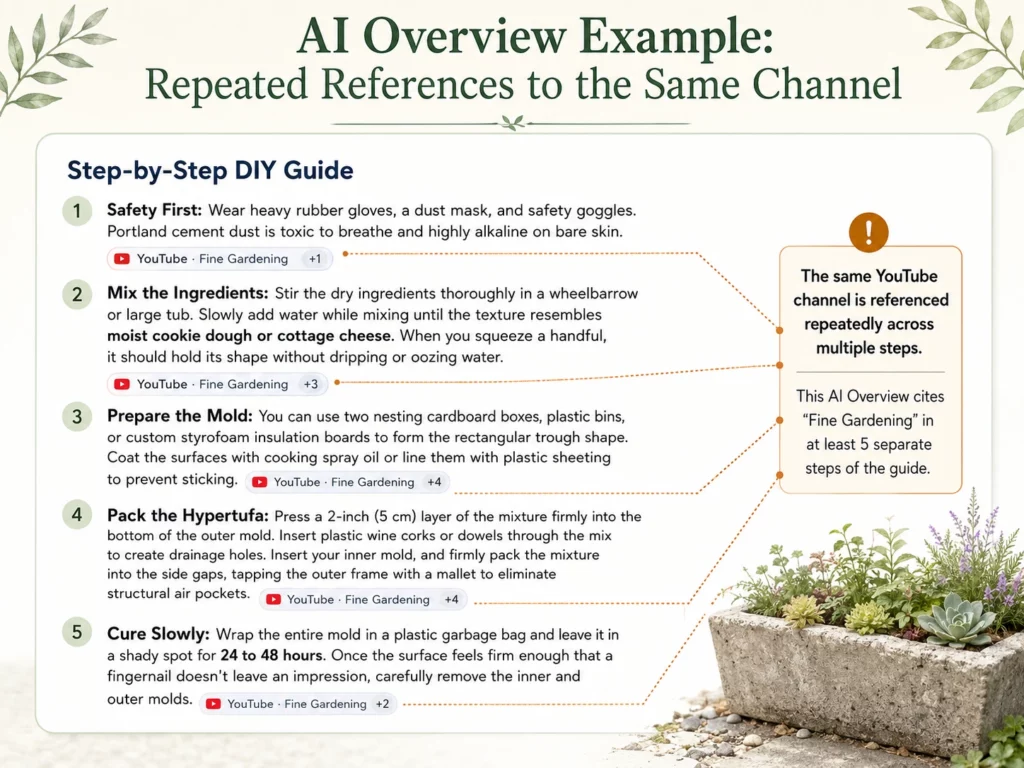
The AI Overview also showed YouTube results, and I noticed the same video channel appearing more than once.
My first reaction was that this felt a little unfair on the creator. If their video helped inform the AI Overview, but users no longer clicked through because the answer was already summarised, then the creator had helped search without necessarily getting much in return.
But then I thought about it another way.
Google and YouTube can understand videos partly through things like transcripts, chapters and timestamps. If a video is well structured, and the creator has clearly separated the stages of a process, then that video may be easier for search engines to understand.
So perhaps appearing several times was not only a negative. Perhaps it also showed that the video was comprehensive enough to match several stages of the answer.
That led to a further thought.
If creators believe that useful timestamps, chapters and clearly labelled video sections help their content appear in search features or AI results, then many will start producing content in that exact way.
And that is where the risk begins.
The Old Keyword Formula
This reminded me of the old keyword approach to SEO.
For years, people were taught to structure content in a very particular way:
Put the keyword in the title.
Put the keyword in the first paragraph.
Use the keyword in an H2 heading.
Add related questions.
Use a FAQ section.
Create a separate page for every slightly different keyword variation.
Some of that advice was not wrong. In fact, it was often sensible.
A good title helps people and search engines understand the page. A clear heading helps structure the content. Using words that real people search for is not a bad thing.
The problem was that the technique became the strategy.
Instead of asking, “How can I help this reader?”, many sites seemed to ask, “How can I build a page that looks like the kind of page Google ranks?”
The result was a huge amount of content that looked useful on the surface but often felt formulaic. It followed the expected structure. It answered the obvious questions. It included the right headings. But it did not always add much beyond what was already available elsewhere.
How I Think the Helpful Content Update Fits In
Google’s Helpful Content Update, and the later incorporation of helpful content systems into core ranking, seemed to be aimed at this kind of problem.
Google has said for a long time that it wants to reward content made for people rather than content made primarily to gain search traffic. It has also encouraged creators to ask whether their content provides original information, substantial value, first-hand expertise, and a satisfying experience.
That all sounds sensible.
But from a creator’s point of view, I think the update exposed a difficult truth.
Some sites may have been genuinely trying to help people while still using the same keyword-led structure as everyone else.
In other words, the content may have been useful in places, but the overall pattern still looked like search-first publishing.
That is where I think many people got caught.
I do not think we can say with certainty exactly how Google judged every site. Google would not describe the system as simply penalising “keyword-style” content. But it seems reasonable to say that if a certain format becomes strongly associated with low-value, search-first publishing, then even better sites using a similar format may become more vulnerable.
That is the uncomfortable lesson.
It is not enough for one page to be mildly useful if the whole site appears to be built around capturing search queries.
The Trade-Off
This is only my opinion, but I suspect Google accepted a trade-off.
If a large number of low-quality pages shared the same search-led patterns, reducing the visibility of those patterns would probably improve search results overall.
But that kind of broad improvement can still hurt some sites that were not terrible.
Some creators may have had helpful articles, but those articles existed inside a publishing model that looked too similar to the weaker sites Google wanted to reduce.
That is a harsh lesson, but an important one.
When a content format becomes overused, it can become risky even if the original idea behind it was useful.
Could AI Overview Structure Become the New Keyword Formula?
This brings me back to AI Overviews.
At the moment, an AI Overview can be useful to a content creator because it reveals the framework of an answer. It shows what Google appears to understand as the main stages, subtopics or decision points behind a query.
For a practical topic such as making a hypertufa trough, that framework can be very helpful.
But if creators start treating that framework as a formula, we could see the same pattern repeat.
Instead of keyword-stuffed articles, we may get AI Overview-shaped content.
Articles and videos might start to look like this:
Here is the exact AI Overview structure.
Here are the same steps in the same order.
Here are the same subheadings.
Here are timestamps matching each stage.
Here is a FAQ section covering the same questions.
Here is a “complete guide” that does not add much new.
That may work for a while.
But if everyone does it, the format itself may eventually become a weak signal rather than a strong one.
The danger is not structure. The danger is mistaking structure for value.
The Better Way to Use AI Overviews
I do think AI Overviews can be useful for content creators.
But I would use them as a map, not a script.
The AI Overview can help you understand the searcher’s journey. It can show you what a beginner probably needs to know. It can reveal gaps in your own thinking. It can help you avoid missing obvious stages in a process.
But the real value has to come from you.
For the hypertufa trough example, the AI Overview might show the basic steps, but a genuinely helpful article or video could add:
What I actually bought.
What the materials cost.
What the mix looked and felt like.
Which mould I used.
What went wrong.
How heavy the finished trough was.
Whether it cracked.
How long I left it before planting.
What I would do differently next time.
Photos of each stage.
An honest conclusion on whether it was worth making rather than buying.
That is much harder to replace.
It is also much harder to fake convincingly.
Value First, Signalling Second
This is the distinction I think matters most.
There is nothing wrong with helping Google understand your content. Clear headings, useful timestamps, descriptive titles, image alt text and sensible structure are all good things.
But they should support the value of the content. They should not become the value of the content.
The order matters.
First, create something genuinely useful.
Then, organise it clearly.
Then, signal that structure in a way search engines can understand.
Not the other way round.
If the process begins with “How do I match the AI Overview?”, the content is already in dangerous territory.
If the process begins with “How do I help someone complete this task better than a summary can?”, the structure becomes a helpful tool rather than a trick.
The Fine Line
This is why I think there is such a fine line between sensible SEO and fragile SEO.
Sensible SEO helps people and search engines understand genuinely useful content.
Fragile SEO follows a pattern because everyone believes that pattern is what Google wants.
That is what happened with keyword-led content. The original advice was not necessarily bad. The problem was that the web became flooded with pages that followed the formula without adding enough value.
My concern is that the same thing could happen with AI Overview-led content.
Creators may look at the AI Overview, copy the structure, add chapters, add headings, add FAQs, and assume they have produced something useful.
But unless they bring something new to the page, they are really just rebuilding the summary in a slightly longer form.
The Safer Long-Term Approach
If there is a lesson from the Helpful Content Update, I think it is this:
Do not build your whole content strategy around a format that everyone else is following.
Use frameworks, but do not become trapped by them.
Use AI Overviews to understand the shape of a query.
Use Google’s results to understand what searchers are being shown.
Use timestamps and headings to make your content easier to navigate.
But add something that could only come from a real person doing real thinking, research, testing or explanation.
That might be personal experience.
It might be original photos.
It might be a small experiment.
It might be a cost breakdown.
It might be a comparison based on actual use.
It might be a mistake you made and how you fixed it.
It might be a clearer explanation than anything else you found.
The point is that the structure should hold the value. It should not replace it.
Final Thought
AI Overviews may show the pathway.
That is useful.
But if every creator simply follows the same pathway in the same way, the content becomes predictable, replaceable and vulnerable.
The opportunity is not to copy the AI Overview.
The opportunity is to improve on it.
Use the framework to understand what the searcher needs. Then add genuine value through experience, evidence, judgement and clarity.
That, to me, is the safer lesson from the Helpful Content era.
Do not just create content that looks like an answer.
Create content that proves a real person has tried to help.