
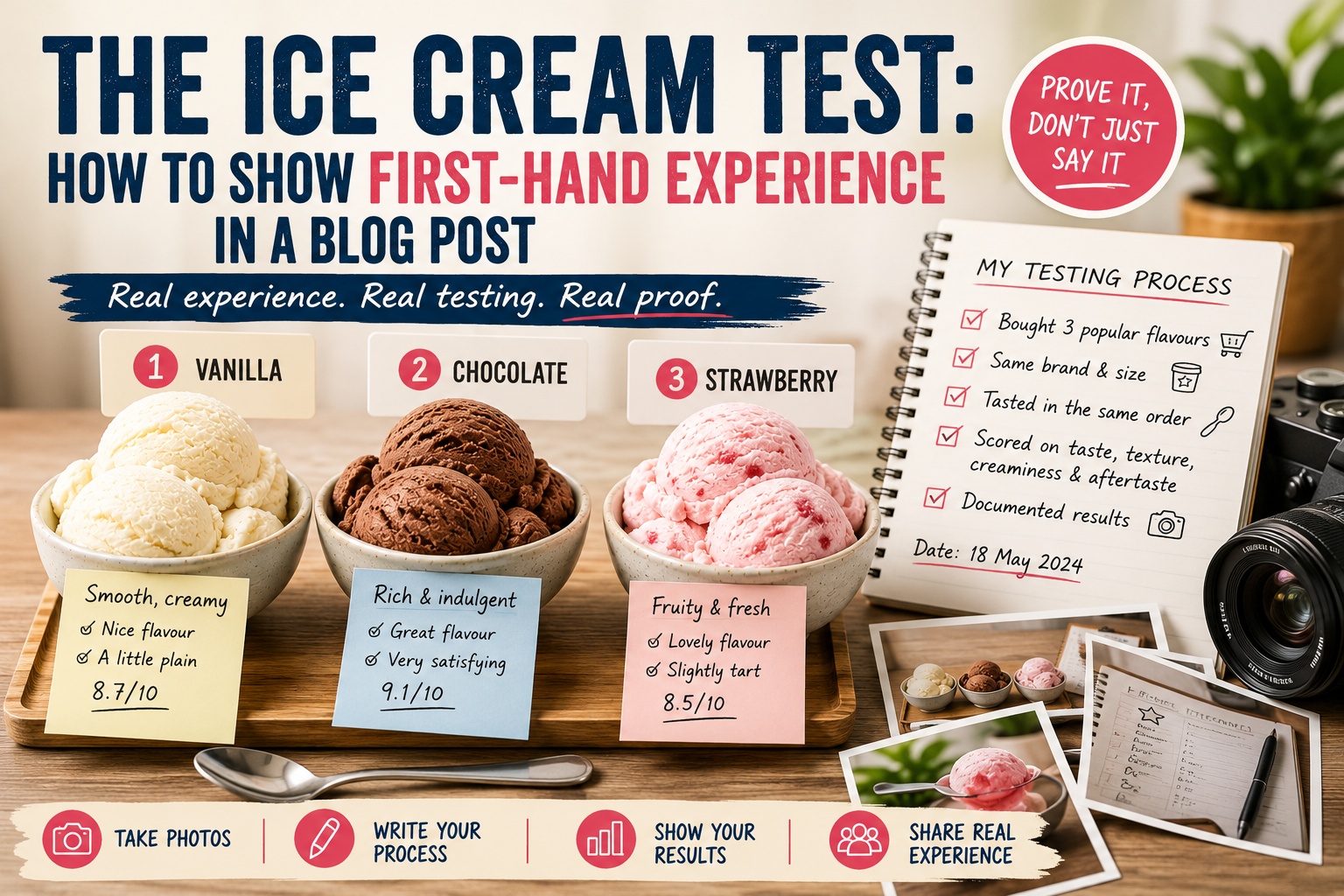
A lot of blogging advice says the same thing:
Show first-hand experience.
That sounds sensible, but what does it actually mean on the page?
It does not simply mean adding phrases like:
“In my experience…”
“When I tried this…”
“I personally found…”
Those phrases can help, but they are not proof.
A stronger article shows the reader what happened.
To explain the difference, let’s use a deliberately simple example.
Ice cream.
The weak version
Imagine I wrote this in a blog post:
ChatGPT was able to suggest the top three favourite ice cream flavours.
That sentence may be true, but it is weak.
The reader does not know:
- what I asked
- how I asked it
- what answer I received
- whether I tested anything properly
- whether anything surprised me
- whether I am simply repeating a generic answer
There is no evidence trail.
It is just a claim.
The stronger version
Now compare it with this:
I wanted to test what ChatGPT would suggest if I asked for the world’s top three ice cream flavours. So I used a simple prompt and recorded the answer.
The prompt I used was:
“What are generally considered the three most popular ice cream flavours in the world?”
ChatGPT suggested:
| Position | Flavour suggested |
|---|---|
| 1 | Vanilla |
| 2 | Chocolate |
| 3 | Strawberry |
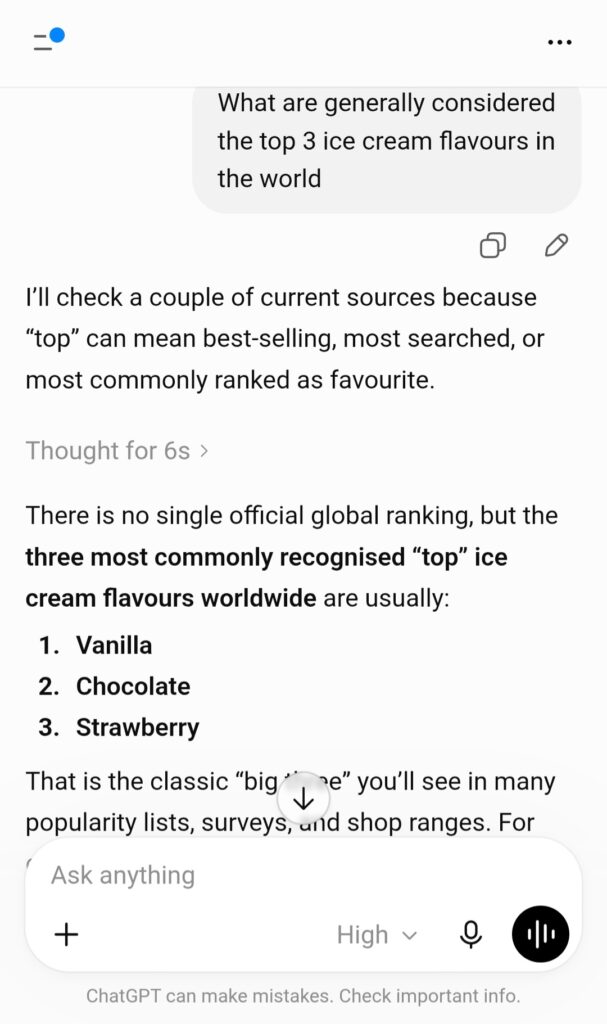
This was not a scientific survey, and I would not present it as proof of the world’s actual favourite ice cream flavours.
It was simply a small test of what ChatGPT suggested in response to that exact prompt.
But the second version is much stronger than the first.
Why?
Because the reader can see the process.
They can see what I asked, what answer I received, how I recorded the result, and how I interpreted it.
I was also slightly surprised that mint chocolate chip was not included in the top three. That small personal reaction matters because it shows I was actually looking at the result, not just repeating it.
That is the basic idea behind first-hand evidence.
It turns this:
“Here is something that happened.”
Into this:
“Here is what I did, here is what happened, here is the evidence, and here is what I noticed.”
First-hand experience leaves an evidence trail
The important word is evidence.
A blog post feels more first-hand when the reader can see signs that you actually did the thing you are writing about.
That evidence might be:
- a screenshot
- a photo
- a prompt
- a result table
- a date
- a cost
- a mistake
- a before-and-after comparison
- a timeline
- a personal observation
- a note about what you would do differently
You do not need all of these in every article.
But if there is no evidence at all, the article can easily sound like something anyone could have written after reading a few other posts.
Think like you are proving it in court
A useful way to think about first-hand evidence is to imagine you are in court.
You have written a blog post claiming that you tested something, built something, visited somewhere, used a product, or solved a problem.
Now imagine the judge says:
“Prove it.”
What could you show?

That may sound dramatic, but it is a useful mindset.
If all you have is a polished paragraph, the reader has to take your word for it.
If you have screenshots, photos, dates, notes, results, mistakes, and observations, the article feels much more real.
You are not just telling the reader what happened.
You are showing them the evidence.
Follow here for a live first hand experience documentation process.
This works online and in the real world
First-hand evidence applies to almost any type of content.
If you are testing something digital, such as ChatGPT, WordPress, Canva, a plugin, an app, or a spreadsheet, collect evidence as you go.
You might record:
- the exact prompt you used
- screenshots of the output
- settings you changed
- errors you saw
- results in a table
- before-and-after comparisons
- how long the task took
- what worked
- what failed
For example, do not just write:
ChatGPT can help you create blog titles.
Show the prompts.
Show the results.
Explain which answers were useful, which were generic, and what you changed to improve them.
That is much more useful than a bare claim.
The same applies to practical hobbies
If you are writing about a practical hobby, take photos while you are doing the work.
If you are building a small garden water feature, show:
- the starting point
- the materials
- the messy middle
- the problem you hit
- the part that did not fit
- the finished result
- what you would change next time
That is stronger than simply writing:
Building a small water feature is a good weekend project.
The reader wants the real details.
They want to know what actually happened.
Often, the small mistakes and awkward moments are the most useful parts of the article.
Travel content can use the same approach
Travel writing is another clear example.
A weak version might say:
Parking at the airport was easy and check-in was straightforward.
A stronger version would show more of the experience:
We used the long-stay car park, arrived just after 6 a.m., waited around 12 minutes for the transfer bus, and reached the terminal with enough time for check-in. The signs were clear, but the return journey was slower than expected because the bus stop was busier than it had been on the way out.
That version is more useful because it contains practical evidence.
It gives the reader something they can picture and learn from.
You could also include:
- your itinerary
- parking details
- ticket screenshots
- photos from the journey
- notes about delays
- costs
- what you would do differently next time
Again, the aim is not to overload the article.
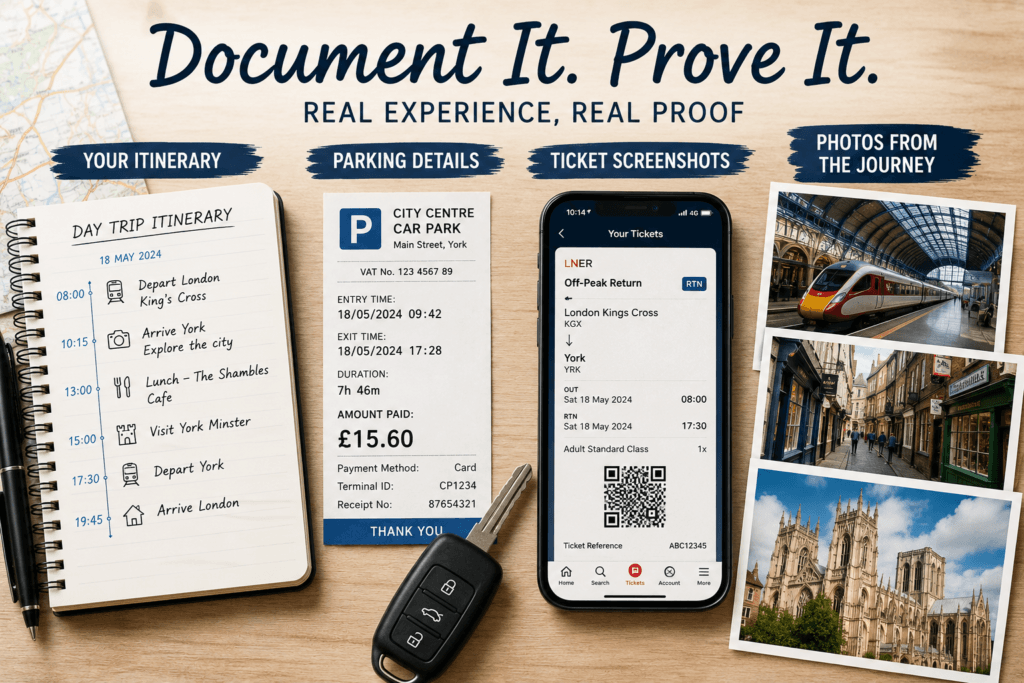
The aim is to include enough real detail that the reader can tell you were there.
A simple evidence ladder
Not all first-hand evidence is equally strong.
Here is a simple way to think about it.
| Level | What the article includes | Strength |
|---|---|---|
| 1 | Generic advice only | Weak |
| 2 | First-person wording | Slightly better |
| 3 | A personal story | Better |
| 4 | Screenshots, photos, dates, results, or examples | Strong |
| 5 | Failures, updates, comparisons, and lessons learned over time | Very strong |
Every article does not need to reach level five.
But if the article is based on something you claim to have done, it is worth asking:
Can I move this higher up the evidence ladder?
Sometimes one screenshot, one photo, or one honest mistake is enough to make the post feel much more credible.
Collect the evidence before you write
First-hand evidence is much easier to include if you collect it while you are doing the thing.
Do not wait until the article is finished and then try to make it sound experienced.
Instead, gather the proof as you go.
If you are testing software, take screenshots.
If you are building something, take photos.
If you are comparing products, keep notes.
If you are using AI, save the prompts and outputs.
If you are travelling, record the practical details.
If something goes wrong, write it down.
That mistake may become one of the most helpful parts of the article.
A simple first-hand evidence checklist
Before publishing, ask yourself:
Could a reader tell that I actually did this?
Then check whether you have included answers to some of these questions:
- What did I personally do?
- When did I do it?
- What exact tool, product, place, prompt, or method did I use?
- What proof can I show?
- What happened?
- What surprised me?
- What went wrong?
- What did I learn?
- What would I do differently next time?
- What should the reader be careful about?
You do not need every answer in every post.
But if the article contains none of them, it may not feel very first-hand.
The lesson from the ice cream test
The ice cream example is silly, but that is why it works.
The weak version said:
ChatGPT suggested the top three favourite ice cream flavours.
The stronger version showed:
- the prompt
- the result
- the table
- the limitation
- the personal reaction
The topic did not become more serious.
The evidence became clearer.
That is the real lesson.
First-hand experience is not about making every article a major research project.
It is about showing enough of the process that the reader can see what actually happened.
Final thought
If you want your blog posts to feel more real, do not start by asking:
How can I make this sound more experienced?
Ask:
What evidence can I show that proves I actually did this?
That one question changes the article.
It moves you away from generic advice and towards documented experience.
And in a world where generic content is easy to produce, that evidence trail may become one of the most valuable things a small site owner can create.