
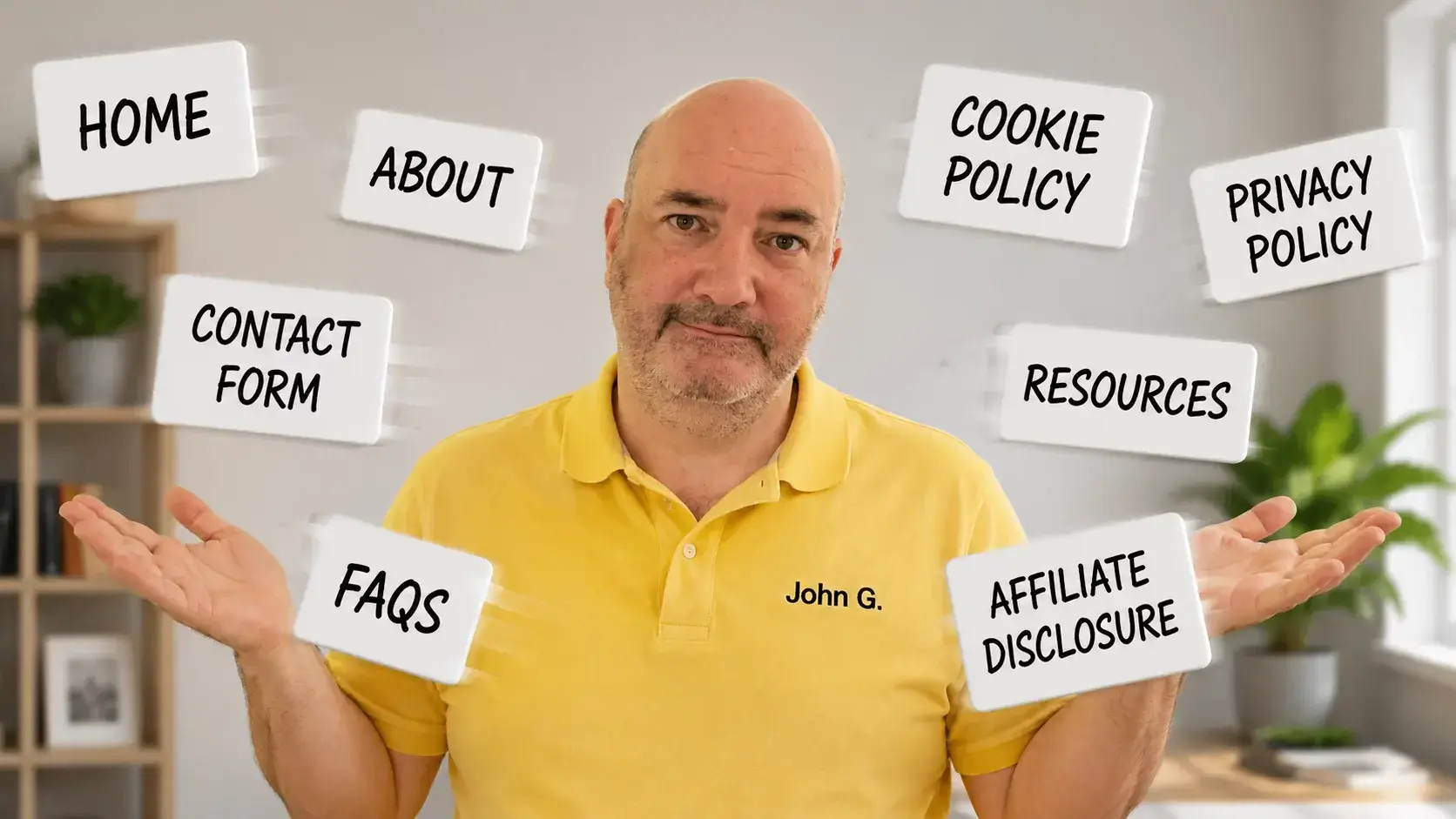
When you install WordPress, it is easy to assume that your next job is to create every page mentioned in a website-building checklist.
Home, About, Contact, Privacy Policy, Cookie Policy, Terms and Conditions, Disclaimer, Resources, Services—the list can quickly make a small hobby website feel like a multinational company.
In reality, you probably need far fewer pages.
The important question is not simply, “What pages should a website have?” It is:
What pages does my website need to help its visitors and accurately explain what happens when they interact with it?
Some pages help readers understand and navigate your website. Others may be needed because you collect personal information, use cookies or earn commission from recommendations. A few will only become relevant if you later sell something, create a membership or introduce additional features.
For a typical new hobby website, a sensible starting point is:
- A homepage
- An About page
- A Contact page
- A Privacy Policy
- Cookie information and consent controls where required
- An Affiliate Disclosure if you use affiliate links
- A Start Here page if readers need help navigating a larger subject
Topic hub pages can then be added as your content grows.
Start with what your website actually does
Before copying policy templates or creating pages, look at how people can interact with your website.
Ask yourself:
- Can visitors submit a contact form?
- Can they leave comments?
- Do I use website analytics?
- Do I embed YouTube videos?
- Do I use affiliate links?
- Can someone join an email newsletter?
- Do I sell products or services?
- Can visitors register for an account, membership or course?
Your answers determine which pages and disclosures you need.
For example, a simple website containing articles and photographs will have different requirements from one that collects email addresses, processes payments and allows people to create accounts.
This is why copying a standard privacy policy without understanding it is not a good solution. The policy needs to describe what your website actually does.
Pages that help visitors use your website
The first group of essential pages exists primarily for the reader. These pages explain the website, establish who is behind it and help visitors find useful content.
Your homepage
Your homepage is often the first opportunity to help someone understand where they have arrived.
There are two common approaches.
A static homepage can introduce the website, explain who it is for and direct readers towards its main sections. Alternatively, the homepage can display a blogroll containing the latest posts.
Neither approach is automatically correct.
I currently use a blogroll as the homepage of Action With AI. It displays the growing volume of content on the site, while a separate Start Here page and the main navigation provide more structured guidance.
I could instead make the Start Here page my homepage. That would probably give a first-time visitor more immediate direction. However, the present arrangement works well enough while the website is still being built, so changing it is not an urgent priority.
The real test is not which layout convention you follow. It is whether a new visitor can work out:
- What the website covers
- Who it is intended to help
- Where to begin
- What they should read next
A blogroll is not a substitute for proper organisation. Even if it eventually contains links to every post, a long chronological list does not explain how those posts fit together.
Topic hubs, categories and contextual internal links provide that structure more effectively.
A Start Here page
A Start Here page is especially useful when your website teaches a process or guides readers through a journey.
Action With AI is intended to help someone move from the idea of creating a hobby website through choosing a subject, building the site, producing useful content, finding an audience and potentially earning from it.
A new visitor should not have to reconstruct that journey from the order in which posts happened to be published.
A Start Here page can:
- Explain who the website is for
- Set realistic expectations
- Introduce the main stages of the journey
- Direct readers to the appropriate topic hub
- Help someone identify their next step
A small hobby diary containing a handful of posts may not need a separate Start Here page. However, it becomes increasingly helpful as a website grows or covers a process with several stages.
An About page
An About page helps visitors understand who is behind the website and why they should pay attention to it.
It does not need to be a formal biography or a dramatic success story. It should explain:
- Who you are
- Why you created the website
- Your relevant experience
- Who you are trying to help
- What readers can expect
- Any important limits to your expertise
This is particularly valuable for a hobby website. Readers are not necessarily looking for a polished corporate identity. They may be more interested in hearing from a real person who is learning, experimenting and sharing genuine experience.
My own About page needs to be revised. It reflects an earlier version of Action With AI, when I was considering writing about a much wider range of AI tools. The website now has a clearer focus on helping people build useful hobby websites with assistance from AI.
I intend to complete the main content hubs before producing the full replacement. That will allow the About page to reflect what the finished site actually offers rather than requiring several complete rewrites along the way.
However, an outdated page should not be allowed to give visitors a misleading impression indefinitely. A short interim amendment can explain the website’s current direction until the full rewrite is ready.
Crucially, rewriting an About page does not mean changing its address. I can replace or substantially revise the content while keeping the same URL.
That preserves any existing links and avoids creating unnecessary page-not-found errors.
A Contact page
A Contact page gives readers a way to ask questions, report problems or contact the person behind the site.
You do not have to publish your personal email address. A contact form can provide a more controlled route and reduce the likelihood of your address being collected by automated systems.
The form on Action With AI sends the visitor’s message to the site administrator’s email address. It does not save the submission inside WordPress, and my email address is not displayed publicly.
That exact process matters when describing the form in the site’s privacy information.
Although WordPress does not retain the message, personal information is still transmitted by email and may remain in the receiving email account. The privacy policy should describe what really happens rather than simply saying that the website does not store submissions.
It is also sensible to place a short privacy notice beside the form. For example:
Your details will be used to respond to your enquiry. Information submitted through this form is emailed to the site administrator and is not stored on this website. Please see the Privacy Policy for more information.
The words “Privacy Policy” should link directly to the policy.
The UK Information Commissioner’s Office recommends providing privacy information when personal data is collected. A policy elsewhere on the website can be used, but the person should be made aware of it and given an easy way to access it. A clear link beside the contact form provides that connection.
Topic hub pages
Topic hubs help organise a growing collection of articles.
Each main hub on Action With AI represents a distinct part of the reader’s journey. The hub explains the broad subject and links to individual posts that explore particular questions in more detail.
Once completed, the Build Your Website hub will connect posts about hosting, domain names, WordPress installation, settings, themes, plugins, backups and essential pages.
Individual posts should link back to their relevant hub. They can also link to closely connected articles where that helps the reader move naturally between subjects.
You do not need to create an elaborate hub for a topic that currently contains only one or two posts. Hubs become useful when there is enough content to organise and explain.
Policy and disclosure pages
The next group of pages concerns privacy, cookies and commercial transparency.
The precise requirements depend on what your site does, where you are based, where your visitors are located and which services you use. The following is general website guidance rather than individual legal advice.
Privacy Policy
A Privacy Policy should explain how personal information is handled.
Depending on the site, this could include information collected through:
- Contact forms
- Comments
- Analytics
- Newsletter subscriptions
- Orders and payments
- User accounts
- Embedded third-party content
- Cookie-consent records
A useful policy should explain what information is collected, why it is used, where it goes, who may process it, how long it is retained and what rights the individual has.
The ICO’s right-to-be-informed guidance provides a more complete explanation of the information UK website operators may need to provide.
Traffic volume does not determine whether these activities exist. A website with three visitors can still collect an email address, set an analytics cookie or send data to a third-party service.
That does not mean a small hobby website should panic. It means its privacy information should be proportionate, understandable and based on its actual setup.
Cookie Policy and consent controls
Cookies are small pieces of information stored on or accessed through a visitor’s device. Some are required for a website to function, while others may support analytics, advertising, embedded media or additional features.
Cookies and similar technologies can be introduced by:
- Analytics services
- YouTube and other embedded content
- Comment systems
- Contact forms
- Advertising platforms
- Social-media integrations
- WordPress plugins
This is one reason cookie compliance can feel confusing. You may not have deliberately written any tracking code, but a plugin or embedded service can introduce it.
I initially used CookieYes on Action With AI. While researching privacy and cookie requirements for this series, I decided to test several alternatives and eventually changed to Complianz.
I found its setup wizard easier to understand. Its scan identified services associated with Site Kit, YouTube embeds, comments and my contact form. The resulting banner gives visitors the option to accept or reject relevant technologies and includes links to the Privacy Policy and Cookie Policy.
My testing indicated that YouTube content and analytics remained blocked when the relevant option was rejected.
That does not mean every hobby website should automatically install the same plugin. It illustrates the value of using a tool that helps you understand what is present rather than merely displaying a generic banner.
Cookie requirements are detailed enough to justify their own article. The essential point here is that the policy and consent setup must correspond with the tools your website actually uses.
Affiliate Disclosure
If you may receive money or another benefit when someone follows a recommendation, that relationship should be made clear.
Action With AI currently has one affiliate relationship: Wealthy Affiliate. I have been a member since 2015 and recommend it based on my own experience, but I may also receive a commission if someone joins through one of my affiliate links.
The site has a dedicated Affiliate Disclosure explaining that relationship. It also makes clear that building a website, joining Wealthy Affiliate or following the guidance on Action With AI does not guarantee earnings.
Those are two related but different messages:
- The affiliate disclosure tells readers that I may receive a commission.
- The earnings qualification explains that there is no promised financial result.
A separate disclosure page in the footer is useful, but it should not be the only indication of an affiliate relationship. A short, clear disclosure should also appear within or near content containing affiliate links, where readers are likely to see it before deciding whether to click.
Care is also needed with income claims. Saying that results are not guaranteed does not make an unsupported earnings promise acceptable. The overall impression must still be honest.
ASA guidance on earnings claims says quoted earnings should be truthful and realistic, and that figures should not be based on a small, unrepresentative group of unusually successful people.
For a site like mine, the simplest approach is not to promise that a hobby website will produce a particular income. It may create opportunities to earn, but success depends on the subject, audience, competition, quality of the work, consistency and time invested. Many websites never produce significant income.
Terms and Conditions
Not every simple hobby blog automatically needs an elaborate Terms and Conditions page.
It becomes more relevant if the website:
- Sells products or services
- Offers paid memberships
- Provides downloadable products with usage restrictions
- Allows people to create accounts
- Runs competitions
- Accepts substantial user-generated content
- Needs to establish contractual terms
If your site simply publishes informational articles, you should not add a complicated terms page solely because it appeared on a generic checklist.
Create it when there is a real activity or relationship for the terms to govern.
Specialist disclaimers
Some subjects involve greater risk and may require additional care.
Examples include websites providing content about:
- Health and medical matters
- Personal finance
- Legal questions
- Regulated products
- Safety-sensitive activities
A disclaimer is not permission to publish careless information. The content itself still needs to be properly researched, accurately presented and clear about its limitations.
If your website moves into a regulated or high-risk area, generic wording generated from a template may not be enough. That may be the point at which appropriate professional guidance becomes worthwhile.
Where should these pages appear?
It helps to separate your website navigation into two broad groups.
The main menu can focus on the reader’s journey:
- Start Here
- Main subjects
- Topic hubs
- Other central content destinations
A footer or utility menu can contain:
- About
- Contact
- Privacy Policy
- Cookie Policy
- Affiliate Disclosure
- Terms and Conditions, if applicable
That is how Action With AI is currently organised. Its About, Contact and policy pages are accessible through footer menus, leaving the main navigation available for the website-building journey.
However, appearing in the footer does not mean a policy can remain disconnected from the activity it explains.
Relevant notices should also appear where the interaction happens:
- A privacy link beside a contact form
- An affiliate disclosure near affiliate links
- Appropriate terms during a purchase or registration process
The footer provides permanent access. The contextual notice helps someone make an informed decision at the appropriate moment.
Pages that can wait
You may eventually find a use for pages such as:
- Resources
- Recommended tools
- Services
- Work With Me
- Testimonials
- Media or press information
- Newsletter archives
- Courses
- Memberships
- Individual author profiles
You do not need to create them before the underlying purpose exists.
Theme demonstrations often contain impressive layouts with numerous menu items. Beginners can then feel they need to invent content to fill those spaces.
I have made that mistake in the past—trying to find a reason to keep features simply because they looked impressive in a demonstration.
A page should exist because it helps the visitor or supports a real website function, not because the theme contained a space for it.
Delete the sample content
A new WordPress installation may contain a sample post, sample page or hosting-provider welcome post.
Wealthy Affiliate installations generally include welcome-style content instead of the standard WordPress example. Either way, it is demonstration content rather than part of your website.
Once you understand its purpose, delete it.
Leaving unrelated placeholder content published does not add anything useful and can make an unfinished website look more confusing.
Review these pages as your website changes
Supporting pages are not something you create once and forget forever.
Review them when you:
- Install a plugin that handles visitor information
- Introduce analytics or advertising
- Embed a new third-party service
- Start an email newsletter
- Add a new affiliate relationship
- Sell a product or service
- Create memberships or user accounts
- Change how contact forms are handled
- Substantially change the website’s purpose
You can update the contents of an established page without changing its URL.
That is normally the safest approach. Keep the existing address, revise the information and allow visitors and search systems to find the updated version in the same place.
A practical minimum-page checklist
For a typical new hobby website, I would prioritise the following.
Create early
- A suitable homepage
- An About page
- A Contact page
- A Privacy Policy reflecting the site’s actual setup
- Cookie information and consent controls where required
- An Affiliate Disclosure if affiliate links are used
- A Start Here page if the subject needs a guided route
Add as the website develops
- Topic hubs when you have enough connected content
- Terms for sales, memberships or user accounts
- Specialist disclaimers for sensitive subjects
- Services, resources, courses or other pages when those offerings genuinely exist
Keep the page list simple and accurate
Your hobby website does not need every page that a large commercial organisation might use.
It needs enough information to help visitors understand the site, find their way around, contact its owner and know what happens when they submit information or follow a commercial recommendation.
Begin with a small set of useful and accurate pages. Make them easy to find, connect them to the relevant parts of the website and review them when the site changes.
A short policy that truthfully explains what your website does is more valuable than an impressive legal-looking template that you do not understand and which bears little relationship to reality.