
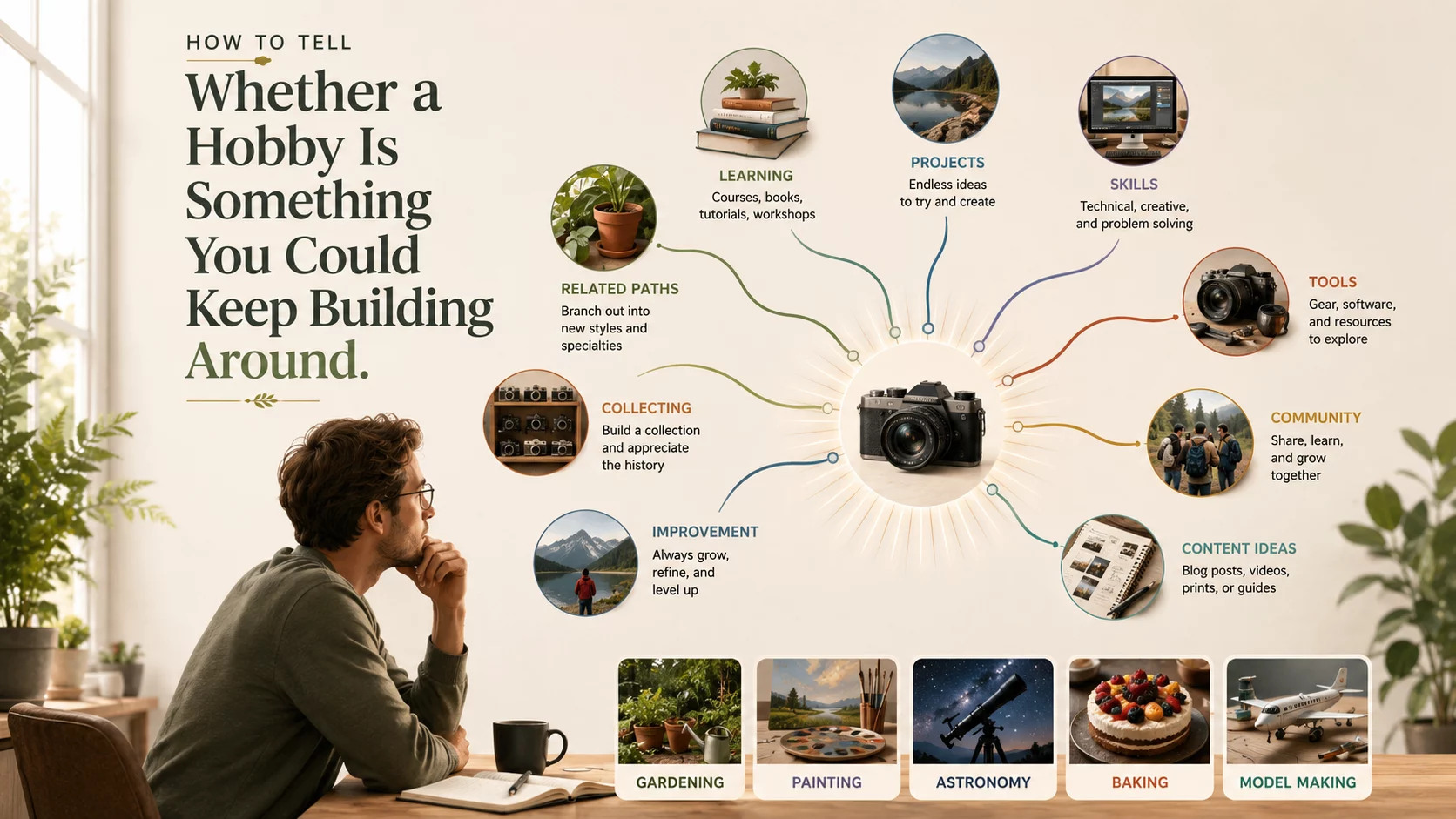
Before building a hobby website, it is worth asking a simple question:
Is there enough in this hobby for me to keep creating useful content over time?
You do not need every article planned before you start.
You do not need to know exactly what the website will look like in two years.
But the hobby does need some depth.
A good hobby website is usually not built from one idea. It grows from connected ideas: beginner questions, practical tasks, buying decisions, mistakes, comparisons, guides, personal experiences, tools, resources, and things you learn along the way.
So before choosing your hobby website topic, it helps to map the hobby out.
Not in a complicated way.
Just enough to see whether there is something there.
Start with a simple hobby map
For this kind of brainstorming, I personally find pen and paper works best.
Typing on a screen can be useful later, but when I am trying to get ideas out of my head, physically writing them down often works better.
There is something about sketching, circling, crossing out, connecting lines, and adding ideas in the margins that helps the thinking flow.
You do not need a perfect system.
Write the hobby in the middle of the page and start adding anything that comes to mind.
You might add:
Beginner questions.
Common mistakes.
Equipment.
Places.
Techniques.
Things to buy.
Things to avoid.
Things to practise.
Things to compare.
Things to photograph.
Things to explain.
Things you wish you had known earlier.
At this stage, do not judge the ideas too quickly.
Just get them down.
Look for the main branches
Once you have a few ideas on the page, look for branches.
A hobby usually has different areas inside it.
Beginner astronomy might branch into telescopes, binoculars, Moon viewing, planet viewing, light pollution, eyepieces, apps, first-night mistakes, accessories, and what you can realistically see.
Baking might branch into equipment, ingredients, recipes, oven temperature, cake troubleshooting, bread making, biscuits, decorating, and beginner techniques.
Chess might branch into openings, tactics, endgames, time controls, ratings, online play, common mistakes, training routines, books, and game analysis.
The exact branches do not matter at this stage.
What matters is whether the hobby naturally breaks into useful areas.
If it does, that gives your future website somewhere to grow.
Ask what people actually do in the hobby
A useful hobby website often grows from real activity.
So ask:
What do people physically do in this hobby?
Do they make things?
Fix things?
Collect things?
Visit places?
Compare equipment?
Follow events?
Practise skills?
Track progress?
Watch tutorials?
Join groups?
Take photos?
Keep notes?
Upgrade tools?
Solve problems?
The more practical activity there is around a hobby, the more content opportunities there usually are.
A person who enjoys gardening might plant, prune, water, compost, build raised beds, choose tools, solve pest problems, visit garden centres, compare products, and take seasonal photos.
A person who enjoys model railways might plan layouts, build scenery, wire track, choose locomotives, paint details, fix problems, visit exhibitions, and review accessories.
A person who enjoys fitness might choose equipment, learn exercises, track progress, avoid injury, compare routines, and adjust training around real life.
Those activities can become articles, guides, videos, checklists, comparisons, and personal examples.
Look for beginner confusion
Beginner confusion is one of the best signs that a hobby can support useful content.
Every hobby has things that experienced people forget were once confusing.
Terms.
Tools.
Rules.
Costs.
Setup steps.
Common mistakes.
Buying decisions.
Safety concerns.
Unrealistic expectations.
If you can remember what confused you at the beginning, write it down.
Those questions are valuable because they come from real experience.
For example:
Why does my telescope show the image upside down?
Why does my cake sink in the middle?
Which chess opening should I learn first?
What size pump do I need for a small water feature?
What dumbbells should a beginner over 50 start with?
Simple questions are often exactly what beginners search for.
Connect related ideas
Once you have a messy page of ideas, start connecting them.
Some ideas will naturally group together.
Beginner questions may connect to equipment.
Equipment may connect to buying guides.
Buying guides may connect to mistakes.
Mistakes may connect to troubleshooting.
Troubleshooting may connect to checklists.
Checklists may connect to downloadable resources.
This is useful because it shows how a website could grow.
You are not just looking for isolated article ideas.
You are looking for clusters.
For example, a beginner telescope cluster might include:
What can you see with a beginner telescope?
What type of telescope should a beginner buy?
What does aperture mean?
Why can’t I find planets?
What eyepieces do I need?
What accessories are actually useful?
First night telescope checklist.
That is not one random article.
That is a small content area.
A strong hobby website often grows from these connected groups of content.
Leave it and come back
Do not try to finish the map in one sitting.
Have a go, then leave it for a while.
Come back later.
You will often find that more ideas appear after your brain has had time to keep working quietly in the background.
Add anything that comes to mind.
A question someone asked you.
A mistake you made.
A product you once compared.
A video you watched.
A place you visited.
A tool you use.
A phrase you had to look up.
A problem you solved.
A small detail that made the hobby easier.
The map does not need to be neat.
It just needs to show whether the hobby has enough life inside it.
Use AI to expand the map
This is also a good place to use AI.
Once you have made your own rough hobby map, you can ask an AI tool like ChatGPT to help you develop it further.
I would not start with AI before doing any thinking yourself.
The first version should come from you, because your own ideas, memories, questions, experiences, and interests are what make the website personal.
But once you have something on paper, AI can be very useful.
You can tell it what hobby you are thinking about, list the branches you have already identified, and ask it to suggest anything you may have missed.
For example, you could ask:
I am thinking about building a hobby website around beginner astronomy. So far, I have thought of telescopes, binoculars, Moon viewing, planet viewing, light pollution, eyepieces, first-night mistakes, and astronomy apps. Can you help me expand this into a wider hobby map, including beginner questions, practical activities, common mistakes, buying decisions, useful resources, and possible content clusters?
You could do the same for baking, gardening, chess, role-playing games, fitness, model railways, crafts, fishing, photography, or any other hobby.
AI might suggest extra branches, related questions, beginner problems, content ideas, or topic clusters that you had not thought of.
It can also help you organise your messy notes into groups.
The important thing is to treat AI as a helper, not as the source of the whole idea.
Your own interest gives the map its life.
AI can help you widen it, tidy it, challenge it, and spot gaps.
What a strong hobby map shows
A promising hobby map usually has several signs.
There are clear beginner questions.
There are practical things people do.
There are mistakes to avoid.
There are products or tools to compare.
There are skills people improve over time.
There are terms to explain.
There are personal experiences you could share.
There are photos, examples, or demonstrations you could create.
There are different branches the site could grow into later.
You do not need all of these.
But if several appear naturally, that is encouraging.
It means the hobby may have enough depth for a website.
What if the map looks empty?
If your map looks empty, do not panic immediately.
It may mean you need more time to think.
It may mean you need to research what beginners ask.
It may mean your first idea is too narrow.
It may mean the hobby should be widened into a bigger topic.
For example, one specific gamebook may not give you enough ideas.
But interactive gamebooks, solo role-playing games, maps, dice-based adventures, retro gaming, and fantasy storytelling may give you much more to work with.
One small product may not support a website.
But the wider hobby around that product might.
The question is not always:
Should I abandon this idea?
Sometimes the better question is:
What wider hobby area does this idea belong to?
A simple exercise
Take a blank piece of paper.
Write your hobby idea in the middle.
Then add branches for:
Beginner questions.
Practical activities.
Equipment or tools.
Common mistakes.
Things to compare.
Things to explain.
Places, people, or communities.
Personal experiences.
Possible guides or resources.
Then leave the page for a while and come back to it.
Add more.
Circle the strongest ideas.
Connect related ideas.
Then ask:
Could this become a website with plenty of useful things to create?
If the answer is yes, the hobby may be worth exploring further.
If the answer is no, you may need to widen the idea or choose a different starting point.
Final thought
A hobby website needs more than one good idea.
It needs enough depth to keep creating useful content over time.
That is why mapping the hobby is so helpful.
It shows whether the topic has branches.
It shows whether there are practical things to explain, compare, photograph, document, or turn into resources.
It helps you see whether the hobby is something you could keep building around.
If the ideas start flowing once you put pen to paper, that is a good sign.
It means there may be enough there to build from.