
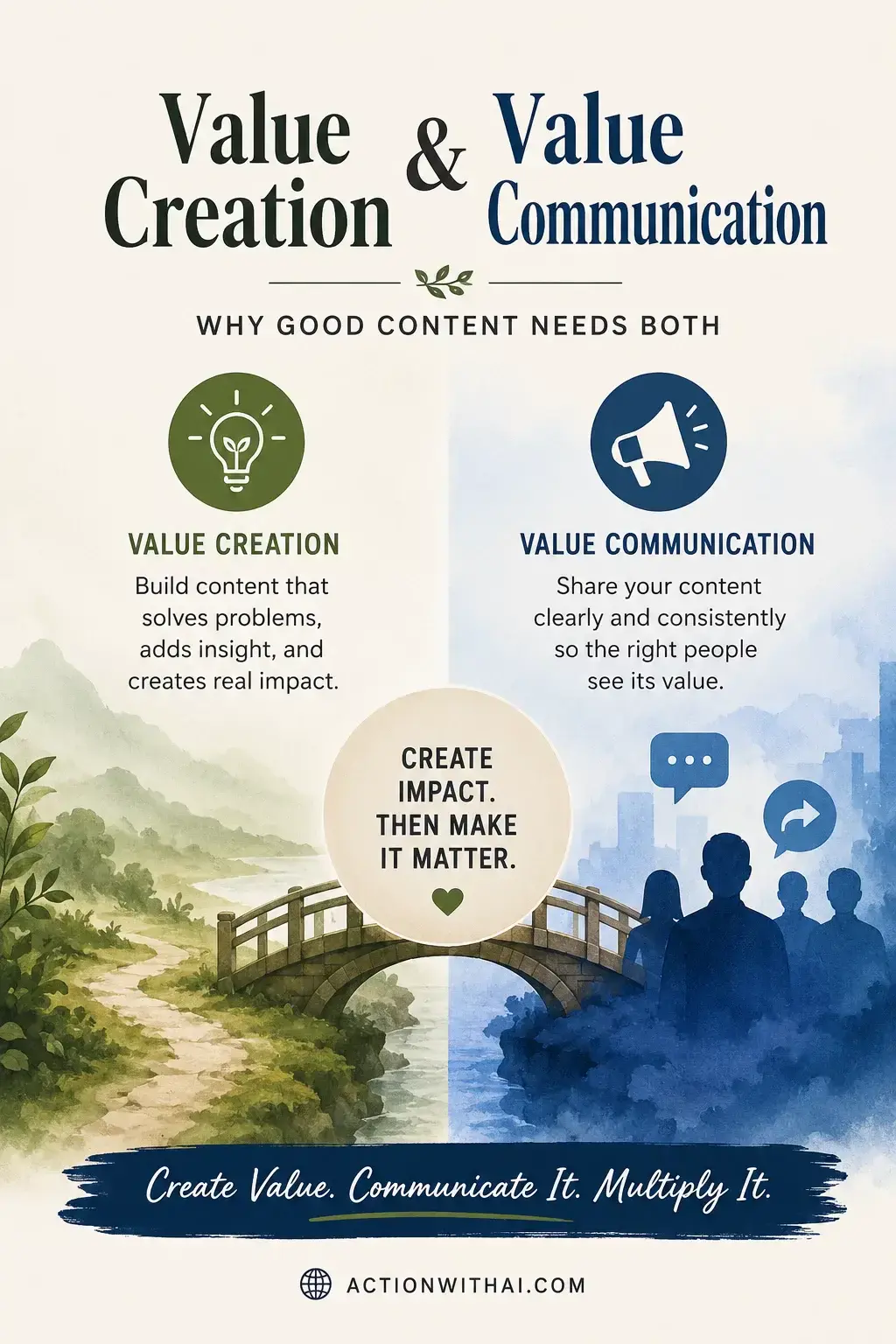
There are two separate jobs involved in creating a useful piece of online content:
- Creating the value
- Communicating the value
You need both.
But they are not the same thing.
This distinction matters because many website owners spend most of their time on value communication while doing very little value creation.
They add headings, summary boxes, tables, FAQs, images, schema markup and carefully written introductions. They study the structure of pages that rank well or receive AI citations. They try to identify the signals that search engines and AI systems might favour.
Then they wonder why the article gains no traction.
The problem may not be how the article was communicated.
The problem may be that there was not enough underlying value to communicate.
What Is Value Creation?
Value creation is the work that gives you something worthwhile to say.
It happens before you decide where to place your headings or what colour to make your summary box.
Value creation might involve:
- conducting an original experiment;
- testing a product, method or process;
- documenting something you have actually done;
- reading and comparing several sources;
- identifying a disagreement that other articles have overlooked;
- analysing data;
- gathering first-hand evidence;
- explaining a subject from a genuinely useful new perspective;
- forming a reasoned conclusion from scattered information.
This is often the difficult part of content creation.
It requires time, curiosity, judgement and sometimes practical work.
It is also the part that cannot be replaced by formatting.
Researching AI Citations Is Value Creation Work
Imagine that Google AI Mode gives you an answer supported by eight citations.
The easiest option is to accept the synthesis, rewrite the main points and publish another article covering broadly the same information.
That may produce a competent summary.
But it is unlikely to add much to what already exists.
A more valuable approach is to open the citations and read the underlying articles.
You may discover that:
- a citation does not fully support the claim beside it;
- several articles are repeating the same original source;
- experts disagree more than the AI answer suggests;
- apparently contradictory advice applies to different situations;
- an important limitation has been removed during synthesis;
- a confident conclusion is supported by surprisingly weak evidence;
- one source contains a valuable practical detail that the AI answer omitted.
You can then compare the sources, assess the evidence and form your own view.
That process is value creation.
The value does not come from placing eight citations at the bottom of your article.
It comes from reading, questioning, comparing and interpreting those sources.
An Experiment Does Not Automatically Create Value
Conducting an experiment sounds impressive, but the existence of an experiment does not automatically make an article useful.
Suppose you run an AI Mode analysis.
Whether that work creates value depends on several things.
Was the question worth investigating?
The experiment should be grounded in something people genuinely want to understand.
A technically original experiment may still be unimportant if it investigates a question that has no meaningful application.
Was the test designed sensibly?
The queries, number of tests and comparisons should be appropriate to the question.
The experiment should not be designed merely to create a surprising headline.
Were the results recorded properly?
You may need to preserve:
- the exact queries;
- the full responses;
- cited sources;
- screenshots;
- dates;
- changes in wording;
- any other variables that could affect the outcome.
The evidence should allow readers to see what actually happened.
Do the conclusions follow from the results?
This is critical.
A small experiment may reveal an interesting pattern without proving that the pattern always occurs.
A useful article separates:
- what the results demonstrate;
- what they suggest;
- what they do not establish;
- what would require further testing.
The value comes from the quality of the question, method, evidence and reasoning.
Calling something an experiment is not enough.
What Is Value Communication?
Value communication is how you help readers understand the worthwhile work you have done.
Once you have investigated the question and reached a defensible conclusion, you still need to present it clearly.
That might involve:
- descriptive headings;
- a concise opening summary;
- screenshots of the evidence;
- a table comparing results;
- photographs showing the process;
- quotations from relevant sources;
- clear explanations of your reasoning;
- captions that explain why an image matters;
- a logical sequence that takes the reader from question to conclusion.
These techniques help human readers follow the article.
They may also help search engines and AI systems identify the subjects, claims, evidence and relationships within the page.
But they do not create the original value.
They reveal and organise value that already exists.
A Summary Box Cannot Rescue a Weak Idea
Suppose someone conducts ten poorly controlled AI searches about an obscure topic.
The answers vary slightly, and the writer concludes:
Changing one word completely changes how AI Mode reasons.
The evidence may not support that conclusion.
Perhaps the sample was too small. Perhaps the results changed for unrelated reasons. Perhaps the differences were only superficial.
The writer then presents the article beautifully.
It contains:
- a polished introduction;
- clearly numbered sections;
- a colourful “Key Finding” box;
- a comparison table;
- screenshots;
- an FAQ section;
- structured data;
- a professional featured image.
None of that repairs the weak experiment.
The article may now communicate its weakness very clearly, but it has not become more valuable.
By contrast, a carefully designed experiment written in plain text could still be extremely useful.
The underlying work comes first.
The Mistake of Starting With Signals
Search engines and LLMs operate programmatically.
They retrieve, classify, rank, combine and present information through computational systems.
It is therefore understandable that publishers begin thinking programmatically too.
They ask:
- How many headings should I use?
- Should I put the answer in a coloured box?
- Does every article need a comparison table?
- How long should each paragraph be?
- Should I add an FAQ?
- Where should I place my key phrase?
- Will a particular format make the page more likely to be cited?
These can be reasonable communication questions.
The problem begins when they replace the more important questions:
- Is this subject genuinely useful?
- What have I discovered?
- What work have I actually done?
- What evidence supports my conclusion?
- What does this article add?
- Why should this page exist?
When those questions are ignored, content creation becomes an exercise in manufacturing signals.
The Cargo-Cult Approach to Content
This is similar to a cargo cult: copying the visible features associated with a successful outcome without recreating the conditions that actually caused it.
A publisher notices that successful articles often contain comparison tables.
The observation gradually becomes:
Tables help readers compare information.
Then:
Google likes tables.
Then:
Every article should contain a table.
Eventually, writers add pointless tables to pages that contain nothing worth comparing.
The same thing can happen with:
- short paragraphs;
- author boxes;
- statistics;
- original images;
- FAQs;
- quotations;
- expert comments;
- “key takeaway” sections;
- schema markup.
All of these can be useful.
None of them guarantees that the underlying article is useful.
A short paragraph can say nothing.
A statistic can be irrelevant.
An author biography cannot manufacture expertise.
A photograph does not prove that the accompanying conclusion is correct.
A citation does not show that the source was understood.
A table cannot turn weak information into strong evidence.
Correlation Is Not Necessarily Causation
Years ago, studies of social media engagement often produced precise recommendations.
A successful tweet might supposedly need:
- a particular number of characters;
- short sentences;
- a link in a certain position;
- a specific number of hashtags;
- an image;
- publication at a particular time.
Those characteristics may genuinely have been common among highly engaged posts.
But that does not establish that they caused the engagement.
The successful posts may also have:
- expressed an unusually strong idea;
- reacted quickly to an important event;
- come from accounts with large audiences;
- said something surprising;
- made people laugh;
- provoked disagreement;
- captured something readers already felt.
It is much easier to count characters than to measure whether an idea matters.
The visible feature becomes the recommendation because it is easy to quantify.
The harder-to-measure value creation work disappears from the formula.
Ask What the Technique Does for the Reader
A useful way to assess any content recommendation is to ask:
What problem does this solve for the reader?
A summary box may help a reader understand the central finding quickly.
A table may make genuine differences easier to compare.
Clear headings may help someone find the section relevant to their situation.
Shorter paragraphs may improve readability on a phone.
Photographs may demonstrate that a practical process really took place.
Screenshots may allow readers to inspect the results of an online experiment.
These are legitimate uses of communication techniques.
However, when there is no clear reader benefit, the feature may have been added mainly as a ritual intended to influence an algorithm.
That is when optimisation starts to replace communication.
A Better Content Workflow
A strong article usually develops in the following order.
1. Find a worthwhile question
Start with something people genuinely care about.
Look for confusion, disagreement, uncertainty, missing practical detail or a gap between general advice and real-life application.
2. Investigate the question
Read the sources.
Follow the citations.
Conduct the test.
Try the method.
Document the process.
Look for evidence that challenges your initial assumption.
3. Form a defensible conclusion
Decide what the evidence supports.
Be honest about limitations.
Do not force the results into a stronger conclusion than they justify.
4. Explain why the finding matters
A result becomes more useful when the reader understands what it changes.
Does it affect a choice?
Does it reveal a risk?
Does it challenge common advice?
Does it suggest a better way to approach the problem?
5. Communicate the work clearly
Now decide how to present the article.
Use the headings, tables, screenshots, summaries and images that genuinely help explain what you found.
6. Improve discoverability without manufacturing signals
Make the subject and structure clear to search engines and AI systems.
Optimise the communication of real value.
Do not imitate the appearance of valuable work that was never performed.
Four Layers of a Valuable Article
The distinction can be understood as four layers.
Layer 1: Relevance
Is the question worth answering?
Layer 2: Rigour
Was the research, test or practical work conducted sensibly?
Layer 3: Insight
Do the results support a useful conclusion?
Layer 4: Communication
Can readers and computational systems understand the work clearly?
The first three create the substance.
The fourth helps the substance travel.
Many weak content strategies begin at layer four.
They concentrate on layout, headings, phrasing and technical signals while assuming that value will somehow emerge from the presentation.
It rarely does.
The Citation Is Not the Value
Citations provide another useful example of this distinction.
A page containing fifteen sources may look more authoritative than a page containing three.
But the important questions are:
- Were the sources actually read?
- Are they credible?
- Do they support the surrounding claims?
- Were conflicting sources considered?
- Has the writer explained what the evidence means?
- Did the research change or refine the conclusion?
Fifteen decorative citations may add less value than three sources examined carefully.
The citation communicates that supporting material exists.
The research and interpretation create the value.
Evidence Also Needs Interpretation
The same principle applies to photographs, videos, screenshots and data.
Evidence is valuable because it allows readers to inspect what you did.
However, simply displaying evidence may not be enough.
You should also explain:
- what the evidence shows;
- why it is relevant;
- what changed;
- what comparison the reader should make;
- how it supports the conclusion;
- what it does not prove.
A photograph of a clean bathroom sink demonstrates an outcome.
A sequence showing the dirty sink, chosen product, application process and final result communicates much more.
Your explanation then connects that evidence to the conclusion.
The evidence supports the article.
The interpretation makes it meaningful.
A Simple Question Before Publishing
Before worrying about formatting or discoverability, ask:
What valuable work have I done that would disappear if this page did not exist?
A strong answer might be:
- I conducted an experiment and recorded the results.
- I compared sources that are normally discussed separately.
- I uncovered a disagreement hidden by AI synthesis.
- I tested common advice in a real situation.
- I documented a complete process with original evidence.
- I developed a useful conclusion from scattered information.
- I explained an established idea for a specific audience whose circumstances are usually ignored.
A weaker answer might be:
I collected information from several existing pages and expressed it in different words.
That does not mean summaries are never useful.
A clear summary can still help a particular audience understand a difficult subject.
But the writer should be able to explain what has been made clearer, more practical, more accessible or more relevant.
There still needs to be a reason for the page to exist.
Create Something Worth Discovering
No content format guarantees search visibility, AI citations or an audience.
A strong article may still struggle to gain traction.
But communication techniques cannot compensate for the absence of underlying value.
The proper objective is therefore not simply to create something that looks optimised.
It is to:
Create something worth discovering, then make its value easy to discover.
Value creation gives the article a reason to exist.
Value communication gives people and systems a chance to understand, trust and share it.
The difficult work comes first.
Research the subject.
Read the sources.
Conduct the test.
Record the evidence.
Think carefully about what the results mean.
Then use headings, tables, summaries, images and structured presentation to communicate that work as clearly as possible.
Optimise the communication.
Never manufacture the signals.