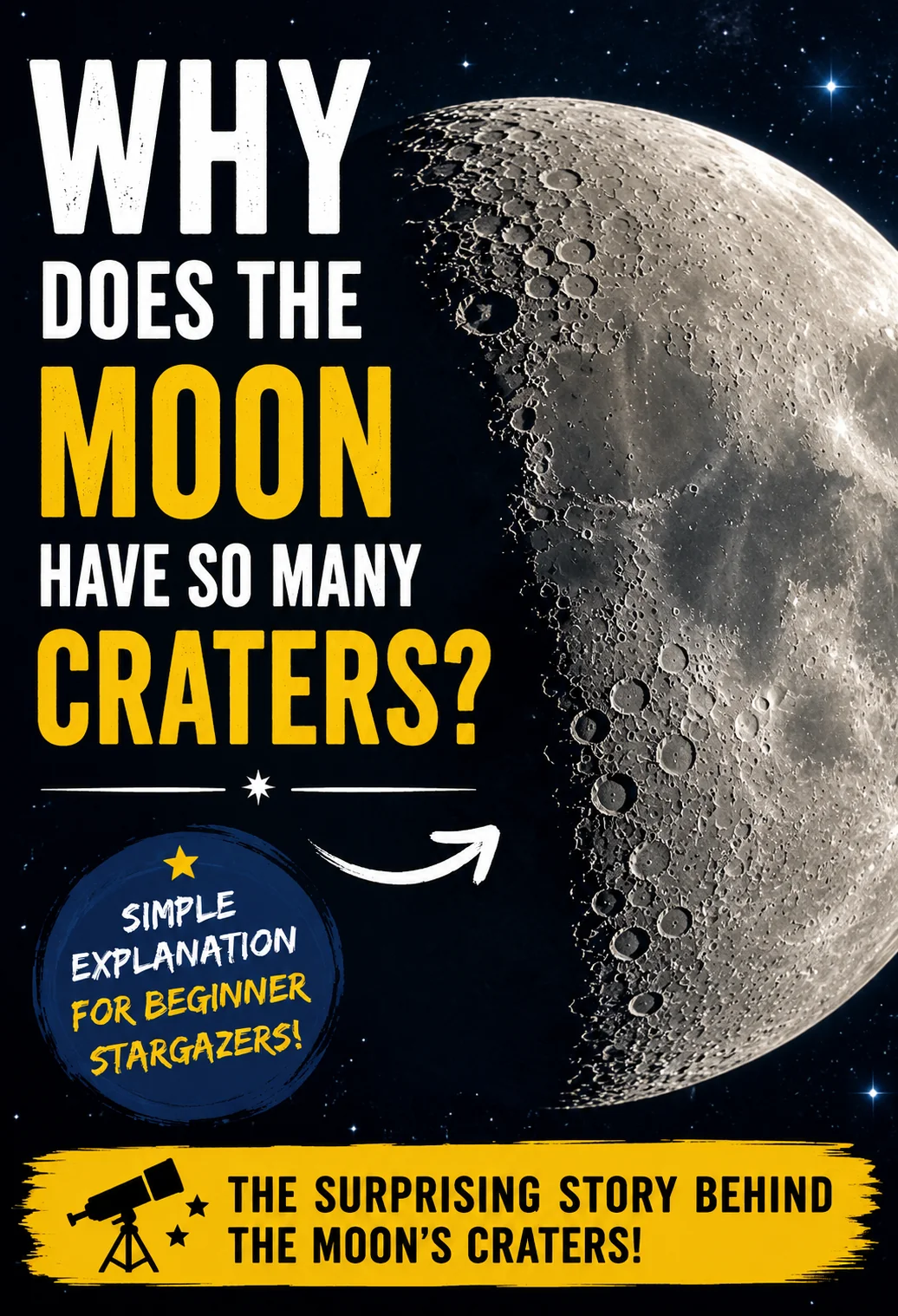
Look closely at the Moon and one thing jumps out straight away: it is absolutely covered in craters.
Some are huge. Some are tiny. Some have bright streaks spreading out around them. And once you notice them, the Moon suddenly stops looking like a smooth glowing ball and starts looking like a battered, ancient world with a story written all over its surface.
So why does the Moon have so many craters?
The short answer is this:
Most Moon craters were made when space rocks smashed into the lunar surface at high speed — and because the Moon has almost no weather, those impact marks can remain visible for an incredibly long time.
Let’s break that down in plain English.
What Are Moon Craters?
Moon craters are round dents or depressions in the lunar surface.
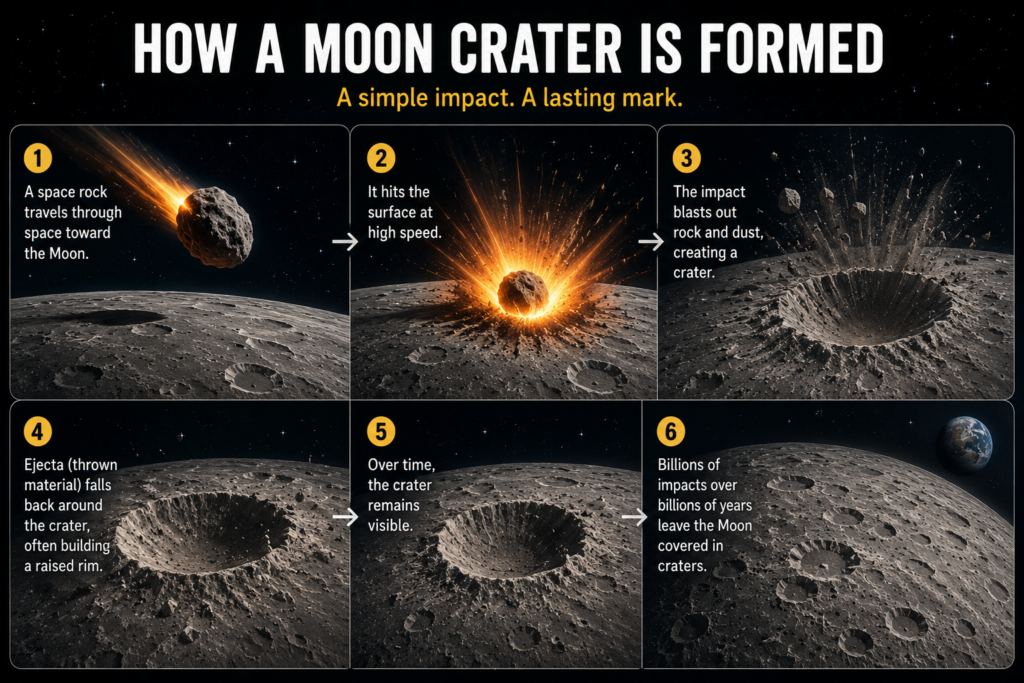
Most of them were caused by impacts. That means objects such as meteoroids, asteroids or comets hit the Moon and blasted material outwards.
Imagine dropping a stone into soft mud, except on a much more violent scale. The impact creates a hollow, throws material around it, and can leave a raised rim around the edge.
On the Moon, some impacts were tiny. Others were enormous. Over billions of years, the surface became covered in craters of many different sizes.
Why Did So Many Things Hit the Moon?
The Moon has been around for a very long time, and the early Solar System was a much messier place than it is today.
There was more debris flying around: bits of rock, dust, ice, asteroids and leftover material from the formation of the planets.
As those objects travelled through space, some collided with the Moon.
The Moon does not need to be “unlucky” to have lots of craters. It has simply been sitting there for billions of years, collecting evidence of impacts.
Why Are the Craters Still There?
This is the really important part.
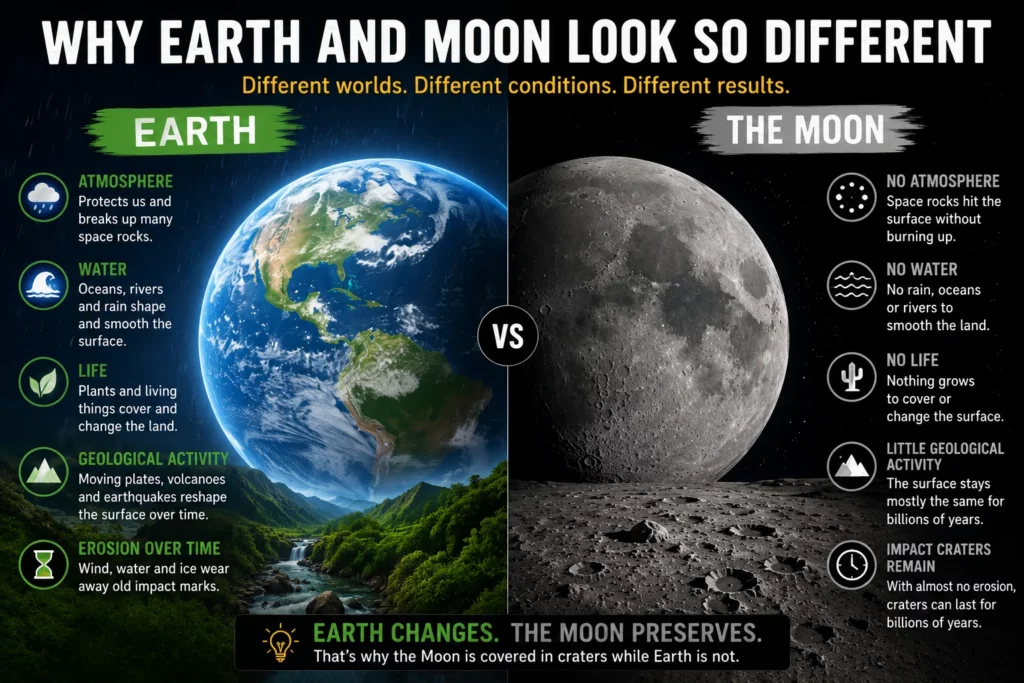
Earth has been hit by space rocks too. But Earth is active. It has weather, oceans, rivers, plants, volcanoes, earthquakes and moving plates. Over time, those processes can wear away, bury or reshape old impact marks.
The Moon is very different.
It has no rain washing the surface away. No rivers. No oceans. No plants growing over the marks. No wind like we have on Earth.
So when a crater forms on the Moon, there is far less to erase it.
That is why the Moon still shows so many ancient scars.
Why Don’t Space Rocks Burn Up Before Hitting the Moon?
On Earth, many small incoming objects burn up in our atmosphere. That is why we see meteors, often called “shooting stars”, streak across the sky.
The Moon does not have a thick protective atmosphere like Earth.
So small objects that might burn up in Earth’s atmosphere can reach the Moon’s surface and make an impact.
That is another reason the lunar surface is so heavily marked.
Are New Moon Craters Still Being Made?
Yes. This is one of the most fascinating parts.
Moon craters are not only ancient. New ones are still forming today.
NASA’s Lunar Reconnaissance Orbiter, often shortened to LRO, has been taking detailed images of the Moon from orbit. Scientists can compare older images with newer images of the same area and look for changes.
That means they can spot fresh impact craters.
In one famous example, a bright flash was seen on the Moon in March 2013. Later, images from NASA’s Lunar Reconnaissance Orbiter Camera helped identify a new crater caused by that impact.
What makes this especially interesting is that the impact did not just make a neat little hole. It also threw bright material across the surface. These streaks are called ejecta rays.
By looking at those bright rays of scattered material, scientists could trace the pattern back towards the new crater.
What Are the Bright Rays Around Some Craters?
Some Moon craters have bright streaks spreading out around them.
These are called rays, and they are made from material thrown out during the impact.
When a fast-moving object smashes into the Moon, it blasts lunar material away from the impact site. Some of that material lands around the crater in long, bright patterns.
These rays can make some craters stand out beautifully, especially through binoculars or a beginner telescope.
Can You See Moon Craters Yourself?
Yes, and this is one of the best things about beginner stargazing.
You do not need to be an expert to enjoy looking at the Moon.
Many craters can be seen with binoculars or a small beginner telescope, especially when the lighting is right.
The best time to look is often not during the full Moon. A full Moon is bright, but the light can be quite flat, making surface detail harder to see.
A better time is when the Moon is partly lit. Look near the line between the bright side and the dark side. This line is called the terminator.
Near the terminator, the Sun is low in the lunar sky, which creates longer shadows. Those shadows help crater rims, mountains and surface features stand out more clearly.
Quick Beginner Crater-Spotting Tips
- Look when the Moon is partly lit rather than completely full.
- Focus near the terminator, where shadows make craters easier to see.
- Use binoculars first if you do not have a telescope.
- Try a beginner telescope for a closer look at crater rims and shadows.
- Compare what you see with a Moon map so you can start recognising features.
- Go slowly — the Moon is full of detail, and it rewards patient looking.
So, Why Does the Moon Have So Many Craters?
The Moon has so many craters because it has been hit by space rocks for billions of years.
Those impacts blasted holes into the surface and threw material out around them.
Unlike Earth, the Moon has almost no weather, no flowing water, no plants, and very little surface change to erase those marks.
So the craters remain visible.
In a way, the Moon is like a giant record book. Its surface preserves the story of countless impacts across the history of the Solar System.
Thanks for reading!
Could This Kind of Question Become a Hobby Website Article?
This is exactly the kind of simple question that can become a useful hobby website post.
A beginner stargazing website does not need to start with complicated science or expert-level equipment reviews. It can start by answering the questions ordinary people have when they look up at the night sky:
- Why does the Moon have craters?
- Why does the Moon change shape?
- Can you see Saturn’s rings with a beginner telescope?
- What can you see with binoculars?
- What telescope should a beginner buy first?
That is how helpful hobby websites often begin: one real question, one clear answer, one useful article at a time.
If you enjoy topics like stargazing, gardening, birdwatching, crafts, fitness, photography or almost any other hobby, you may already have the starting point for a helpful website.
I have created a visual guide showing how this works using beginner telescopes as the example.
Next step: Read my guide: How a Hobby Can Become a Helpful Website — Telescope Example.