How AI Tools Can Help You Create Bird Identification Cards for a Helpful Birdwatching Website
If you enjoy birdwatching, you probably already know how useful a clear visual guide can be.
When someone is new to birdwatching, they often want quick, simple answers:
- What bird am I looking at?
- How can I recognise it next time?
- What does it eat?
- Where might I see it?
- Is it common in gardens?
- What are the key features to look for?
This is where AI tools can be incredibly useful.
With the right prompt, tools like ChatGPT can help you plan, write and create visual bird identification cards, bird fact cards and beginner-friendly information posters that make your birdwatching website more useful and engaging.
And that is the real point: not using AI to replace your interest, knowledge or judgement, but using it to help turn your ideas into helpful content that other people can actually use.
What Is a Bird Identification Card?
A bird identification card is a simple visual guide that helps a beginner recognise a particular bird.
For example, a card about a robin might include:
- a clear picture or illustration of the bird;
- its key colours and markings;
- its size;
- where it is commonly found;
- what it eats;
- what its song or call is like;
- a simple beginner identification tip.
Instead of presenting all of that as a long block of text, you can turn it into a helpful visual card that is easier to understand, easier to share, and more attractive on a website or Pinterest pin.
Why Bird Fact Cards Are So Useful for Beginners
Beginner birdwatchers can easily feel overwhelmed.
They may see a bird in the garden, take a quick photo, and then wonder whether it is a robin, dunnock, sparrow, juvenile blackbird, fledgling, or something else entirely.
A clear fact card can help them focus on the most important details.
For example, instead of saying “look carefully at the bird,” a good card might say:
- Robin: look for the orange-red breast and confident garden behaviour.
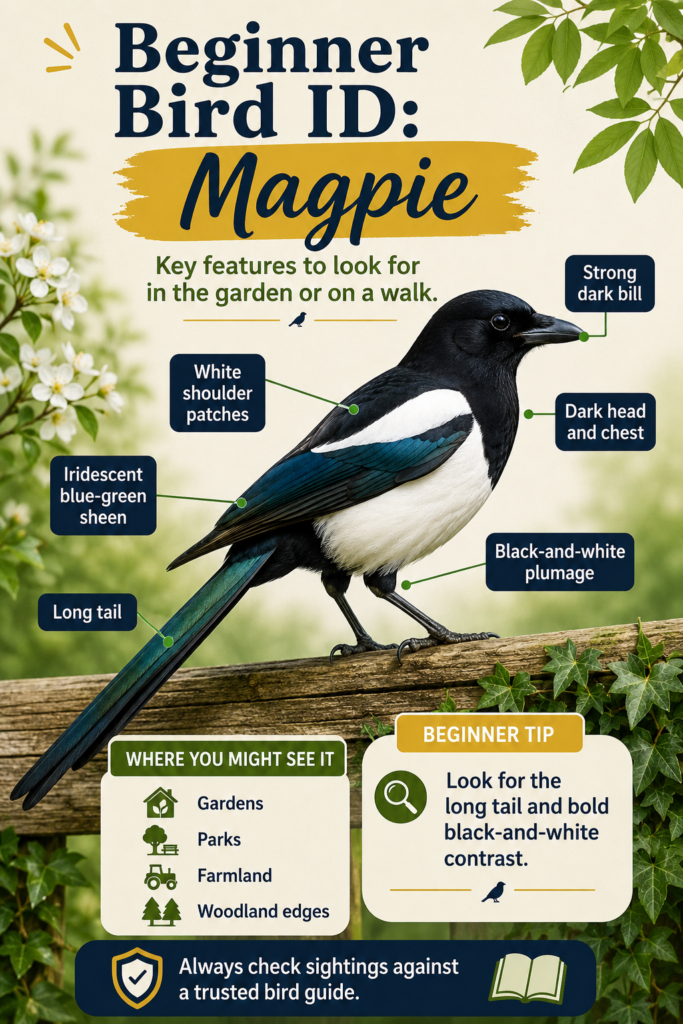
- Magpie: look for the long tail and bold black-and-white plumage.
- Blue tit: look for the blue cap, yellow belly and small size.
- Blackbird: look for the dark male bird with orange-yellow bill, or the browner female.
That kind of simple explanation is exactly what makes a hobby website helpful.
How AI Can Help Create These Visual Cards
AI tools can help at several stages of the process.
1. AI Can Help You Choose the Information to Include
You can ask AI to suggest what a beginner bird fact card should include.
For example, you might ask:
“Create a beginner-friendly fact card outline for a European robin. Include size, appearance, food, habitat, call, where it is found, and one simple identification tip.”
This gives you a useful starting structure.
2. AI Can Help Turn Facts Into Simple Beginner Language
Bird guides can sometimes feel technical. AI can help rewrite information in simpler language, so beginners can understand it more easily.
For example:
“Rewrite this bird description for someone who has only just started birdwatching.”
This is useful because a helpful hobby website should not just repeat information. It should explain things clearly.
3. AI Can Help Generate Image Prompts
Once you know what you want on the card, AI can help create a detailed image prompt.
For example, you could ask for:
“A vertical Pinterest-style bird fact card showing a European robin on a branch, with labelled sections for size, food, habitat, call and beginner ID tip.”
This can then be used to create a visual image that supports your article.
4. AI Can Help Create a Series
One bird fact card is useful. But a series is even better.
You could create a full set of beginner-friendly cards, such as:
- Robin fact card
- Blue tit fact card
- Blackbird fact card
- Magpie fact card
- Goldfinch fact card
- House sparrow fact card
- Dunnock fact card
- Starling fact card
- Wood pigeon fact card
- Great tit fact card
Each card could become a Pinterest pin, a section of a larger article, or a standalone post on your website.
But Accuracy Still Matters
This is very important.
AI tools are helpful, but they should not be treated as the final authority on bird facts.
If you are creating bird identification content, you should check the details against trusted sources such as field guides, birdwatching organisations, or reputable wildlife websites.
AI can help you create the structure, wording and visual style, but your judgement still matters.
Before publishing a card, check things like:
- Is the bird illustration accurate?
- Are the colours and markings correct?
- Is the size information broadly correct?
- Is the habitat description accurate?
- Is the food information sensible?
- Could a beginner be misled by anything?
That extra checking is what helps turn AI-assisted content into genuinely useful content.
A Simple Example: A Robin Fact Card
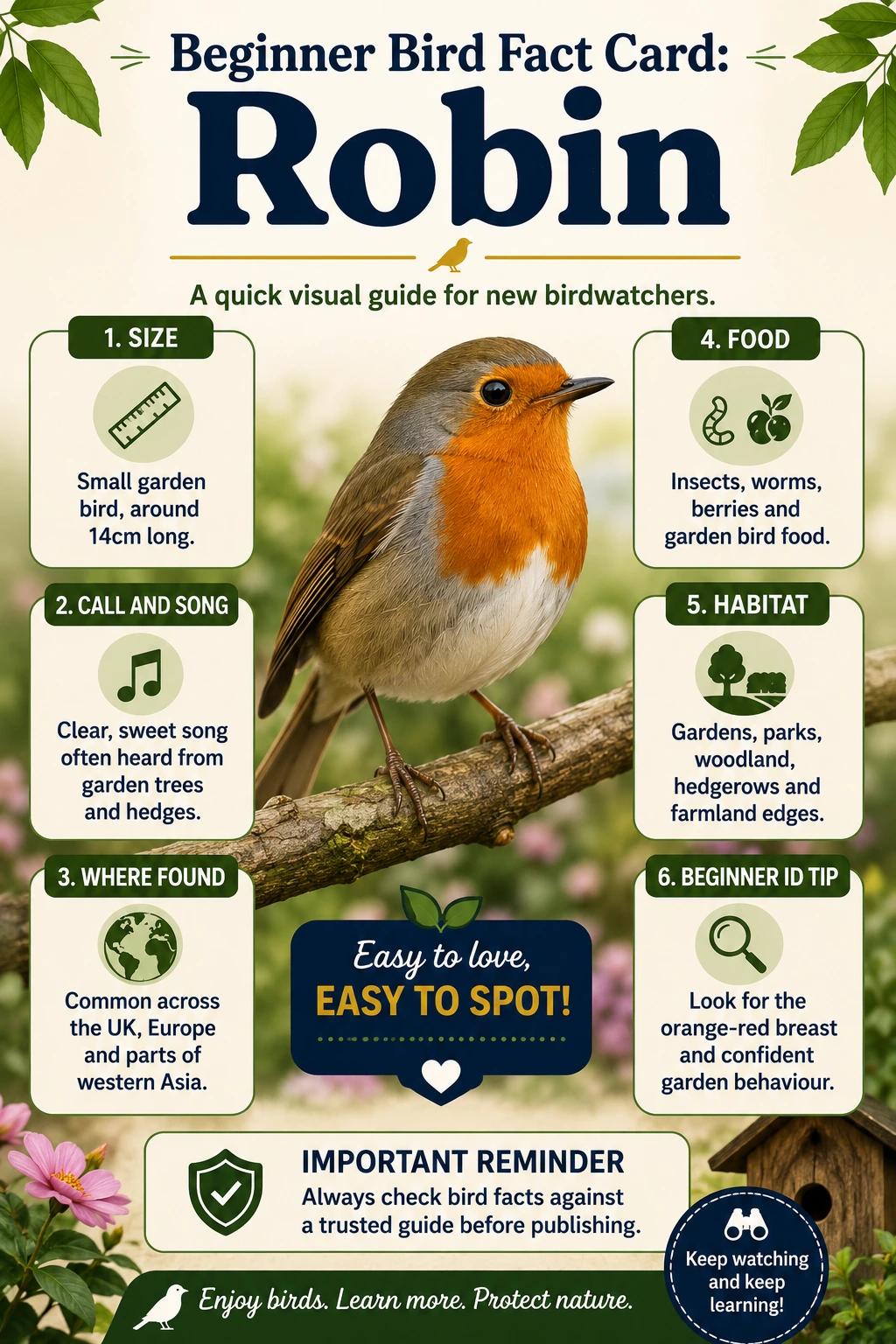
A beginner bird fact card about a robin might include:
- Size: small garden bird, around 14cm long.
- Appearance: orange-red breast, brown upperparts and pale belly.
- Food: insects, worms, berries and garden bird food.
- Habitat: gardens, parks, woodland, hedgerows and farmland edges.
- Call and song: clear, sweet song often heard from trees and hedges.
- Beginner tip: look for the orange-red breast and confident garden behaviour.
That information can become a visual card, a Pinterest pin, and a short article.
One Bird Card Can Become Several Pieces of Content
This is where the website-building idea becomes really interesting.
A single bird fact card can lead to several helpful pieces of content.
For example, from one robin card you could create:
- a Pinterest pin called “Beginner Bird Fact Card: Robin”;
- a website article called “Robin Bird Facts for Beginner Birdwatchers”;
- a comparison article called “Robin or Dunnock? How to Tell the Difference”;
- a seasonal article called “Why Robins Are Seen So Often in Winter”;
- a feeding article called “What Do Robins Like to Eat?”;
- a garden article called “How to Make Your Garden More Robin-Friendly.”
That is how a helpful birdwatching website grows: one useful idea leads to another.
Bird Identification Cards Also Work Well on Pinterest
Pinterest is a visual platform, so bird fact cards and identification posters are a natural fit.
A clear, attractive pin can help someone quickly learn something useful, and then they may click through to your website for the fuller explanation.
For example, you could create pins such as:
- Beginner Bird ID: Magpie
- Beginner Bird Fact Card: Robin
- How to Tell a Blue Tit from a Great Tit
- Common Garden Birds for Beginners
- What Garden Birds Eat
- Bird Migration Map: Where Do Swallows Go?
- Fledgling Identification Guide
Each pin can be useful on its own, but it can also point people back to a more detailed article on your website.
Why This Is a Great Example of AI Helping a Hobby Website
This is exactly the kind of thing that shows why AI tools are so useful for hobby website builders.
Without AI, you might have an idea in your head but struggle to turn it into a polished visual or article structure.
With AI, you can move much more quickly from:
- idea;
- outline;
- fact card structure;
- image prompt;
- draft article;
- finished visual;
- published website page.
But AI is only part of the process.
Your role is still essential. You choose the topic, check the facts, add context, decide what would help beginners, and make sure the final content is genuinely useful.
Use AI, But Do Not Lose Your Own Voice
One of the risks with AI content is that everything can start to sound and look the same.
That is why your own experience matters.
If you have seen robins in your garden, photographed magpies on a walk, compared birds at your feeder, or struggled to identify a fledgling, those experiences can make your content more personal and more interesting.
You can add comments like:
- “This is one of the first birds I learned to recognise.”
- “I often see these in my garden after putting food out.”
- “This is the feature I find easiest to spot.”
- “This is where beginners often get confused.”
- “Here is what I would check before deciding what bird it is.”
People respond to people. AI can help you create, but your observations, judgement and personality make the website feel real.
How This Could Fit Into a Birdwatching Website
A birdwatching website could have a whole section called something like:
- Beginner Bird ID Cards
- Common Garden Bird Fact Cards
- Birdwatching Visual Guides
- Garden Birds Explained
Inside that section, you could build a growing library of visual guides.
Over time, that could become a useful resource for beginner birdwatchers.
You could then add related articles, such as:
- best beginner bird identification books;
- binocular terminology explained;
- garden bird feeding tips;
- how to attract more birds to your garden;
- how to photograph garden birds;
- where to go birdwatching as a beginner.
That is the foundation of a helpful hobby website.
Where Recommendations Can Fit Naturally
If your website is genuinely helpful, recommendations can fit naturally.
For example, a bird identification article might mention:
- a field guide you personally found useful;
- beginner binoculars that help with identification;
- a bird feeder that helped you observe birds more clearly;
- a notebook or app for recording sightings;
- camera equipment used for bird photos.
The important thing is that the recommendation should fit the reader’s problem.
Good affiliate marketing is not about forcing products into articles. It is about helping someone solve a problem and mentioning genuinely useful resources where they make sense.
Helpful content comes first. Any income opportunity comes second.
Could You Build This Kind of Website Yourself?
Yes.
You do not need to be a world-leading bird expert to start a helpful birdwatching website.
You need curiosity, consistency, and a willingness to help people who are one step behind you.
If you enjoy learning about birds, organising information, creating helpful visuals and sharing what you discover, then a birdwatching website could be a really enjoyable project.
AI tools can make the process faster and easier, but the website still needs your direction and care.
Learn the Website-Building Process
Creating bird fact cards is just one example of what is now possible.
You can use AI tools to help create:
- bird identification posters;
- migration maps;
- binocular terminology explainers;
- garden bird feeding guides;
- bird photography tip cards;
- article outlines;
- Pinterest pins;
- website content plans.
The exciting part is that your hobby, your ideas and your experiences can now be turned into useful website content far more easily than before.
That is what ActionWithAI.com is about: taking something you are interested in, using AI tools to make the process easier, and then taking action by building something helpful.
My Recommendation
If you like the idea of building a website around birdwatching or another hobby, I recommend learning the process properly.
I have been a member of Wealthy Affiliate for over 10 years, and it is the platform where I learned much of what I know about building websites, affiliate marketing and online content.
Wealthy Affiliate is not simply cheap hosting. It is a beginner-friendly website-building and learning platform that brings together training, WordPress hosting, tools, support and a community of people building websites too.
You can still benefit from the guides on this site whether you join Wealthy Affiliate or not. But if you want a structured place to learn how hobby websites work, I do recommend taking a look at their free starter membership.
It gives you a chance to look inside before committing to anything.
Final Thought
A simple bird fact card may seem like a small thing.
But it represents something much bigger.
It shows how a hobby idea can become a useful visual, then a helpful article, then part of a growing website.
If you enjoy birdwatching and like helping others understand what they are seeing, you may already have the starting point for a genuinely useful hobby website.
Use AI as a tool. Add your own judgement. Check your facts. Share what helps. Build something useful.